Earthing is one of the most misunderstood aspects of Victron inverter installations. Get it wrong and your RCDs will not trip in a fault condition, metalwork can become live, and galvanic corrosion can eat through a boat hull. This guide explains the principles of earth bonding in Victron systems, covers the MultiPlus ground relay, and addresses the specific requirements for vehicles, boats, and off-grid installations in the UK.
Why Earthing Matters
The earth connection in an electrical system serves two critical safety functions:
- Fault protection: if a live conductor touches exposed metalwork (a fault), the earth path carries enough current to trip the protective device (MCB or fuse), disconnecting the supply before someone gets a shock
- RCD operation: an RCD works by detecting an imbalance between the current flowing in the line conductor and the current returning through the neutral. For this to work, the neutral must be bonded to earth at one — and only one — defined point
Without a proper neutral-earth bond, an RCD cannot detect a fault. A person could touch a live conductor and receive a lethal shock, and the RCD would sit there doing nothing. This is why getting earthing right is not optional.
UK Earthing Systems: TT, TN-S, and TN-C-S
Before discussing Victron-specific earthing, you need to understand the three earthing systems used in the UK:
| System | Earth Source | Common In | Key Characteristic |
|---|---|---|---|
| TN-S | Separate earth conductor from supply transformer | Older UK properties | Low earth impedance, reliable earth path |
| TN-C-S (PME) | Combined neutral-earth in supply cable, split at meter | Most modern UK properties | Very low impedance, but restrictions on connections to external metalwork |
| TT | Local earth rod at the installation | Rural areas, campsites, boats, off-grid | Higher impedance, always requires RCD protection |
The earthing system determines how the neutral-earth bond is established and where it should be. This directly affects how you configure the earthing on a Victron inverter.
Neutral-Earth Bond on Inverter Output
The Fundamental Rule
For an RCD to function correctly, there must be exactly one neutral-earth bond on the circuit it protects. If there is no bond, the RCD cannot detect faults. If there are two bonds, the RCD may not trip because fault current can return via the alternative earth path without creating the necessary line-neutral imbalance.
When on Shore Power (Grid Connected)
When your Victron system is connected to the grid or shore power, the neutral-earth bond already exists at the supply source — either at the transformer (TN systems) or effectively at the meter position. Your inverter output must not create a second bond. This means the neutral and earth on the inverter output must remain separate when mains power is present.
When on Inverter (Off-Grid / Battery Power)
When the grid or shore power is disconnected and the inverter is producing AC from batteries, there is no external neutral-earth bond. The inverter output is a floating supply with no earth reference. In this condition, you must create a neutral-earth bond on the inverter output, or your RCDs will not function.
The Problem: Two Different Requirements
This creates a dilemma for systems that switch between shore power and inverter power. On shore power, you need no bond. On inverter power, you need a bond. The solution is the Victron ground relay.
The MultiPlus Ground Relay
What It Does
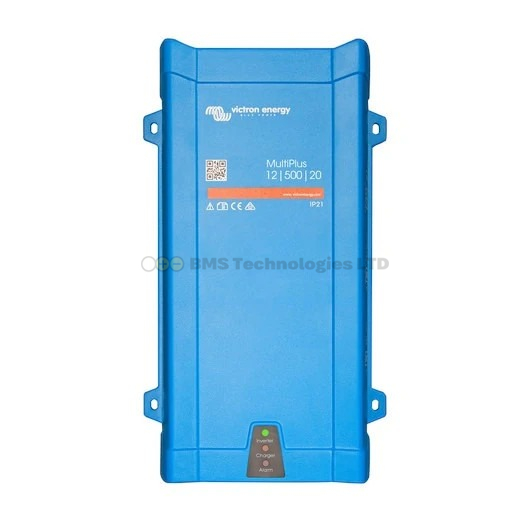
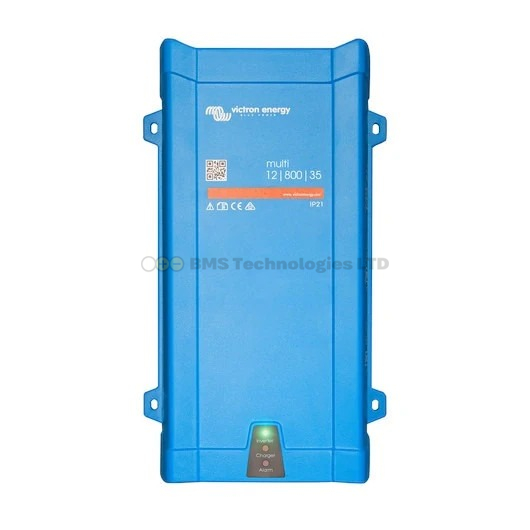
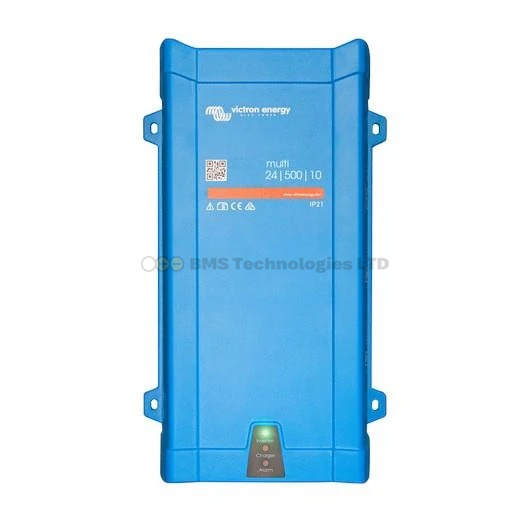
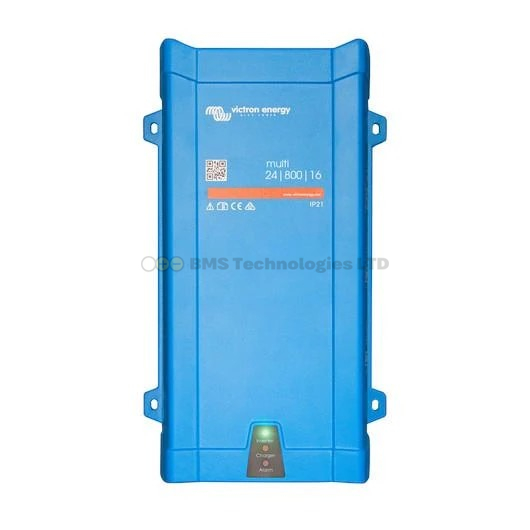
The MultiPlus and MultiPlus-II have a built-in ground relay that automatically connects the neutral to the earth terminal when the unit is operating in inverter mode (no AC input). When shore power is connected and the MultiPlus passes it through, the ground relay opens, removing the internal neutral-earth bond and relying on the external supply's bond instead.
This automatic switching is exactly what is needed: bond when inverting, no bond when on shore power.
How to Enable It
The ground relay is enabled by default on most MultiPlus units, but you should verify this in VEConfigure (the PC-based configuration tool accessed via an MK3-USB adapter). The relevant setting is under the General tab: "Ground relay" should be ticked. You can also check this through the Cerbo GX remote console under the MultiPlus settings.
Connecting the Earth
For the ground relay to work, the MultiPlus earth terminal (PE) must be connected to your system earth (the consumer unit earth bar, vehicle chassis, or earth rod as appropriate). The ground relay then connects or disconnects an internal link between the neutral busbar and this earth terminal.
Earthing in Vehicles: Motorhomes and Campervans
Vehicle Chassis as Earth
In a motorhome or campervan, the vehicle chassis is commonly used as the earthing reference for the 12V DC system. However, the 230V AC system requires its own earth conductor — you cannot rely on the vehicle body as the sole earth path for AC circuits. BS EN 1648 requires a dedicated earth conductor (green/yellow) run alongside the live and neutral conductors to each circuit.
Shore Power Connection
When plugged into a campsite or home shore power supply, the earth comes from the supply via the hook-up cable. The MultiPlus ground relay opens, and the external earth is used. Your vehicle's consumer unit earth bar connects to the shore power earth via the hook-up cable.
Inverter Mode
When unplugged and running on inverter power, the MultiPlus ground relay closes, bonding neutral to earth at the MultiPlus. The earth path runs from the MultiPlus earth terminal to the consumer unit earth bar and out to all circuits. This gives your RCDs a reference to work against.
Chassis Bonding
Whether to bond the 230V AC earth to the vehicle chassis is debated. BS EN 1648 does not specifically require it, but in practice, bonding the consumer unit earth bar to the vehicle chassis with a 6.0mm² or larger green/yellow conductor provides an additional safety path. Any exposed metalwork that could become live in a fault should be bonded to the earth bar.
Earthing on Boats
The Galvanic Corrosion Problem
Boats face a unique earthing challenge. When connected to shore power in a marina, the shore earth connects your boat's earth system to the marina's earthing network. This creates an electrical path through the water between your boat's underwater metalwork (anodes, propeller, skin fittings) and every other boat on the same supply. Galvanic currents flow, and your bronze and aluminium fittings dissolve — a process called galvanic corrosion.
Galvanic Isolation
The solution is galvanic isolation. This blocks the low-voltage DC galvanic currents while still allowing the AC earth fault current to flow (which is essential for safety). There are two approaches:
- Galvanic isolator: a device containing back-to-back diodes, installed in the earth conductor of the shore power cable. It blocks voltages below about 1.2V (the galvanic potential) while allowing higher fault currents through. Victron does not manufacture galvanic isolators, but they are widely available from marine electrical suppliers.
- Isolation transformer: a 1:1 transformer installed between shore power and the boat's electrical system. This provides complete electrical isolation — no direct connection between shore earth and boat earth. The Victron Isolation Transformer range is designed specifically for this purpose. The boat then operates as a TT system with its own earth.
Earth Bonding on a Boat
On a boat with an isolation transformer, the earthing is straightforward: the boat has its own earth system with a neutral-earth bond on the secondary side of the transformer. The MultiPlus ground relay handles this bond when switching between the transformer output and inverter mode.
Without an isolation transformer, the shore earth connects directly to the boat's earth system. A galvanic isolator should be fitted in the earth conductor. The MultiPlus ground relay still operates as described — bonding neutral to earth in inverter mode, opening in passthrough mode.
Off-Grid Installations
Earth Rod
In a fixed off-grid installation (shed, workshop, remote building), you need a local earth rod to establish a TT earthing system. The earth rod should be driven at least 1.2 metres into the ground, and the earth electrode resistance should be measured (ideally below 200 ohms, though lower is better).
RCD Protection Is Mandatory
TT systems always require RCD protection because the earth fault loop impedance is typically high. A 30mA RCD provides the necessary shock protection. This is exactly the scenario where the MultiPlus ground relay is essential — when the MultiPlus is inverting, its ground relay provides the neutral-earth bond that the RCD needs to function.
Generator Operation
If a generator is connected to the MultiPlus AC input, the generator should provide its own neutral-earth bond. Most portable generators have a floating output with no bond, which means the MultiPlus ground relay may need to remain active even when the generator is connected. Check your generator's specifications and test RCD operation with the generator running.
Common Earthing Mistakes
- No neutral-earth bond when inverting: the RCDs do not work, and the system is unsafe. Ensure the MultiPlus ground relay is enabled, or fit a manual bond switch.
- Double bonding: having two neutral-earth bonds (for example, one at the MultiPlus and one at a generator) can prevent RCDs from tripping. There must be only one bond per supply.
- Missing earth conductor: running only live and neutral without an earth conductor to each circuit. Every 230V circuit must have a properly sized earth conductor.
- Chassis bonding without shore power earth isolation: on a boat, bonding the 230V earth directly to the hull without a galvanic isolator or isolation transformer causes corrosion.
- Earth conductor undersized: the earth conductor must be at least equal in cross-section to the line conductor for cables up to 16mm². A 2.5mm² twin-and-earth cable has a 1.5mm² earth conductor, which is the minimum for a 20A circuit.
- Not testing RCD operation: after installation, test every RCD with both the test button and a proper RCD tester. Test in both shore power mode and inverter mode to confirm the ground relay is working.
Testing Your Earth Installation
After completing the installation, the following tests should be performed by a qualified electrician:
- Continuity of protective conductors: verify that every earth conductor has a low-resistance path back to the main earth terminal
- Earth electrode resistance: for TT systems, measure the earth rod resistance
- Earth fault loop impedance: confirm that the earth fault loop impedance is low enough for protective devices to operate within the required time
- RCD operation: test all RCDs with a calibrated tester in both shore power and inverter modes
- Polarity: check that line, neutral, and earth are connected correctly throughout
Summary
Correct earthing ensures your RCDs and MCBs will protect you in a fault. The MultiPlus ground relay is the key component — it automatically provides the neutral-earth bond when inverting and removes it when on shore power. For boats, add galvanic isolation to prevent corrosion. For off-grid installations, install a proper earth rod. And whatever the application, have a qualified electrician test the installation before you use it. Use our price comparison tool to find the best UK prices on Victron MultiPlus units and other equipment for your installation.