Choosing the right inverter for your motorhome is one of the most important electrical decisions you'll make. Too small and you'll trip the overload protection every time you use the microwave. Too large and you waste money, space, and battery capacity on equipment you don't need. This guide covers Victron's inverter and inverter/charger range with specific recommendations for every type of motorhome.
Inverter vs Inverter/Charger: Which Do You Need?
Victron makes two distinct product lines for converting battery DC to mains AC:
Phoenix Inverter (Inverter Only)
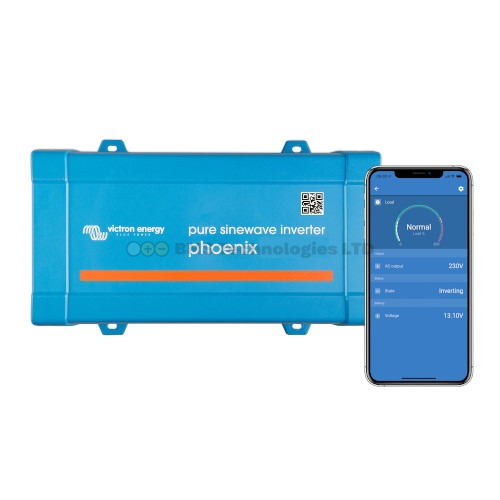
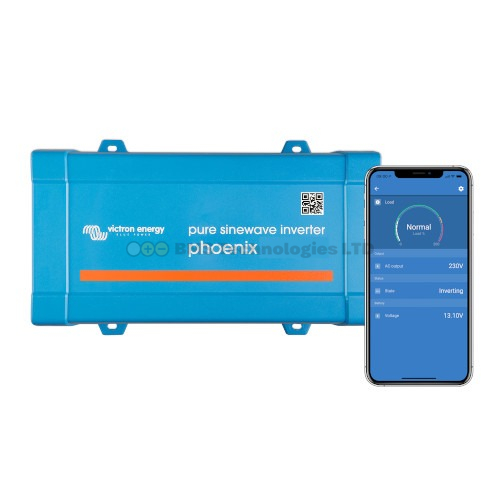
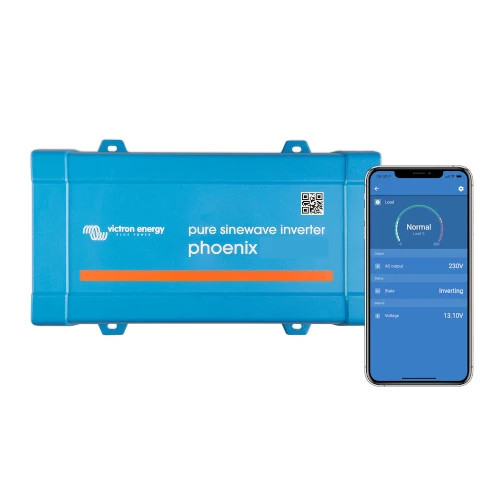
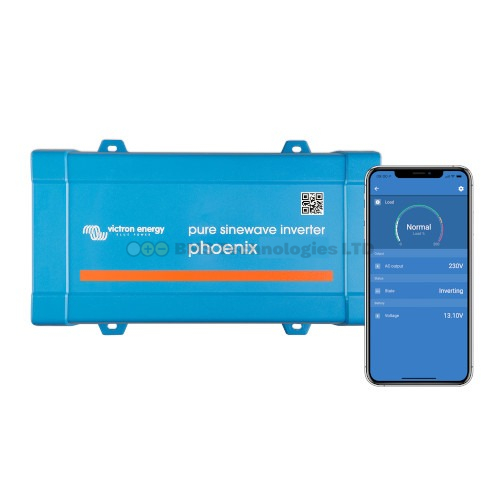
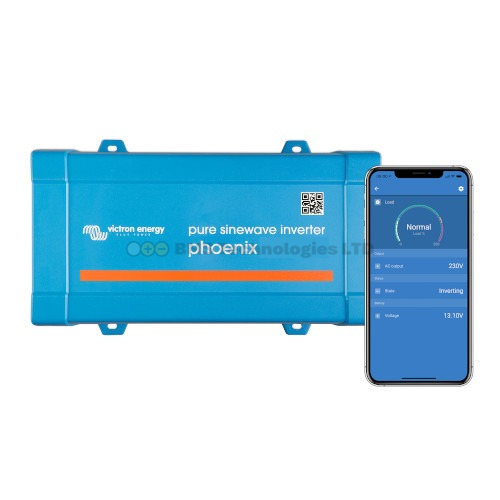
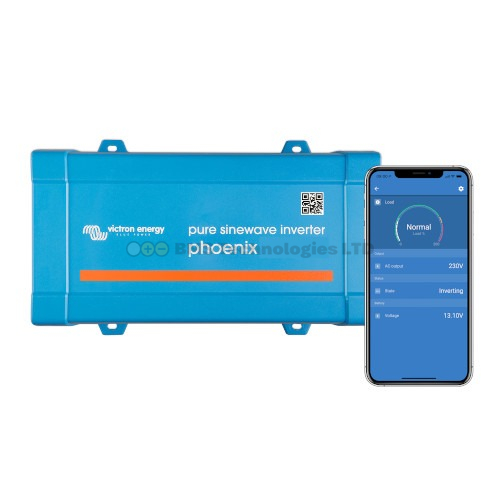
The Phoenix range converts 12V or 24V DC to 230V AC. That's all it does — no battery charging, no transfer switch. Models range from the tiny 250VA (£120) to the powerful 5000VA (£1,800+). The Phoenix is the right choice if you already have a separate battery charger and don't need automatic shore power switching.
MultiPlus (Inverter + Charger + Transfer Switch)
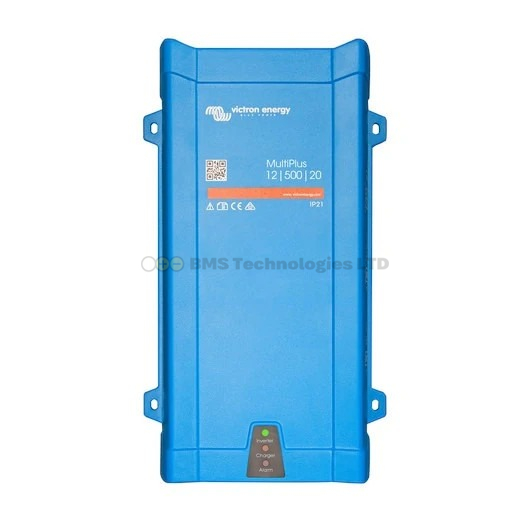
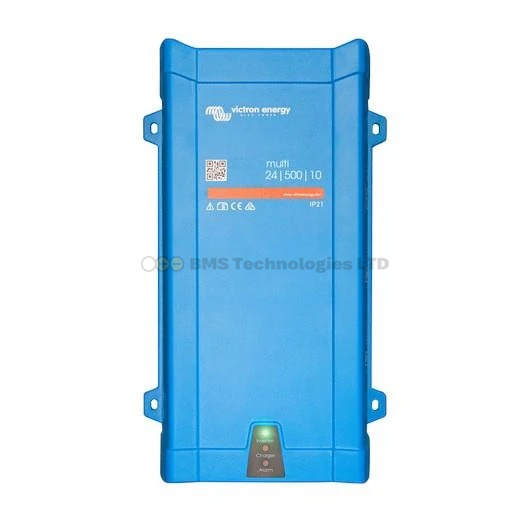
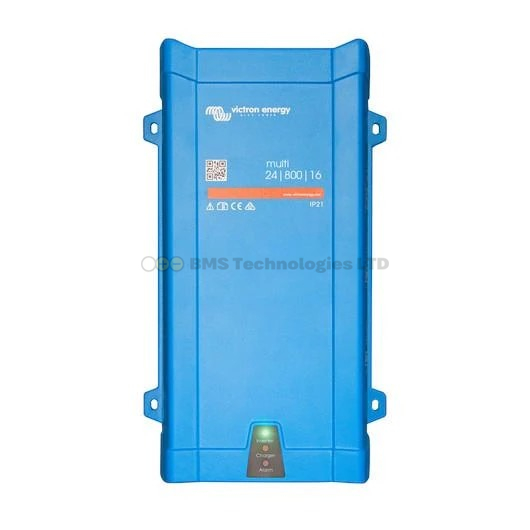
The MultiPlus combines three functions: a powerful pure sine wave inverter, a multi-stage battery charger, and an automatic transfer switch. When you plug into shore power, the MultiPlus automatically switches to pass-through mode and charges your batteries. When you unplug, it seamlessly switches to inverter mode. For most motorhome owners, the MultiPlus is the better choice.
MultiPlus-II
The MultiPlus-II adds built-in grid code compliance (UK G98/G99) for grid-connected installations. Unless you're building a home ESS system, the standard MultiPlus is what you want for a motorhome — it's cheaper and does everything you need.
Sizing Your Inverter: What Do You Actually Need?
The most common mistake is buying an inverter based on the single largest appliance you own. Instead, think about what you'll realistically run simultaneously.
Typical Motorhome Appliance Power Draws
| Appliance | Running Watts | Surge Watts | Notes |
|---|---|---|---|
| Microwave (standard) | 800–1,200W | 1,500W | Most common high-power appliance |
| Coffee machine (filter) | 800–1,000W | 1,200W | Espresso machines can draw 1,500W+ |
| Coffee machine (espresso) | 1,200–1,500W | 1,800W | Nespresso-type pod machines |
| Hairdryer (low setting) | 1,000W | 1,200W | High setting can exceed 2,000W |
| Hairdryer (high setting) | 1,800–2,200W | 2,400W | Often too much for smaller inverters |
| Electric kettle | 2,000–3,000W | 3,000W | Consider a low-wattage travel kettle (750W) |
| Television (LED) | 30–80W | 100W | Often better run from 12V directly |
| Laptop charger | 45–90W | 120W | USB-C chargers are more efficient |
| Phone/tablet charger | 10–25W | 30W | Better from a USB socket than inverter |
| Air conditioner (portable) | 800–1,500W | 2,500W | Very high surge; needs large inverter |
| Induction hob (single) | 1,000–2,000W | 2,200W | Only practical with large battery banks |
The Surge Factor
Many appliances draw significantly more power when starting than when running. Motors (in air conditioners, compressors, some microwaves) can surge to 2–3 times their running wattage for a fraction of a second. Victron inverters handle surges well — the MultiPlus 12/2000/80 can handle a 4,000W surge briefly — but you need to account for this when sizing.
12V vs 24V for Motorhomes
Most motorhomes and campervans use 12V systems because vehicle electrics (lighting, water pumps, fridges) run on 12V. Sticking with 12V means your leisure batteries can share a common system voltage with everything else.
Choose 12V if: You have a standard motorhome or campervan with typical loads under 3,000W. This covers the vast majority of builds.
Choose 24V if: You have a large coach conversion with heavy electrical loads (3,000W+), long cable runs, or plan to run high-power appliances frequently. 24V halves the current for the same wattage, allowing thinner cables and lower losses — but requires a 24V-to-12V converter for vehicle electrics.
Recommended Models by Motorhome Type
Small Campervans (VW Transporter, Ford Transit Custom)
Phoenix 12/800 (£250–£310) — If you only need to charge laptops and run a few small appliances. No microwave capability.
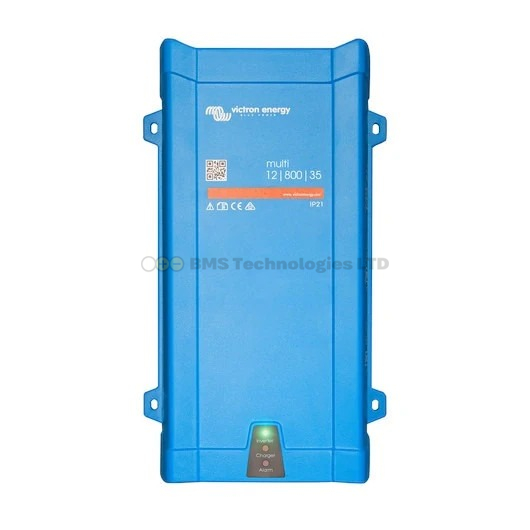
MultiPlus 12/800/35 (£480–£560) — Same power with built-in charger and transfer switch. Best for campervans that use shore power regularly.
Medium Motorhomes (Fiat Ducato-based, self-builds)
MultiPlus 12/1600/70 (£650–£780) — The sweet spot for most motorhomes. Handles a microwave, coffee machine, or hairdryer (on low). The 70A charger fills batteries quickly on hookup. 1,600W continuous with 3,000W surge handles most realistic load combinations.
MultiPlus 12/2000/80 (£850–£980) — For those who want headroom. 2,000W continuous handles a microwave plus laptop simultaneously. The 80A charger is excellent for large lithium battery banks.
Large Motorhomes and Luxury Coaches
MultiPlus 12/3000/120 (£1,100–£1,350) — For motorhomes with serious electrical needs: microwave, air conditioning, induction cooking. The 120A charger can replenish a 400Ah lithium bank quickly. At this power level, consider whether 24V might be more practical.
MultiPlus 24/3000/70 (£1,100–£1,350) — Same power output on a 24V system. Halves the DC current draw, meaning smaller cables and lower losses. The right choice for large coach conversions.
Comparison Table
| Model | Continuous | Surge | Charger | Best For | Price Range |
|---|---|---|---|---|---|
| Phoenix 12/500 | 500W | 900W | — | Laptops, small electronics | £160–£200 |
| Phoenix 12/800 | 800W | 1,500W | — | Small appliances, no microwave | £250–£310 |
| Phoenix 12/1200 | 1,200W | 2,200W | — | Microwave-capable (no charger) | £320–£400 |
| MultiPlus 12/800/35 | 800W | 1,500W | 35A | Small campervans with hookup | £480–£560 |
| MultiPlus 12/1600/70 | 1,600W | 3,000W | 70A | Most motorhomes | £650–£780 |
| MultiPlus 12/2000/80 | 2,000W | 4,000W | 80A | Larger vans, frequent AC use | £850–£980 |
| MultiPlus 12/3000/120 | 3,000W | 6,000W | 120A | Large motorhomes, air con | £1,100–£1,350 |
PowerAssist and PowerControl
Two features make the MultiPlus exceptional for motorhome use:
PowerControl limits the total current drawn from shore power to prevent tripping the campsite breaker. Set it to match your hookup (6A for European sites, 10A or 16A for UK sites), and the MultiPlus automatically reduces its charge current when you switch on appliances.
PowerAssist goes further — when your appliance demand exceeds the shore power supply, the MultiPlus supplements with battery power. On a weak 6A European hookup, you can still run a microwave because the MultiPlus tops up the missing watts from the battery. This is genuinely transformative for European touring.
Common Inverter Mistakes
- Forgetting surge ratings: A 1,000W inverter cannot reliably start a 1,000W microwave — the surge will trip protection. Always buy an inverter rated for at least 1.5x your largest load's running watts.
- Ignoring power factor: Some appliances (especially motors and cheaper electronics) have a power factor below 1.0, meaning they draw more VA than watts. A 1,000W-rated appliance might draw 1,200VA.
- Undersizing cables: A 2,000W inverter at 12V draws over 180A from the battery. This needs 50mm² or 70mm² cables kept as short as possible, with appropriate fusing.
- Trying to run a standard kettle: A 3,000W kettle is impractical on a 12V system — it draws 270A+. Buy a 750W travel kettle or use gas for boiling water.
- Not accounting for standby draw: Inverters consume 10–25W just being switched on, even with no load. Use the remote on/off switch or Bluetooth to turn off the inverter when not needed.
Our Recommendation
For most motorhome owners, the MultiPlus 12/1600/70 is the best balance of capability, size, and cost. It handles a microwave, charges batteries at 70A on hookup, includes PowerAssist for weak European supplies, and fits comfortably in a standard motorhome electrical bay. If you regularly run high-power appliances or want more headroom, step up to the MultiPlus 12/2000/80.
Use our price comparison tool to find the best UK prices on any Victron inverter or MultiPlus. For help choosing between a Phoenix and MultiPlus, read our detailed comparison guide.