Victron Energy has become the default choice for marine electrical systems across the UK boating community. Their products carry proper IP ratings for harsh environments, integrate into a single monitoring ecosystem, and have a proven track record on everything from canal boats to bluewater cruising yachts. This guide covers the best Victron products for different boat types with UK pricing and recommended system packages.
Why Victron Dominates the Marine Market
Boat electrics demand more from equipment than almost any other application. Salt air corrodes cheap components, vibration loosens connections, and moisture finds its way into everything. Victron stands out for three reasons:
- Proper IP ratings — IP22 for below-deck, IP65/67 for exposed or engine bay locations
- Proven reliability — core designs refined over decades with real field testing on ocean-crossing yachts
- Full system integration — every product connects to a single GX monitoring platform for batteries, solar, shore power, and engine charging
Different Boats, Different Needs
Sailboats
Cruising sailboats have the most demanding requirements. You're often anchored for days without shore power, relying on solar and the engine alternator. Space is tight, power budgets matter, and everything must handle heeling. A 35-45ft cruiser typically needs 200-400Ah of lithium and 300-600W of solar.
Motorboats
Motor cruisers have more alternator charging time, more space, and spend longer on shore power. The focus shifts toward powerful inverter/chargers for domestic appliances and robust shore power management. A 30-40ft motor cruiser benefits from 200-300Ah of battery with a strong inverter/charger.
Canal Boats and Narrowboats
Narrowboats are floating homes running washing machines, microwaves, and heating. Power demands are high but the inland environment is less harsh than saltwater. Roof space is generous for solar. A well-equipped narrowboat might have 400-600Ah of lithium and 600W+ of solar.
Essential Products for Marine Systems
Battery Monitoring
On a boat, accurate battery monitoring is safety-critical. The SmartShunt (from ~£60) provides state of charge, voltage, current, and history via Bluetooth. The BMV-712 Smart (from ~£130) adds a dedicated display for the helm or nav station. Read our SmartShunt installation guide for wiring details.
Inverter/Chargers
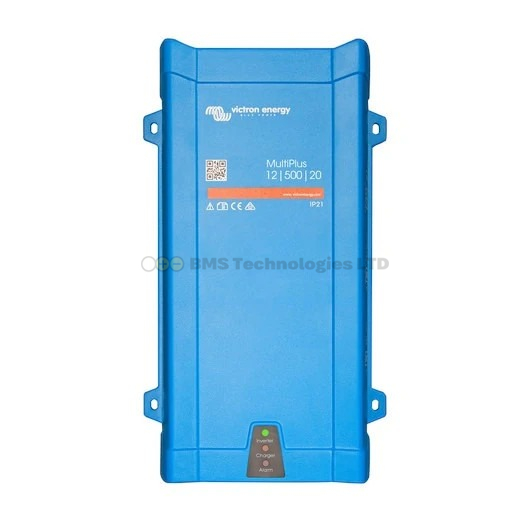
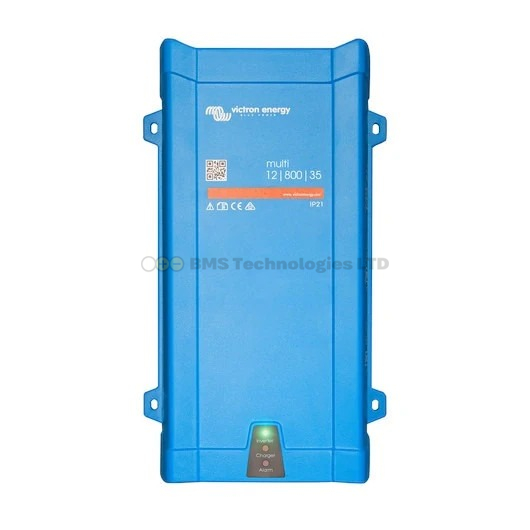
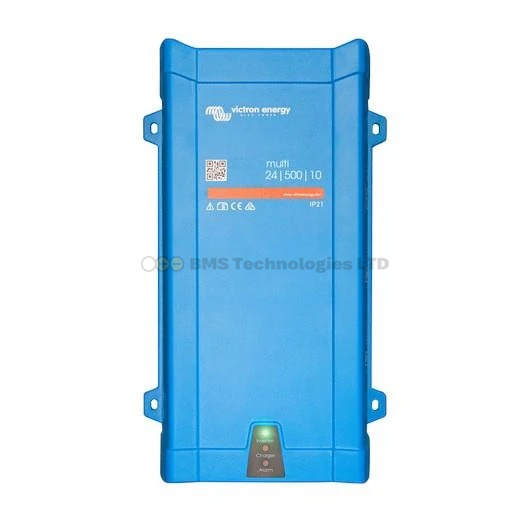
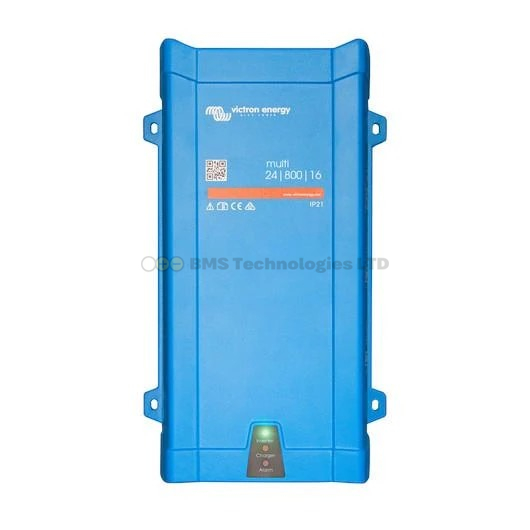
The MultiPlus Compact 12/1600/70 (from ~£650) is the most popular choice for sailboats. It delivers 1600W continuous, charges at 70A from shore power, and provides automatic transfer switching. For larger vessels, the MultiPlus 12/3000/120 (from ~£1,100) handles washing machines and multiple appliances with 120A shore charging. See our inverter comparison guide for help choosing.
Solar Charging
Deck space is limited, so series-wired panels with 150V-input MPPT controllers are ideal. Series wiring means higher voltage, lower current, and reduced cable losses on long runs from deck to battery compartment. The SmartSolar MPPT 150/35 (from ~£195) handles up to 500W at 12V. The 100/30 (from ~£140) suits smaller 200-400W installations.
Shore Power Charging
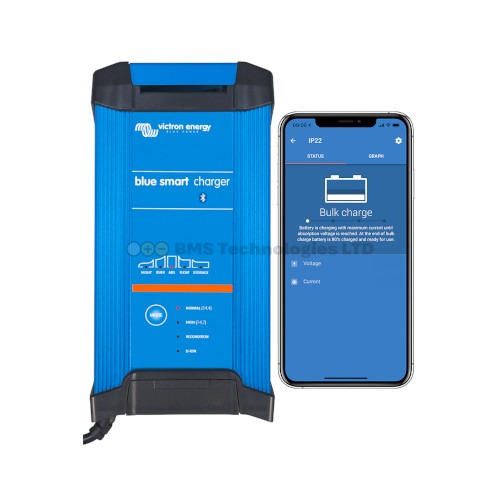
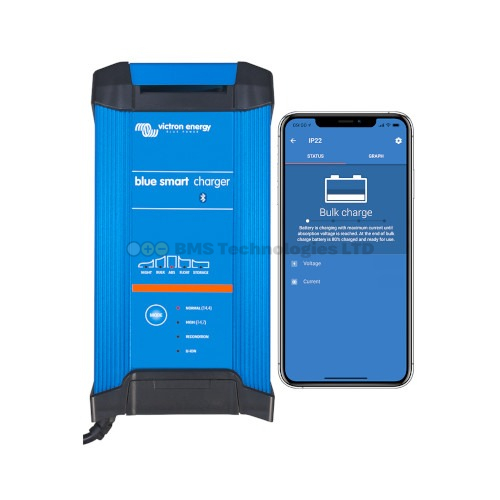
The Blue Smart IP22 12/30 (from ~£130) has three outputs for service, starter, and bow thruster batteries, with adaptive profiles for lead-acid and lithium. For engine bays, the Blue Smart IP65 12/25 (from ~£140) handles moisture better. See our charger comparison.
DC-DC Alternator Charging
With lithium batteries, a DC-DC charger protects your alternator and manages the charging profile. The Orion-Tr Smart 12/12-30 (from ~£150) delivers 30A of regulated charge with automatic engine detection. Two units can be paralleled for 60A. See our DC-DC charger guide.
System Monitoring
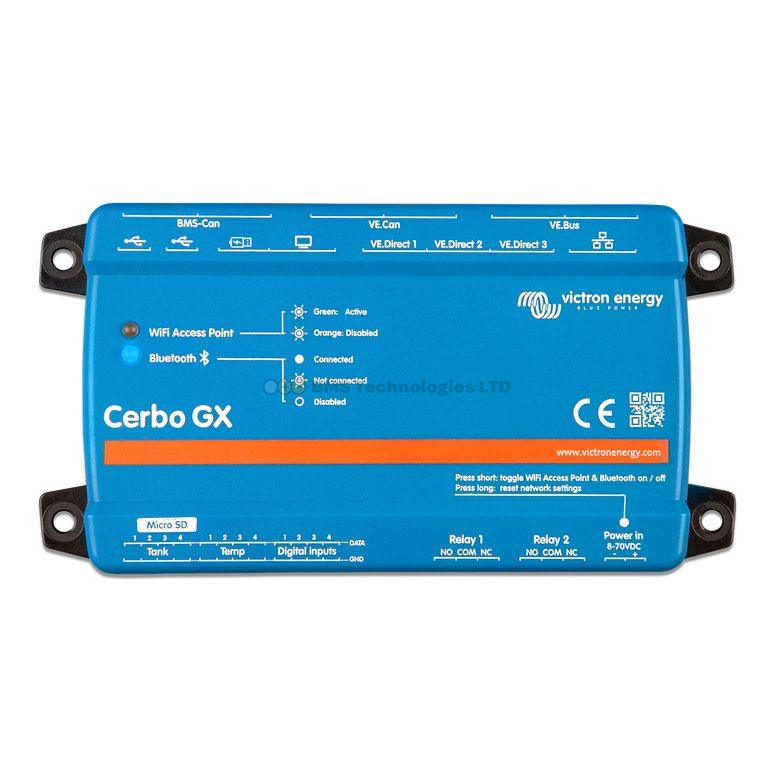
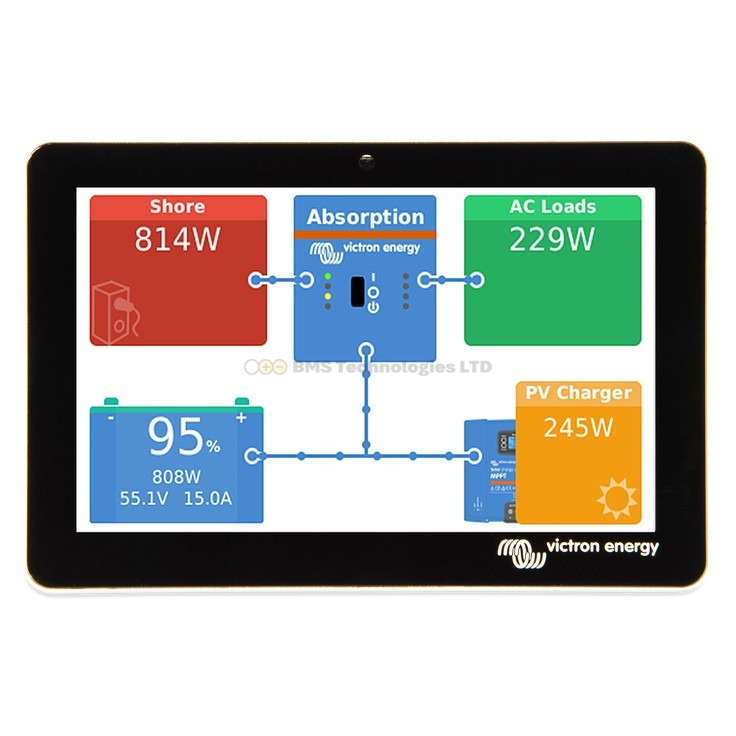
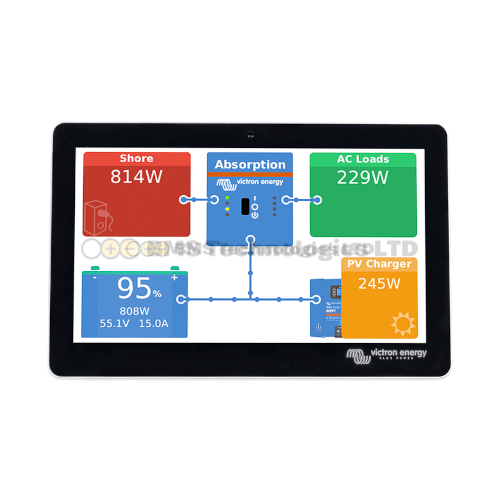
The Cerbo GX (from ~£230) connects everything into one dashboard. Add a GX Touch 50 (from ~£160) at the nav station for real-time visibility. With internet, the Cerbo uploads to Victron's free VRM portal — check your boat's batteries from anywhere. See our GX devices guide.
Marine IP Rating Guide
| Location | Min. IP Rating | Suitable Products |
|---|---|---|
| Cabin / saloon | IP22 | MultiPlus, Blue Smart IP22, Cerbo GX, SmartShunt |
| Engine bay | IP65 | Blue Smart IP65, Orion-Tr Smart, BatteryProtect |
| Deck locker | IP65 | SmartSolar MPPT (IP43 — use sealed locker), Blue Smart IP65 |
| Fully exposed | IP67 | Blue Smart IP67 |
Tip: On saltwater boats, apply dielectric grease to all terminal connections and inspect quarterly, even on IP65-rated products.
Recommended System Packages
Cruising Sailboat (35-45ft) — From ~£1,800
- MultiPlus Compact 12/1600/70 — ~£650
- SmartSolar MPPT 150/35 — ~£195
- SmartShunt 500A — ~£60
- Orion-Tr Smart 12/12-30 — ~£150
- Cerbo GX + GX Touch 50 — ~£390
- BatteryProtect 65A — ~£40
Motor Cruiser (30-40ft) — From ~£2,100
- MultiPlus 12/3000/120 — ~£1,100
- SmartSolar MPPT 100/30 — ~£140
- BMV-712 Smart — ~£130
- Orion-Tr Smart 12/12-30 — ~£150
- Cerbo GX + GX Touch 50 — ~£390
Narrowboat — From ~£2,400
- MultiPlus 12/3000/120 — ~£1,100
- SmartSolar MPPT 150/60 — ~£310
- SmartShunt 500A — ~£60
- Orion-Tr Smart 12/12-30 x2 — ~£300
- Cerbo GX + GX Touch 50 — ~£390
Use our price comparison tool to find the best current UK prices on all these products.
Installation Tips for Boats
- Use tinned cable — Standard copper corrodes quickly in marine environments. Secure cables every 300mm to prevent chafe, especially on sailboats.
- Ventilate inverters — MultiPlus units generate heat. Ensure 100mm clearance above and below with ventilation to the compartment.
- Fuse correctly — Fuse every positive cable within 200mm of the battery using ANL or Class T fuses rated for DC. Never use domestic AC breakers.
- Mount high — Never install electrical equipment where bilge water could reach it, even in a worst-case scenario.
- Plan for access — Mount components where you can reach the terminals. On a boat, you need to check connections at least annually.
Common Marine Electrical Mistakes
- No battery monitor — Guessing state of charge leads to dead batteries. A SmartShunt costs £60 and pays for itself in battery lifespan.
- Undersized cables — Boats have longer cable runs than vans. Use a cable sizing calculator and go one size thicker than the minimum.
- Lithium direct to alternator — Lithium batteries can pull enough current to burn out your alternator. Always use a DC-DC charger.
- Forgetting the starter battery — Your starter battery needs its own charging source. A Blue Smart IP22 with multiple outputs handles this.
- No galvanic isolation — Shore power connections cause galvanic corrosion through the earth wire. Consider a Victron Isolation Transformer if you spend significant time in marinas.
- Skipping remote monitoring — A Cerbo GX logs faults, alerts you to problems, and lets you check your boat remotely. For liveaboards, it's essential.
Marine electrics demand proper planning and quality components. Victron's ecosystem makes it straightforward to build a reliable system for any boat type. Start with the essentials — battery monitor, charging, and inverter — then expand as needs grow. Compare prices across UK retailers with our price comparison tool.