How you wire your solar panels — in series or in parallel — directly affects your system's performance, safety, and which Victron MPPT controller you need. Get it wrong and you could damage your charge controller or leave significant solar harvest on the table. This guide explains both configurations, their pros and cons, and how to choose the right one for your Victron MPPT setup.
Series vs Parallel: The Basics
Series Wiring
Connect the positive terminal of one panel to the negative terminal of the next. The result:
- Voltages add up — two 22V panels in series = 44V
- Current stays the same — if each panel produces 9A, the string still produces 9A
Parallel Wiring
Connect all positive terminals together and all negative terminals together. The result:
- Voltage stays the same — two 22V panels in parallel = 22V
- Currents add up — if each panel produces 9A, the total is 18A
Why It Matters for Victron MPPT Controllers
Every Victron MPPT has two critical limits:
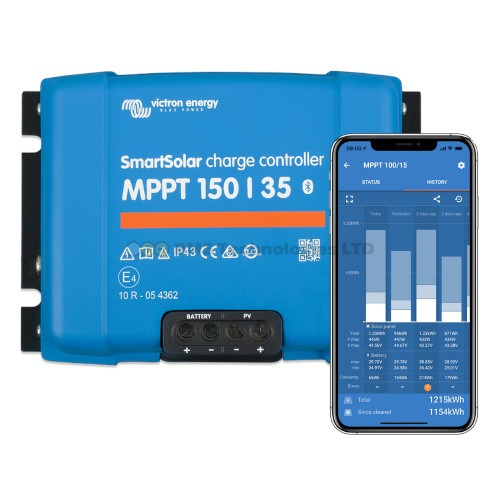
- Maximum PV voltage (Voc) — exceed this and you'll destroy the controller. This is the first number in the model name (75V, 100V, 150V, or 250V).
- Maximum charge current — exceed this and the controller simply limits output (no damage, but wasted capacity).
Series wiring increases voltage towards the first limit. Parallel wiring increases current but keeps voltage low. Your wiring choice determines which controller you need.
When to Wire in Series
Series wiring is generally preferred for Victron MPPT systems because:
1. Better MPPT Efficiency
MPPT controllers work by converting high PV voltage down to battery voltage. The greater the voltage difference, the more efficiently the MPPT algorithm can track the maximum power point. Higher input voltage = better conversion efficiency, especially in the morning and evening when light is low.
2. Lower Cable Current = Thinner Cables
Since series wiring keeps the current the same as a single panel, you can use thinner cables between the panels and the controller. Two 200W panels in series at ~8.5A need much thinner cable than two panels in parallel at ~17A. This saves money and simplifies installation, especially in campervans where cable runs can be long.
3. Better Low-Light Performance
In overcast UK conditions, panel voltage stays relatively high even when irradiance drops. Higher string voltage means the MPPT can still extract useful power when parallel-wired panels might fall below the minimum operating voltage.
When to Wire in Parallel
Parallel wiring is better in specific situations:
1. Partial Shading
This is the big one. In a series string, one shaded panel drags down the entire string. If one of three series panels is 50% shaded, the whole string loses roughly 50% of its output (bypass diodes help, but don't eliminate the problem).
In parallel, a shaded panel only affects itself. The other panels continue producing at full power. For installations where partial shading is unavoidable — such as a campervan roof near a roof fan or skylight that casts shadows — parallel wiring can yield significantly more energy over a day.
2. Voltage Limit Constraints
If your panels have high Voc values (common with modern 400W+ residential panels), wiring even two in series might exceed your controller's voltage limit. In this case, parallel wiring keeps voltage safe.
Example: Two panels with Voc = 49.5V. In series: 99V. With cold-weather correction: ~109V. This exceeds a 100V controller and gets close to a 150V controller's limit with only two panels. Parallel wiring keeps Voc at 49.5V (corrected to ~54V), safely within any controller.
3. Mismatched Panels
If you have panels with different specifications (different wattage, different Voc/Imp), parallel wiring lets each panel operate at its own optimal voltage. Series wiring forces the same current through all panels, which means the weakest panel limits the string.
Mixed Configuration: Series-Parallel
For larger arrays, you can combine both approaches. Wire panels in series to form strings, then wire those strings in parallel.
Example: 4 × 200W panels
- Wire into 2 strings of 2 panels in series
- Connect the 2 strings in parallel
- Result: Voltage = 2 × Voc, Current = 2 × Isc per string
This gives you the MPPT efficiency benefits of higher voltage while limiting current and keeping voltage within controller limits. It's the standard approach for larger off-grid and home battery systems.
Victron MPPT Minimum Voltage Requirements
The MPPT controller needs a minimum PV voltage to start operating. As a rule, the PV voltage must be at least 5V above the battery voltage (known as the start voltage). For a 12V battery system at ~14.4V during absorption charging, you need at least ~19V from the panels.
Most 12V-type panels (Voc around 22V) produce enough voltage even in poor conditions. But if you're using panels with lower voltage ratings, series wiring helps ensure you always meet the minimum start voltage.
Configuration Examples for Common Setups
| Setup | Wiring | Recommended MPPT | Reason |
|---|---|---|---|
| 2 × 100W (Voc ~22V) | Series | SmartSolar 75/15 | 44V Voc, low current, simple |
| 2 × 200W (Voc ~24V) | Series | SmartSolar 100/30 | 48V Voc, ~28A charge current |
| 3 × 200W (Voc ~24V) | Series | SmartSolar 100/50 or 150/35 | 72V Voc — too close for 75V class, use 100V+ |
| 2 × 400W (Voc ~49V) | Parallel | SmartSolar 100/50 | Series would hit 98V+ — too risky with cold correction |
| 4 × 200W (Voc ~24V) | 2S2P (2 series, 2 parallel strings) | SmartSolar 100/50 | 48V Voc, ~56A split to ~28A per string × 2 |
| 3 × 200W with shading | Parallel | SmartSolar 100/50 | Shade resilience outweighs MPPT efficiency gain |
Rules of Thumb
- Default to series unless you have a specific reason for parallel.
- Use parallel for partial shading — if even one panel gets shade during the day, parallel often wins over a full day.
- Never exceed the controller's Voc limit — include cold weather correction (add 10–15% in the UK).
- Use series-parallel for 4+ panels — keeps voltage high enough for efficiency but distributes current.
- Mismatched panels = parallel — different models should not be wired in series.
Summary
For most Victron MPPT installations with matching panels and minimal shading, series wiring is the better default. It gives you higher voltage for better MPPT efficiency, allows thinner cables, and works better in low light. Switch to parallel wiring when shading is an issue or when panel voltages are too high for your controller. For larger arrays, a series-parallel combination gives you the best of both worlds.