Wiring a Victron electrical system in a campervan isn't rocket science, but small mistakes can have serious consequences — from blown fuses and voltage drop to outright fire risk. After seeing hundreds of DIY campervan builds, these are the most common wiring mistakes and exactly how to avoid them.
Mistake 1: Undersized Battery Cables
This is the single most common mistake in campervan wiring. The cables between your battery bank, inverter, and battery-to-bus connections must be sized for the maximum current they'll carry, not the average current.
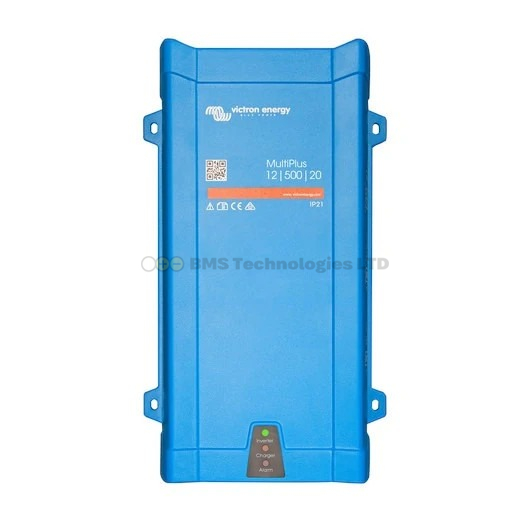
A Victron MultiPlus 12/2000 can draw over 200A from a 12V battery bank at full load. That requires 70mm² cable at minimum for short runs (under 1.5m). Use 95mm² if the run exceeds 2m. A cheap 25mm² cable will overheat, melt its insulation, and potentially start a fire.
How to fix it: Calculate the maximum current for each cable run. Use the Victron wiring documentation or a cable sizing calculator. Always round up to the next cable size. For inverter connections, follow the minimum cable sizes stated in the MultiPlus or Phoenix installation manual — Victron specifies these for good reason.
Mistake 2: Missing Fuses or Fuses Too Far from the Battery
Every positive cable connected to a battery must be fused. The fuse protects the cable, not the equipment at the other end. If a cable shorts against the chassis without a fuse, the battery can deliver hundreds of amps until the cable melts or catches fire.
The fuse must sit as close to the battery positive terminal as physically possible — ideally within 200mm. A fuse at the other end of a 3-metre cable leaves 3 metres of unprotected wire that could short.
How to fix it: Install a fuse holder directly on or immediately next to the battery positive terminal. Use MRBF (Marine Rated Battery Fuses) or MIDI fuses for high-current connections (inverter, bus bar feeds). Use standard blade fuses for smaller circuits. Size each fuse to protect the cable, not the load.
Mistake 3: Wrong Cable Lugs and Poor Crimps
Using the wrong size lug on a cable creates a weak point with higher resistance. A 50mm² lug on a 70mm² cable doesn't make full contact. Equally, a crimp done with pliers instead of a proper hydraulic crimping tool creates a loose, high-resistance joint that heats up under load.
How to fix it: Match lug size exactly to cable size. Use a hydraulic crimping tool (available for around £30-50) for cables 25mm² and above. After crimping, tug the lug firmly to confirm it's secure. Apply adhesive-lined heat shrink over the crimp to seal against moisture.
Mistake 4: Ignoring Voltage Drop
Voltage drop across cable runs is a hidden performance killer. A 0.5V drop on a 12V system is over 4% — your MPPT charge controller sees lower voltage at the battery than actual battery voltage, causing undercharging. Your inverter sees lower voltage than the battery provides, triggering premature low-voltage cutoffs.
How to fix it: Calculate voltage drop for every cable run. The target is under 2% drop for charging circuits and under 3% for general circuits. For a 200A inverter cable: at 2m total length (1m each way), you need at least 70mm² to stay under 2%. Keep high-current cable runs as short as possible.
Mistake 5: Bypassing the Battery Monitor Shunt
A Victron SmartShunt or BMV battery monitor measures current flowing through its shunt resistor. For accurate readings, every single load and charge source must pass through the shunt. If you connect a USB charger directly to the battery positive, bypassing the shunt, the monitor won't see that current and the state-of-charge reading drifts.
How to fix it: Connect the shunt on the negative side of the battery bank. Everything connects to the load side of the shunt — no exceptions. The only connection directly to the battery negative terminal is the single cable to the shunt. All other negatives go to a bus bar on the load side of the shunt.
Mistake 6: Mixing Cable Sizes in Parallel Battery Runs
When connecting batteries in parallel, each battery must have identical cable lengths and sizes to the bus bar. If one battery uses 50mm² cables at 0.5m and another uses 35mm² cables at 1m, the first battery does most of the work. It gets overcharged, over-discharged, and ages faster while the other battery coasts.
How to fix it: Use the same cable size and the same cable length for every parallel connection. Measure and cut cables to identical lengths. Use the same lug types. This applies to both positive and negative runs.
Mistake 7: Not Grounding the Vehicle Chassis Properly
A campervan's metal body should be bonded to the electrical system's negative bus bar with a substantial cable. Without this, static can build up on the bodywork, and in a fault condition, the chassis could become live. Some Victron inverters also require a chassis ground for their internal RCD to function correctly.
How to fix it: Run a 16mm² (minimum) earth cable from your negative bus bar to a clean, bare-metal point on the vehicle chassis. Scrape paint away, use a star washer to bite into bare metal, and apply copper grease to prevent corrosion. Check the connection annually.
Mistake 8: Overloading Circuits
A common mistake is running too many loads off a single fused circuit. Three 5A loads on a 10A fused circuit will blow the fuse every time they run simultaneously. Another variant: running a high-draw appliance like a diesel heater fan (10-12A at startup) on the same circuit as sensitive electronics.
How to fix it: Separate circuits by function: lighting, USB/12V sockets, water pump, fridge, heating. Each gets its own fuse from a 12-way fuse box. Size each fuse for the cable, and size each cable for the maximum load on that circuit.
Mistake 9: Using Household Wire Instead of Automotive Cable
Standard T&E (twin and earth) household cable uses solid copper cores. These are designed to be fixed in place and never flexed. In a van that vibrates constantly while driving, solid-core wire work-hardens and snaps. It's also not rated for the temperature extremes inside a van.
How to fix it: Use flexible multi-strand automotive cable rated to at least 105°C. For DC wiring, tri-rated cable (rated for automotive, industrial, and domestic use) is ideal. For the AC output side of your inverter, use flexible cable rated for 230V — not solid-core domestic T&E.
Mistake 10: Poor Cable Routing Near Heat Sources
Routing cables next to the exhaust pipe of a diesel heater, directly behind a cooking hob, or through the engine bay without protection is asking for melted insulation. Even cables rated to 105°C can fail next to a 300°C exhaust pipe.
How to fix it: Keep cables at least 100mm from heat sources. Where cables must pass near heat, use heat-resistant sleeving or conduit. In the engine bay, use high-temperature cable and protective conduit throughout. Secure cables with P-clips to prevent them vibrating onto hot surfaces while driving.
Mistake 11: No Cable Labelling
Unlabelled cables are a nightmare for troubleshooting. Six months after the build, you won't remember which red cable goes where. If someone else needs to work on your system — or an emergency requires disconnecting something specific — unlabelled wiring wastes time and invites mistakes.
How to fix it: Label both ends of every cable with its circuit name and destination. Use printed cable markers or adhesive labels covered in clear heat shrink. Label at every bus bar, fuse box, and device terminal. It takes 30 minutes during the build and saves hours later.
Mistake 12: Skipping the Wiring Diagram
Starting a wiring job without a complete diagram leads to missed connections, wrong fuse sizes, and ad-hoc additions that create a tangled mess. Professional installers always work from a diagram — DIY builders should too.
How to fix it: Draw a full wiring diagram before buying any components. Include every cable run, its size, its fuse rating, and the device at each end. Victron provides system design guidance and example diagrams. Keep the diagram in the van for future reference.
Quick Reference: Cable Sizing for Common Victron Campervan Components
| Component | Typical Max Current (12V) | Minimum Cable Size (under 2m run) | Fuse Size |
|---|---|---|---|
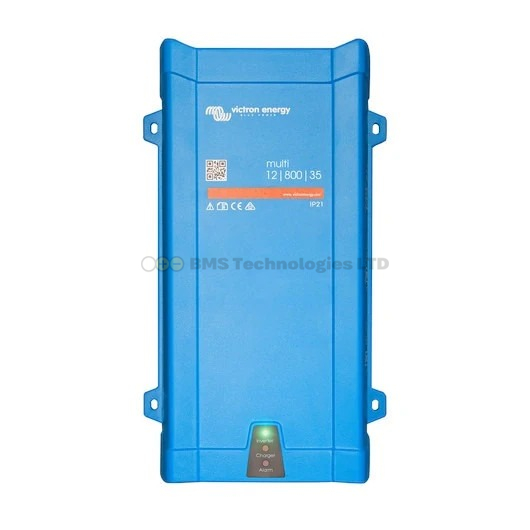
| MultiPlus 12/800 | 70A | 25mm² | 100A |
| MultiPlus 12/1200 | 120A | 50mm² | 150A |
| MultiPlus 12/2000 | 200A | 70mm² | 250A |
| MultiPlus 12/3000 | 300A | 95mm² | 350A |
| Phoenix Inverter 12/500 | 50A | 16mm² | 60A |
| MPPT 75/15 | 15A | 4mm² | 20A |
| MPPT 100/30 | 30A | 6mm² | 40A |
| MPPT 100/50 | 50A | 16mm² | 60A |
| Orion-Tr Smart 12/12-30 | 30A (output) | 10mm² | 40A |
| SmartShunt 500A | 500A | Match largest connected cable | N/A (inline) |
Final Safety Checks Before First Power-Up
- Visual inspection — check every connection is tight, every crimp is solid, every fuse is correct
- Continuity test — use a multimeter to confirm all ground connections have continuity to chassis
- Polarity check — verify positive and negative are correct at every device before connecting the battery
- Fuse audit — confirm every positive cable from the battery has a correctly-sized fuse within 200mm
- Torque check — tighten all bus bar and terminal bolts to the specified torque (usually 5-10 Nm for M8 bolts)
A well-wired Victron system is reliable and safe for years. A poorly-wired one is a constant source of problems and potential danger. Take the time to do it right — your future self will thank you. For more on system design, see our complete Victron system design guide and our campervan electrical system guide.