PowerAssist is a Victron feature that supplements your grid supply with battery power during high-demand periods. If your home has a limited grid connection — common with older UK properties on a 60A or even 40A main fuse — PowerAssist prevents that fuse from blowing when you run multiple high-power appliances simultaneously. It is also increasingly relevant for homes doing tariff-based load shaving with an ESS system.
The Problem: Limited Grid Supply
Every UK home has a main fuse (service cutout fuse) that limits how much current the property can draw from the grid. Common ratings are:
- 60A — typical of older properties, terraced houses, and some semi-detached homes. Maximum draw: approximately 13.8 kW
- 80A — increasingly common in newer builds
- 100A — standard for modern properties and the maximum for most single-phase domestic supplies
A 60A supply sounds like plenty, but consider what happens during a typical evening peak:
| Appliance | Current Draw (at 230V) |
|---|---|
| Electric oven | 13-15A |
| Electric hob (single ring) | 7-9A |
| Kettle | 10-13A |
| Washing machine (heating cycle) | 10A |
| Tumble dryer | 10-13A |
| EV charger (7 kW) | 30A |
| Immersion heater | 13A |
| Electric shower (8.5 kW) | 37A |
An oven, hob, kettle, and washing machine running simultaneously draws approximately 43A. Add a 7 kW EV charger (30A) and you are at 73A — well over a 60A fuse. The result: the main fuse blows, and you lose power to the entire house.
Upgrading your main fuse or getting a three-phase supply from your DNO (Distribution Network Operator) is possible but can cost £1,000-5,000+ and take months. PowerAssist offers an immediate alternative.
How PowerAssist Works
The Victron MultiPlus-II sits between your grid connection and your consumer unit. A current sensor (CT clamp) or energy meter monitors the total grid current. When the system detects that grid draw is approaching the configured limit, the MultiPlus-II begins discharging the battery to supplement the grid supply.
From your appliances' perspective, nothing changes — they receive 230V AC as normal. But part of that power comes from the grid and part from the battery via the inverter. The grid connection never exceeds its safe limit.
Example
Your home has a 60A supply (13.8 kW). You configure the MultiPlus-II with a grid limit of 55A (12.65 kW), leaving 5A of headroom. When your home draws 14 kW:
- Grid supplies: 12.65 kW (55A)
- Battery/inverter supplies: 1.35 kW
- Total available to home: 14 kW
- Main fuse: safe at 55A, well within its 60A rating
With a MultiPlus-II 48/5000, the system can supplement up to 5 kW from the battery — effectively giving your 60A home the capacity of a 82A supply.
Required Hardware
- Victron MultiPlus-II — the inverter/charger. The 48/3000 adds up to 3 kW of battery support; the 48/5000 adds up to 5 kW. Choose based on how much extra capacity you need
- Battery bank — lithium (LiFePO4) recommended for fast discharge response. Size depends on how long and how often peak shaving occurs. Even a modest 5 kWh battery can handle 1-2 hours of peak supplementing per day
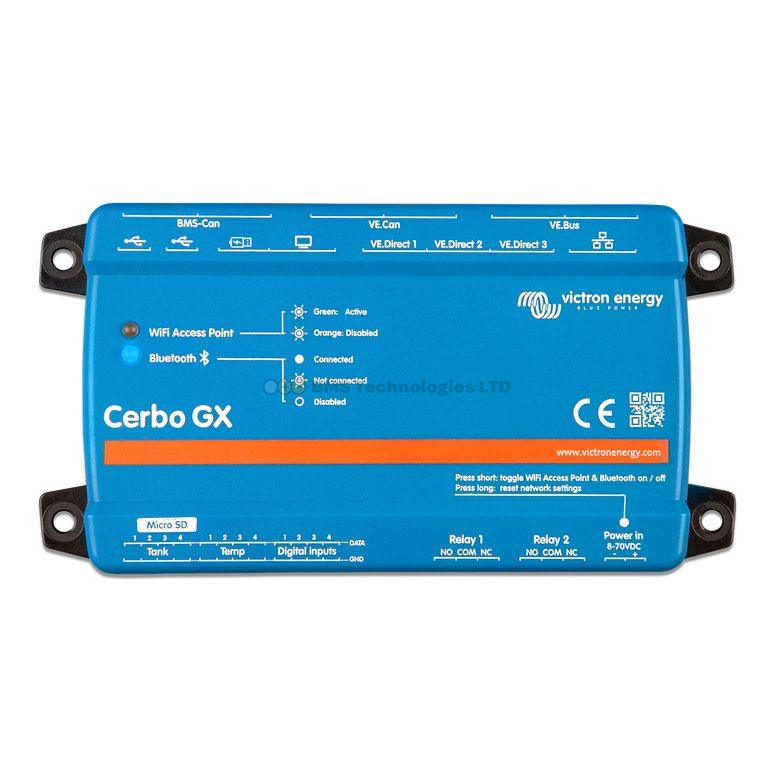
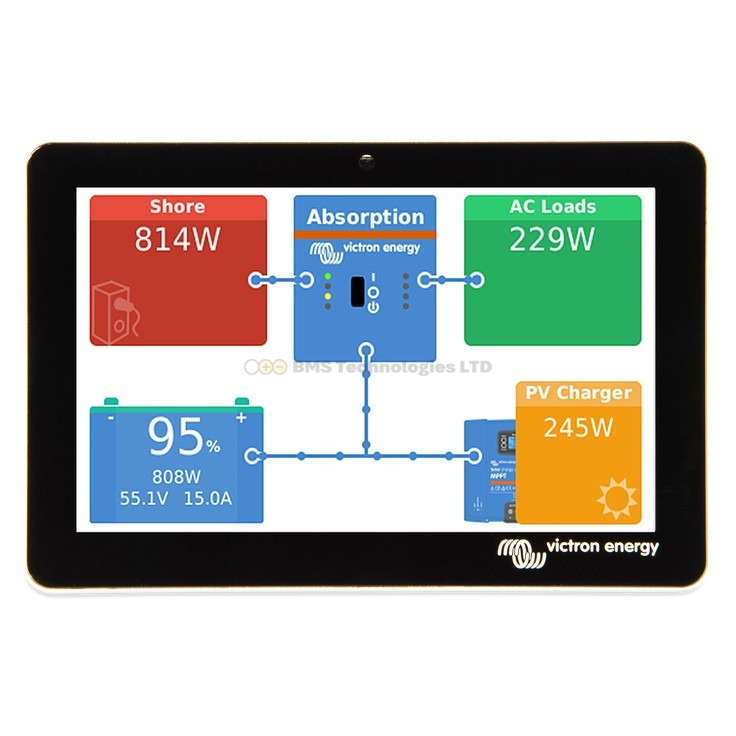
- GX device — a Cerbo GX runs the ESS logic and provides monitoring. Essential for PowerAssist in an ESS configuration
- Current sensor or energy meter — installed at the grid connection point. The Victron ET112 (single-phase) or ET340 (three-phase) energy meter is the standard choice. A CT clamp on the incoming supply cable works as an alternative
Configuration
Setting Up PowerAssist via ESS
PowerAssist in a modern Victron ESS system works through the grid setpoint and input current limit:
- Enable ESS mode on the Cerbo GX (Settings > ESS)
- Set the AC input current limit on the MultiPlus-II. This is the maximum current the system will draw from the grid. Set it below your main fuse rating — e.g., 50A for a 60A fuse, or 85A for a 100A fuse
- Set the grid setpoint to match your goals. For pure load shaving, set the grid setpoint to match your AC input current limit in watts. The system will use battery power to keep grid draw at or below this level
- Configure minimum SOC — set how low the battery can discharge during peak shaving. 20-30% is typical, preserving some reserve for backup
PowerAssist Without ESS
PowerAssist also works in standalone mode (without ESS), configured directly in VEConfigure. In this mode, you set the AC input current limit, and the MultiPlus-II automatically supplements when the limit would be exceeded. This is simpler but lacks the sophisticated SOC management and scheduling of ESS mode.
Response Time
The MultiPlus-II responds to load changes within approximately 20 milliseconds. This is fast enough that your main fuse will not blow even if a large load switches on suddenly. The system briefly allows a grid current spike (the fuse has thermal mass and does not blow instantly) and then ramps in battery power to bring the grid current back within limits.
UK-Specific Considerations
Single-Phase vs Three-Phase
Most UK homes are single-phase. A single MultiPlus-II handles the entire supply. If your home has a three-phase supply (less common in residential UK, but found in some rural properties and larger homes), you need three MultiPlus-II units configured as a three-phase system — one per phase. See our three-phase guide for details.
DNO Notification
Any grid-connected battery system in the UK requires DNO notification under G98 (up to 3.68 kW) or G99 (above 3.68 kW). PowerAssist does not export to the grid — it only supplements import — but the MultiPlus-II is still a grid-connected inverter and must comply. Your installer should handle the notification process.
Main Fuse Rating Verification
Before configuring PowerAssist, verify your actual main fuse rating. Check the service cutout — the sealed unit where the mains supply enters your property. The fuse rating is usually marked on the fuse carrier. Common markings: 60A, 80A, 100A. If you cannot identify it, your DNO can confirm.
Do not assume your main fuse rating based on the age of the property. Some older homes have been upgraded; some newer homes have lower ratings than expected.
EV Charger Integration
EV chargers are the most common reason UK homeowners discover their grid supply is insufficient. A 7 kW home charger draws 30A — half of a 60A supply. Running the charger alongside normal household loads pushes many homes over their limit.
PowerAssist can manage this intelligently. During EV charging, the MultiPlus-II supplements the grid to keep total draw within limits. Some users also schedule EV charging to overnight cheap-rate periods and use ESS scheduled charging to ensure the home battery is full before the EV charger starts.
Battery Sizing for PowerAssist
PowerAssist draws from the battery during peak demand periods. How much battery you need depends on:
- Duration of peaks — cooking dinner typically creates a 1-2 hour peak. EV charging might run for 4-6 hours
- Power deficit — the gap between your grid limit and actual demand. If you are shaving 2 kW for 2 hours, that is 4 kWh from the battery
- Frequency — daily peaks require more battery cycling capacity than occasional overloads
For most UK homes using PowerAssist to avoid main fuse trips:
| Scenario | Typical Power Deficit | Duration | Energy Required | Recommended Battery |
|---|---|---|---|---|
| Evening cooking peak | 1-3 kW | 1-2 hours | 2-6 kWh | 5 kWh minimum |
| EV charging + household | 2-4 kW | 3-5 hours | 6-20 kWh | 10 kWh+ |
| Occasional spikes only | 2-5 kW | Minutes | 0.5-1 kWh | 2.5 kWh minimum |
If you also have solar panels, daytime solar production recharges the battery between peaks, reducing the effective battery requirement.
PowerAssist vs Upgrading Your Supply
| PowerAssist (Victron ESS) | DNO Supply Upgrade | |
|---|---|---|
| Cost | £4,000-8,000 (system) | £1,000-5,000 (varies by DNO and work required) |
| Timeframe | 1-2 weeks installation | 4-12 weeks (DNO scheduling) |
| Additional benefits | Backup power, solar integration, tariff savings | None — just a bigger fuse |
| Ongoing costs | Battery replacement (~10 years) | None |
| Future-proofing | Adapts to changing loads | Fixed capacity |
If your only need is a bigger supply, a DNO upgrade is simpler and often cheaper. But if you also want solar self-consumption, tariff arbitrage, or backup power, a Victron ESS system with PowerAssist solves multiple problems simultaneously. The incremental cost of adding PowerAssist to an existing ESS system is zero — it is a configuration setting, not additional hardware.
Real-World Performance
PowerAssist works reliably in practice. The MultiPlus-II's fast response prevents fuse trips even under sudden load changes. The main limitations are:
- Battery depletion — if the battery reaches minimum SOC during a sustained peak, the system stops supplementing and your grid connection is back to its normal limit. Size the battery appropriately for your peak duration
- Inverter output limit — the MultiPlus-II can only supplement up to its rated continuous output. A 48/3000 provides up to 3 kW; a 48/5000 provides up to 5 kW. If your deficit exceeds this, you may need a larger unit or parallel units
- Recharge time — after a peak shaving event, the battery needs time to recharge (from solar or the grid during off-peak). If peaks occur frequently throughout the day, the battery may not fully recover between events
For most UK households, PowerAssist with a 5-10 kWh battery and a MultiPlus-II 48/5000 eliminates main fuse concerns entirely — even with an EV charger, electric oven, and other heavy loads running simultaneously. For a complete system design, see our system design guide and compare component prices using our system builder.