The voltage of your battery bank is one of the first and most important decisions in any off-grid or energy storage system. It affects cable sizes, available equipment, maximum power capacity, and system cost. Most Victron systems operate at 12V, 24V, or 48V. This guide explains the trade-offs and helps you choose the right voltage for your application.
Why Does System Voltage Matter?
The relationship between voltage, current, and power is fundamental: Power (W) = Voltage (V) x Current (A). For a given amount of power, higher voltage means lower current. Lower current means thinner cables, smaller fuses, less heat, and less energy lost in the wiring.
Consider a 3000W inverter:
| System Voltage | Current at 3000W | Minimum Cable Size (1m run) |
|---|---|---|
| 12V | 250A | 70mm² or larger |
| 24V | 125A | 35mm² |
| 48V | 62.5A | 16mm² |
At 12V, that 3000W inverter draws 250A — a huge current that requires extremely thick (and expensive) copper cables and appropriately rated fuses. At 48V, the same power requires just 62.5A, using cables a fraction of the size and cost.
12V Systems
When 12V Works Well
12V is the standard for campervans, caravans, small boats, and simple off-grid setups. Most automotive and marine accessories run natively on 12V — lights, water pumps, USB chargers, fridges, and fans. Using a 12V battery system means you can power these devices directly without any voltage conversion.
- Best for: Systems under 1500–2000W, campervans, small boats, caravans
- Advantages: Widest selection of 12V native appliances, simplest wiring, most beginner-friendly
- Disadvantages: Very high currents above 1000W, requiring thick expensive cables; limited to smaller inverters
Available Victron Products at 12V
Victron's 12V product range is the most comprehensive:
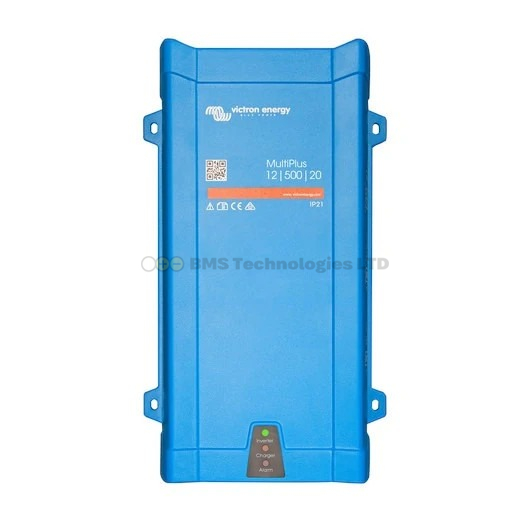
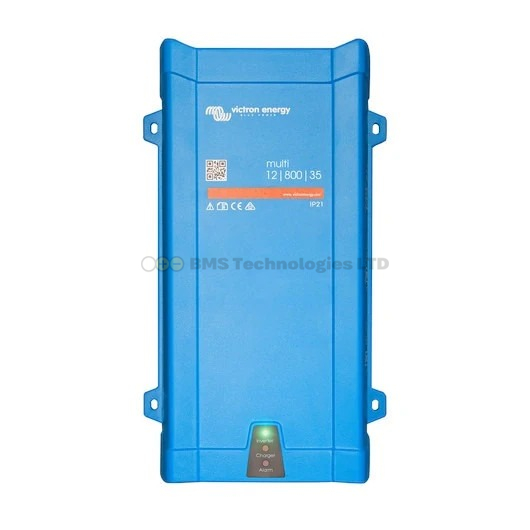
- Inverter-chargers: MultiPlus 12/500, 12/800, 12/1200, 12/1600, 12/2000, 12/3000; MultiPlus-II 12/3000; Quattro 12/3000, 12/5000
- MPPT controllers: SmartSolar 75/10, 75/15, 100/15, 100/20, 100/30, 100/50, 150/35, 150/45, 150/60, 150/70, 150/85, 150/100, 250/60, 250/85, 250/100
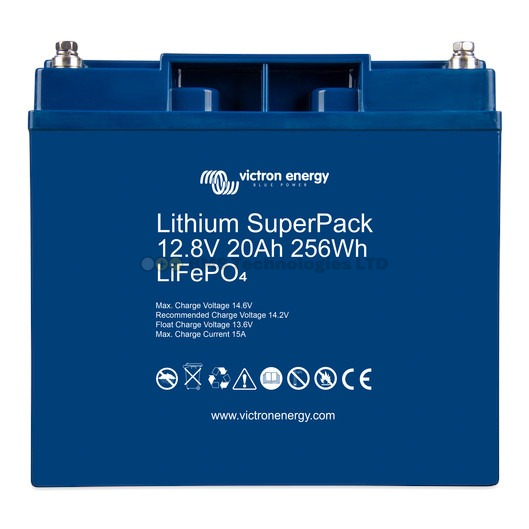
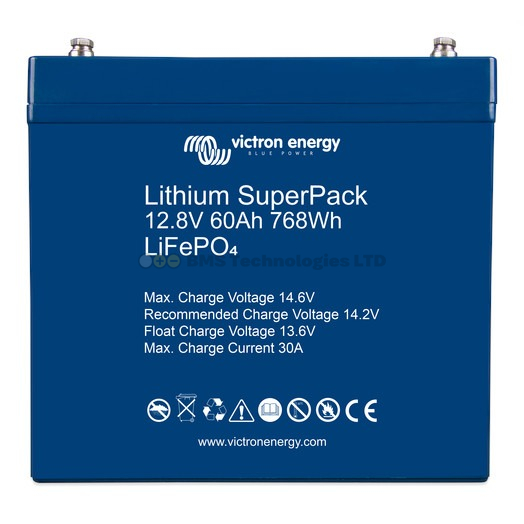
- Batteries: Lithium Smart 12.8V (100Ah, 150Ah, 200Ah); full AGM range
- DC-DC chargers: Orion-Tr Smart 12/12
- Inverters: Phoenix 12/250, 12/375, 12/500, 12/800, 12/1200
24V Systems
When 24V Is the Sweet Spot
24V is often the ideal compromise for medium-sized systems. It halves the current compared to 12V, allowing thinner cables and larger inverters, while still being straightforward to build. Many Victron products are available at 24V, and 24V is increasingly popular for campervan builds that need more than 2000W of inverter capacity.
- Best for: Systems from 1000W to 5000W, larger campervans, boats, small off-grid homes
- Advantages: Half the current of 12V, reasonable cable sizes, good product availability
- Disadvantages: Need a DC-DC converter for 12V appliances, fewer native 24V accessories
Available Victron Products at 24V
- Inverter-chargers: MultiPlus 24/500, 24/800, 24/1200, 24/1600, 24/2000, 24/3000, 24/5000; MultiPlus-II 24/3000, 24/5000; Quattro 24/3000, 24/5000, 24/8000
- MPPT controllers: All SmartSolar models (same range as 12V — the MPPT auto-detects battery voltage)
- Batteries: Victron Lithium Smart 25.6V (100Ah, 200Ah); 24V AGM available via series-connecting 12V batteries
- DC-DC chargers: Orion-Tr Smart 24/12 (steps down to 12V for accessories), Orion-Tr Smart 24/24
- Inverters: Phoenix 24/250, 24/375, 24/500, 24/800, 24/1200
Running 12V Appliances on a 24V System
The main inconvenience of 24V is that most campervan and marine accessories (lights, fans, USB sockets, water pumps) are 12V. The solution is a DC-DC converter — specifically the Victron Orion-Tr Smart 24/12. This steps the 24V battery voltage down to 12V for your accessories. It adds a small cost (£50–£90) and a slight efficiency loss (~95%), but it's a well-proven approach used in thousands of installations.
Alternatively, you can buy 24V-native versions of many accessories. LED lights, USB chargers, and water pumps are all available in 24V versions, though the selection is smaller than 12V.
48V Systems
When 48V Is Necessary
48V is the standard for larger off-grid homes, commercial installations, and high-power systems. It's required for Victron's largest inverter-chargers and the MPPT RS solar charge controller. The dramatically lower currents mean cable sizes and costs are much more reasonable at high power levels.
- Best for: Systems above 3000W, off-grid homes, commercial installations, ESS systems
- Advantages: Lowest currents, smallest cables, highest efficiency, required for largest Victron equipment
- Disadvantages: Fewer product options in some categories, need DC-DC conversion for 12V loads, higher battery costs, more cells to balance
Available Victron Products at 48V
- Inverter-chargers: MultiPlus-II 48/3000, 48/5000, 48/8000, 48/10000, 48/15000; Quattro-II 48/5000, 48/10000, 48/15000
- MPPT controllers: All SmartSolar models plus the high-power MPPT RS 450/100, 450/200
- Batteries: Victron Lithium Smart range available at higher voltage configurations; also compatible with many third-party 48V server rack batteries (Pylontech, BYD)
- DC-DC chargers: Orion-Tr Smart 48/12 (for 12V accessories)
Choosing the Right Voltage: Decision Guide
| Factor | 12V | 24V | 48V |
|---|---|---|---|
| Max practical inverter size | 2000–3000W | 3000–5000W | 5000–15000W+ |
| Cable cost (for equivalent power) | Highest | Moderate | Lowest |
| Native 12V accessory compatibility | Direct | Needs DC-DC converter | Needs DC-DC converter |
| Product range (Victron) | Widest | Wide | Large inverters and MPPT RS only at 48V |
| Typical applications | Campervans, small boats | Large vans, boats, small homes | Off-grid homes, commercial, ESS |
| Battery wiring complexity | Simplest (single battery) | 2S or native 24V batteries | 4S or native 48V batteries |
| Safety risk from DC faults | Lower | Moderate | Higher (more energy in arc faults) |
Quick Recommendations by Application
Campervans and Caravans
12V for most builds. The vast majority of campervan appliances are 12V, and systems rarely exceed 2000W. If you're building a large van with an induction hob, coffee machine, or other high-power AC appliances, consider 24V to support a 3000W+ inverter with manageable cable sizes.
Boats
12V for small boats and day boats. 24V for cruising yachts and liveaboard boats where the electrical system is more substantial. 48V is rare on boats but used on large commercial vessels.
Off-Grid Homes
48V is almost always the right choice. Home systems typically need 3000–10000W of inverter capacity, and the cable cost savings at 48V are significant. The MultiPlus-II 48/5000 is one of the most popular units for UK off-grid homes. See our MultiPlus-II guide for more details.
ESS (Grid-Tied Battery Storage)
48V is standard. Most ESS-compatible batteries (Pylontech, BYD, Victron Lithium Smart) operate at 48V nominal, and the MultiPlus-II 48V range is designed for ESS applications.
Can You Change Voltage Later?
Changing system voltage after installation is difficult and expensive. Your inverter, batteries, MPPT controllers (output side), DC-DC converters, fuses, and cables are all voltage-specific. Moving from 12V to 24V means replacing most of the major components. For this reason, it's worth choosing the right voltage from the start, even if it means spending a bit more upfront.
The one component that typically doesn't need replacing is the MPPT solar charge controller — Victron SmartSolar MPPTs auto-detect battery voltage and work with 12V, 24V, or 48V banks. Your solar panels also don't care about battery voltage — the MPPT handles the conversion.
Summary
Choose 12V for simple campervan and small boat systems under 2000W where direct 12V accessory compatibility matters most. Choose 24V for medium systems (1000–5000W) where you want a balance between cable sizes and product availability — it's an increasingly popular choice for ambitious campervan builds. Choose 48V for off-grid homes, ESS installations, and any system above 3000W where the lowest currents and largest inverter options are needed. When in doubt, go with the higher voltage — you'll never regret thinner cables and cooler connections.