Correct cable and fuse sizing is one of the most critical safety aspects of any battery system. Undersized cables overheat, melt insulation, and cause fires. Undersized fuses fail to protect cables. Oversized fuses allow cables to overheat before the fuse blows. This guide provides the specific cable sizes, fuse ratings, and installation practices you need for a safe Victron system, with UK standards and practical advice throughout.
Cable Sizing Fundamentals
Cable size is determined by two factors: the current carrying capacity (ampacity) of the cable, and the voltage drop across the cable run. You must satisfy both requirements — a cable that can carry the current but drops too much voltage will cause poor performance and wasted energy.
Cable Size by Current Rating
The following table shows recommended minimum copper cable cross-sectional areas for DC circuits. These values are for single-core flexible cable at ambient temperatures up to 30°C in free air. If cables are bundled, run through conduit, or in hot environments, derate by 20–30%.
| Maximum Continuous Current | Minimum Cable Size (mm²) | Approximate AWG Equivalent |
|---|---|---|
| 10A | 1.5mm² | 16 AWG |
| 15A | 2.5mm² | 14 AWG |
| 20A | 2.5mm² | 14 AWG |
| 30A | 6mm² | 10 AWG |
| 50A | 10mm² | 8 AWG |
| 70A | 16mm² | 6 AWG |
| 100A | 25mm² | 4 AWG |
| 125A | 35mm² | 2 AWG |
| 150A | 35mm² | 2 AWG |
| 200A | 50mm² | 1/0 AWG |
| 250A | 70mm² | 2/0 AWG |
| 300A | 70mm² | 2/0 AWG |
Always round up to the next available cable size. It is never wrong to use a larger cable — it reduces voltage drop and runs cooler.
Voltage Drop Calculation
For 12V systems, voltage drop is particularly important because a small absolute drop represents a large percentage of the supply voltage. The target is to keep voltage drop below 3% across any cable run (both directions combined).
The formula for voltage drop is:
Voltage Drop (V) = (2 x Length x Current x Resistivity) / Cross-sectional area
Where length is in metres (one way), current in amps, resistivity of copper = 0.0175 ohm-mm²/m, and cross-sectional area in mm².
Practical Example
A Victron MPPT 100/30 is mounted 2 metres from the battery. Maximum charge current is 30A at 12V.
- Voltage drop = (2 x 2 x 30 x 0.0175) / 6 = 0.35V
- As a percentage of 12V: 0.35 / 12 = 2.9% — just acceptable with 6mm² cable
- Using 10mm² instead: (2 x 2 x 30 x 0.0175) / 10 = 0.21V = 1.75% — much better
For longer runs or higher currents, always recalculate. In a 12V system, even an extra metre of cable length can push voltage drop above the 3% threshold.
Fuse Sizing Rules
A fuse protects the cable — not the device. The fuse rating must be:
- Above the maximum continuous current the circuit will draw (so the fuse doesn't blow during normal operation)
- Below the cable's maximum continuous current rating (so the fuse blows before the cable overheats)
A common rule of thumb is to size the fuse at approximately 125% of the expected maximum continuous current, but never exceeding the cable's rated ampacity.
Example
A Victron MPPT 150/35 has a maximum output of 35A. The battery cable is 6mm² (rated for approximately 45A continuous).
- Minimum fuse: 35A (must not blow at maximum output)
- Maximum fuse: 45A (must not exceed cable rating)
- Correct fuse: 40A
Battery Fuse Location
The battery fuse (or main system fuse) must be installed on the positive cable within 30cm of the battery positive terminal. This is a fundamental safety requirement. If a short circuit occurs anywhere in the system, the battery can deliver hundreds or thousands of amps — the fuse closest to the battery is the last line of defence.
- Use a fuse holder rated for the fuse type and current
- Ensure the fuse holder is mounted securely and the connections are tight
- The cable between the battery and the fuse should be as short as physically possible
- If using a Lynx Smart BMS, the BMS contactor provides disconnection, but a fuse is still required for short-circuit protection
Victron Product-Specific Cable Sizes
MPPT Solar Charge Controllers
| Model | Max Output Current | Recommended Battery Cable | Recommended Fuse |
|---|---|---|---|
| MPPT 75/10 | 10A | 2.5mm² | 15A |
| MPPT 75/15 | 15A | 2.5mm² | 20A |
| MPPT 100/20 | 20A | 4mm² | 25A |
| MPPT 100/30 | 30A | 6mm² | 40A |
| MPPT 150/35 | 35A | 6mm² | 40A |
| MPPT 100/50 | 50A | 10mm² | 60A |
| MPPT 150/60 | 60A | 16mm² | 70A |
| MPPT 150/70 | 70A | 16mm² | 80A |
| MPPT 250/85 | 85A | 25mm² | 100A |
| MPPT 250/100 | 100A | 25mm² | 125A |
MultiPlus Inverter/Chargers
| Model | Max Inverter Current (12V) | Recommended Battery Cable | Recommended Fuse |
|---|---|---|---|
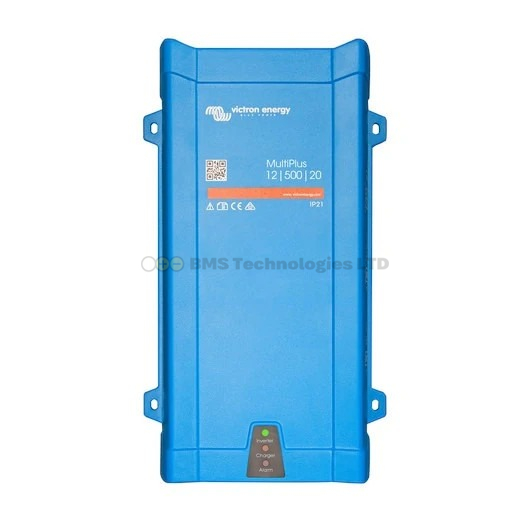
| MultiPlus 12/500 | ~50A | 10mm² | 60A |
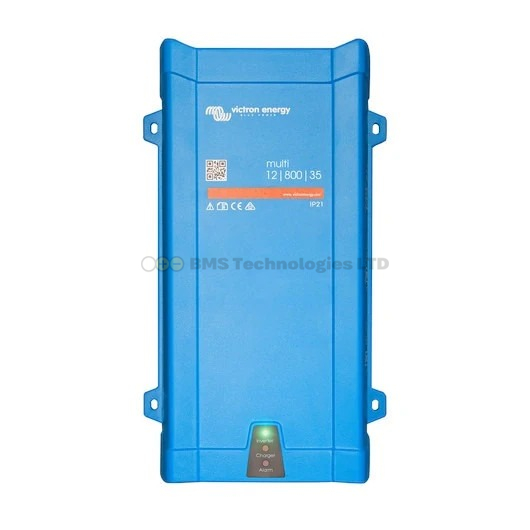
| MultiPlus 12/800 | ~80A | 25mm² | 100A |
| MultiPlus 12/1200 | ~120A | 35mm² | 150A |
| MultiPlus 12/1600 | ~150A | 50mm² | 175A |
| MultiPlus 12/2000 | ~200A | 50mm² | 250A |
| MultiPlus 12/3000 | ~300A | 70mm² | 350A |
Note: 24V and 48V systems draw half or quarter the current respectively for the same power output, so cable sizes are smaller.
Orion DC-DC Chargers
| Model | Output Current | Input Cable | Output Cable | Fuse (input side) |
|---|---|---|---|---|
| Orion-Tr Smart 12/12-18 | 18A | 4mm² | 4mm² | 25A |
| Orion-Tr Smart 12/12-30 | 30A | 6mm² | 6mm² | 40A |
| Orion XS 12/12-50 | 50A | 10mm² | 10mm² | 60A |
Fuse Types for High-Current DC Systems
Not all fuses are suitable for battery systems. DC circuits are harder to interrupt than AC because there is no zero-crossing point. Always use fuses rated for DC at your system voltage or higher.
ANL Fuses
Bolt-in blade-style fuses, available from 35A to 750A. Common in mid-range systems. Affordable and widely available in the UK. Suitable for most campervan and small off-grid installations. Typical DC voltage rating: 32V or 58V.
Mega Fuses
Bolt-in fuses used in the Victron Lynx Distributor. Available from 32A to 500A. These are the standard for Victron Lynx-based installations. DC rated to 32V (58V available for higher voltage systems).
Class T Fuses
High-performance fuses with very high interrupt capacity (up to 20,000A). Required for large battery banks that can deliver extremely high short-circuit currents. Used as the main battery fuse in professional installations with large lithium banks. More expensive but provide the highest level of protection. Available from 110A to 800A.
Common Mistakes
- Using automotive wire: Automotive wire is often CCA (copper-clad aluminium), not pure copper. CCA has significantly higher resistance and lower ampacity for the same cross-section. Always use pure copper cable for battery systems
- Ignoring cable length: A cable size that works for a 0.5m run may cause excessive voltage drop over 3m. Always calculate for the actual cable length in your installation
- Using AC-rated fuses: Standard household fuses (BS 1362) are not rated for DC. They may fail to interrupt a DC fault current, leading to a fire. Always use DC-rated fuses
- No fuse at the battery: Every positive cable leaving the battery must be fused within 30cm of the terminal. No exceptions
- Fuse larger than cable rating: A 200A fuse on a cable rated for 100A provides no protection. The cable will overheat and potentially catch fire long before the fuse blows
- Poor crimp connections: A bad crimp adds resistance at the joint, causing localised heating. Use proper hydraulic crimping tools for cables above 10mm², and always use tinned copper lugs
- Mixing cable sizes in parallel runs: If you run two cables in parallel to share current, they must be the same length and same size. Otherwise current splits unevenly
Quick Reference: System Sizing
For a typical UK campervan or motorhome with a Victron system:
- Battery to bus bar / Lynx Distributor: 35mm² or 50mm² with 200–300A Class T fuse
- Bus bar to MultiPlus 12/2000: 50mm² with 250A Mega fuse
- Bus bar to MPPT 100/30: 6mm² with 40A fuse
- Bus bar to DC fuse box: 6mm² or 10mm² with 60A fuse (depending on total DC loads)
- Alternator to Orion DC-DC 30A: 6mm² with 40A fuse at the starter battery
Always refer to the specific Victron product manual for that product's exact cable size recommendations, and use our price comparison tool to find the best prices on Victron fuses, distribution systems, and accessories.