One of the most common questions in DIY battery system builds is whether you can mix different battery types, brands, or sizes. The short answer is: don't do it. The longer answer involves understanding exactly what happens when you mix batteries and why it causes problems. This guide covers every mixing scenario you might consider and explains what the consequences are for your Victron system.
The Golden Rule of Battery Banks
For the best performance, longevity, and safety, every battery in a bank should be:
- Same chemistry (all AGM, all GEL, all LiFePO4, all flooded lead-acid)
- Same manufacturer and model
- Same capacity (Ah rating)
- Same age (purchased and first used at the same time)
- Same state of health (similar internal resistance and remaining capacity)
Deviation from any of these points causes problems. The more points you deviate from, the worse the outcome.
Never Mix Lithium and Lead-Acid
This is the most dangerous combination and must be avoided completely. Lithium (LiFePO4) and lead-acid batteries have fundamentally different voltage profiles, charge characteristics, and internal resistance values.
Why It Fails
- Voltage profiles don't match: A 12V LiFePO4 battery sits at approximately 13.2–13.4V for 90% of its discharge cycle, then drops rapidly. A 12V lead-acid battery has a gradually declining voltage curve from approximately 12.8V down to 11.8V. When connected in parallel, the lithium battery will supply almost all the current until it hits its BMS low-voltage cutoff, at which point the lead-acid must suddenly take the full load
- Charge voltages differ: LiFePO4 absorbs at 14.2V with no float needed. AGM typically absorbs at 14.4–14.7V and floats at 13.5–13.8V. GEL absorbs at 14.1–14.4V. There is no single charge profile that safely covers both chemistries
- Current sharing is uncontrolled: The battery with lower internal resistance (lithium) will hog both charge and discharge current, defeating the purpose of having two batteries
Your Victron MPPT controller can only be set to one battery type. Your MultiPlus charger can only use one charge profile. There is no safe setting that accommodates both.
Never Mix AGM and GEL
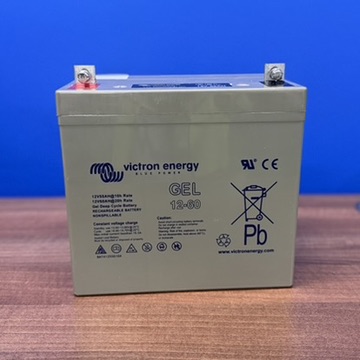
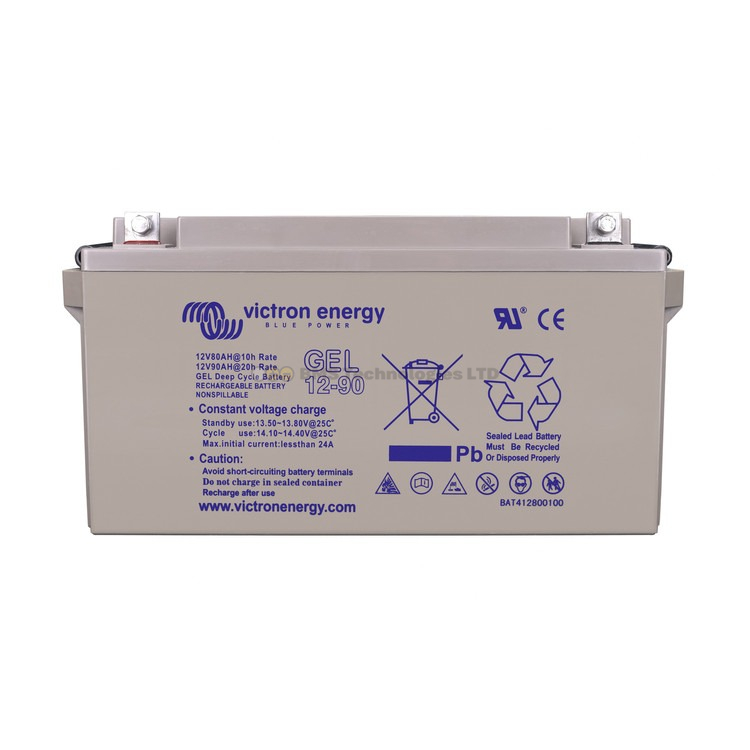
Although both are lead-acid technologies, AGM (Absorbent Glass Mat) and GEL batteries have different charge voltage requirements. GEL batteries are particularly sensitive to over-charging — even a fraction of a volt too high can cause permanent gas pockets in the gel electrolyte, reducing capacity irreversibly.
- AGM absorption voltage: Typically 14.4–14.7V (12V system)
- GEL absorption voltage: Typically 14.1–14.4V (12V system)
If you charge at AGM voltage, you damage the GEL battery. If you charge at GEL voltage, the AGM battery never reaches full charge and will sulphate over time. Neither compromise is acceptable.
Mixing Different Sizes of the Same Type
Connecting a 100Ah battery in parallel with a 200Ah battery of the same type and brand is technically possible, but not recommended. Here's why:
In Parallel
Parallel connection means positive-to-positive and negative-to-negative. Voltage is the same across both batteries, but current splits based on internal resistance. A new 100Ah battery might have different internal resistance than a new 200Ah battery, even from the same manufacturer. Current won't split proportionally to capacity — it splits according to resistance.
The smaller battery may be worked harder relative to its capacity, leading to faster degradation. Over time, the mismatch worsens as one battery ages faster than the other. You end up with a bank where one battery is holding the other back.
In Series
Series connections are far less forgiving. Batteries MUST be identical for series — same model, same capacity, same age. In a series string, the same current flows through every battery. If one battery has lower capacity than the others, it will be fully discharged (or fully charged) first, while the others are not. This causes:
- Over-discharge of the weakest battery
- Over-charge of the weakest battery (it reaches full charge voltage while others are still absorbing)
- Accelerated degradation and potential failure
For lithium batteries in series, the BMS in each battery provides some protection, but relying on the BMS to compensate for mismatched batteries is not a design strategy — it is a failure mode you are deliberately creating.
Mixing Same Model but Different Ages
Suppose you installed two Victron Smart 12.8V 100Ah batteries in parallel two years ago, and now you want to add a third. The new battery will have lower internal resistance, higher actual capacity, and different cell balance compared to the two-year-old batteries.
What Happens
- The new battery will initially take a disproportionate share of charge and discharge current
- Over time, the new battery will degrade faster to "catch up" with the older ones
- You effectively reduce the lifespan of the new battery without significantly improving the bank
- The overall bank capacity is limited by the weakest batteries
When It Might Be Acceptable
If the existing batteries are less than a year old, have been well maintained (proper charge profiles, not deeply discharged regularly), and the new battery is the exact same model, the mismatch may be small enough to be tolerable. This is a grey area — it will work, but it is not optimal. If the existing batteries are more than two years old or have been abused, adding a new battery is throwing money away.
Mixing Different Brands
Even if two batteries are the same chemistry and same capacity, different manufacturers use different cell sources, different BMS designs, and different construction methods. Two "12V 100Ah LiFePO4" batteries from different brands may have quite different actual performance characteristics:
- Different internal resistance
- Different voltage curves under load
- Different BMS cutoff thresholds
- Different maximum charge and discharge rates
One battery's BMS may disconnect at 10.8V while the other disconnects at 10.0V. When the first battery disconnects, its load transfers instantly to the second battery, which may then be overloaded and also disconnect — or be deeply discharged before its own BMS acts.
What to Do When One Battery Fails
If you have a bank of matched batteries and one fails, you face a dilemma: replace just the failed battery (creating a mismatch) or replace the entire bank (expensive but optimal).
Recommended Approach
- Test the remaining batteries: Check internal resistance, capacity, and cell balance using VictronConnect (for Smart/NG batteries) or a battery analyser
- If remaining batteries are in good health (less than 2 years old, good capacity): Replace with the exact same model. The mismatch will be minor and manageable
- If remaining batteries are degraded (more than 3 years old, reduced capacity): Replace the entire bank. Using a new battery alongside degraded ones wastes the new battery's potential
- Consider selling the remaining good batteries second-hand to offset the cost of a complete new bank
When Adding Capacity Is Acceptable
The best time to add battery capacity is when your existing batteries are new and you simply underestimated your energy needs. If you are within the first 6 months and the batteries have been properly maintained:
- Buy the exact same model and brand
- Fully charge all batteries individually before connecting them together
- Ensure all batteries are at the same voltage (within 0.1V) before paralleling
- Use equal-length cables from each battery to the bus bar to ensure even current distribution
Beyond 12 months, adding capacity becomes increasingly problematic. Beyond 2 years, it is almost never worthwhile.
How Victron Systems Handle Mismatched Batteries
Victron charge controllers and inverter/chargers are sophisticated, but they cannot compensate for fundamental battery mismatches. Your MPPT controller sees the battery bank as a single entity — it measures the combined terminal voltage and adjusts its output accordingly. It cannot direct charge current to one battery over another.
Similarly, DVCC on a Cerbo GX coordinates charge voltage and current limits for the whole bank, but it cannot manage individual batteries within a parallel bank (unless each has its own BMS communicating separately, which introduces other complexities).
Summary Table
| Mixing Scenario | Parallel | Series | Verdict |
|---|---|---|---|
| Lithium + Lead-acid | Never | Never | Dangerous — do not attempt |
| AGM + GEL | Never | Never | Incompatible charge profiles |
| Same model, different size | Not recommended | Never | Uneven current sharing |
| Same model, different age (<1yr) | Acceptable | Caution | Minor mismatch, monitor closely |
| Same model, different age (>2yr) | Not recommended | Never | Significant degradation mismatch |
| Different brands, same chemistry | Not recommended | Never | Different BMS and performance |
| Identical batteries, same age | Ideal | Ideal | This is the correct approach |
Final Advice
Plan your battery bank for your expected needs from the start. It is far better to buy the right capacity initially than to try to expand later with mismatched batteries. If you are unsure how much capacity you need, use our system builder tool to estimate your requirements. And when it comes time to buy, use our price comparison to find the best deals on matching batteries from the same retailer, ensuring consistent stock and batch matching.