For many narrowboat owners, shore power is their primary charging source — especially during winter moorings. Setting up a Victron MultiPlus to manage shore power charging properly ensures your batteries stay healthy, your appliances work seamlessly, and you don't trip the marina's circuit breakers every time you boil a kettle. This guide covers the complete process from plugging in to configuring the system.
Understanding UK Narrowboat Shore Power
UK canal marinas and residential moorings typically provide shore power through 16A blue commando sockets (CEE17/IEC 60309 connectors). Some older sites still use standard 13A domestic sockets, while larger marinas or widebeam moorings may offer 32A supplies.
What You Actually Get
| Socket Type | Maximum Current | Maximum Power (230V) |
|---|---|---|
| 13A domestic (rare) | 13A | 2990W |
| 16A blue commando (standard) | 16A | 3680W |
| 32A blue commando (larger berths) | 32A | 7360W |
In practice, the supply may be shared between several boats, and long cable runs from the bollard to your boat introduce voltage drop. Expecting more than 14A continuous from a 16A supply is optimistic. Your system must be configured to respect this limit.
The Victron MultiPlus: Your Shore Power Hub
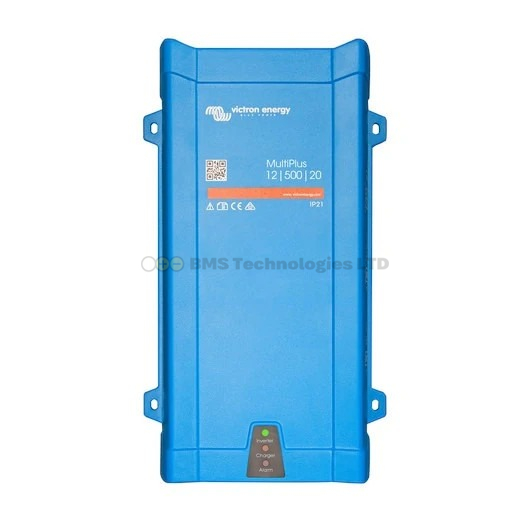
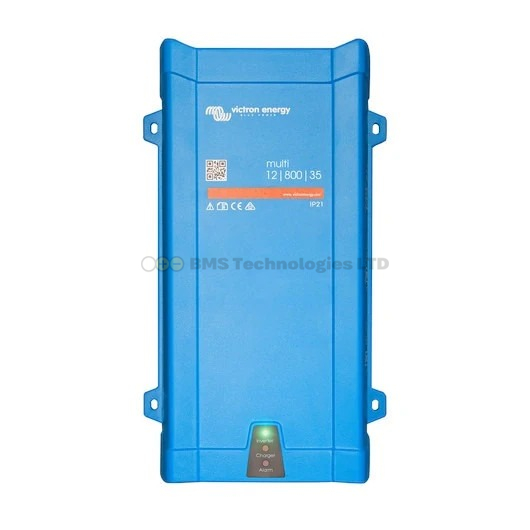
The Victron MultiPlus is the ideal shore power solution for narrowboats because it combines three functions:
- Battery charger — charges your house bank from shore power with proper multi-stage charging
- Inverter — provides 230V AC from batteries when not on shore power
- Transfer switch — seamlessly switches between shore power and inverter output so your appliances never notice the change
When you plug into shore power, the MultiPlus automatically switches from inverter mode to charger + passthrough mode. Shore power flows through to your AC sockets while simultaneously charging the batteries. Unplug the cable, and the MultiPlus seamlessly transitions to inverter mode — no interruption to connected loads.
Step-by-Step Setup
1. Shore Power Inlet and Cable
Install a waterproof shore power inlet on the outside of your narrowboat — typically on the stern near the tiller. Use marine-grade 16A or 32A inlets designed for boats. The cable from the inlet runs to the MultiPlus AC input terminals.
For the cable from the bollard to your boat, use a 25m arctic-grade extension lead rated for 16A. Longer runs (common on linear moorings where you're on the towpath side) need heavier cable to avoid excessive voltage drop. Never coil excess cable — coiled cable overheats.
2. MultiPlus Installation
Mount the MultiPlus in the engine bay or a dedicated electrical cupboard close to the battery bank. Keep DC cable runs under 2 metres if possible. The MultiPlus needs:
- Ventilation — it generates heat during charging and inverting. Ensure at least 100mm clearance above and around the unit
- Protection from direct water — the MultiPlus is not waterproof. Mount it above the bilge waterline
- Short, heavy DC cables — see the installation manual for minimum cable sizes
3. AC Distribution
The MultiPlus AC output connects to your boat's consumer unit (fuse board). From there, individual circuits supply your 230V sockets, water heater, battery charger for the bow thruster bank, and any other AC loads. Install an RCD (residual current device) on the output side for safety — the MultiPlus has one built in, but a second in the consumer unit provides belt-and-braces protection.
4. Earth and Bonding
The MultiPlus chassis ground terminal should be connected to the boat's bonding system (which connects all metalwork and underwater fittings). On a steel narrowboat, this means connecting to the hull. Consider adding a galvanic isolator or isolation transformer to prevent galvanic corrosion through the shore power earth.
Key Configuration Settings
Configure the MultiPlus using VictronConnect (via a VE.Bus to USB MK3 adapter or through a connected GX device). These settings are critical for narrowboat shore power:
Input Current Limit
This is the most important setting. It tells the MultiPlus the maximum current it can draw from the shore power supply. Set it to:
- 13A for domestic socket supplies
- 14-15A for 16A commando supplies (leave headroom for the breaker)
- 30A for 32A supplies
If the MultiPlus is set to 15A input limit but your combined load (passthrough + charging) would exceed 15A, the MultiPlus automatically reduces its charging current to keep within the limit. This is the PowerControl feature and it prevents tripping the shore breaker.
PowerAssist
Enable PowerAssist if your shore power is limited. When the total AC demand exceeds the input current limit, the MultiPlus supplements shore power with battery power. For example: shore power provides 15A, you switch on a 10A load — the MultiPlus draws 10A from shore and 0A from the battery. You then add a 9A kettle — total demand is 19A, exceeding the 15A limit. PowerAssist kicks in: the MultiPlus draws 15A from shore and supplies the extra 4A from the battery via the inverter.
Charger Settings
Configure the battery charger for your battery type:
| Battery Type | Absorption Voltage (12V) | Float Voltage (12V) | Absorption Time |
|---|---|---|---|
| Flooded lead-acid | 14.4V | 13.5V | 4-6 hours |
| AGM | 14.4V | 13.6V | 4-6 hours |
| Gel | 14.1V | 13.5V | 4-6 hours |
| Victron Lithium | 14.2V | 13.5V | 1-2 hours |
The maximum charge current setting depends on your battery bank capacity. As a general rule, charge at no more than 0.2C for lead-acid (20% of capacity — so 60A for a 300Ah bank) or 0.5C for lithium.
Integration with Engine Alternator Charging
Your narrowboat's engine alternator is another key charging source. When cruising, the alternator charges the house bank (via a Victron Orion-Tr Smart DC-DC charger or a Cyrix battery combiner). The MultiPlus and the DC-DC charger coordinate naturally — both are visible through the Cerbo GX, and the battery management system (for lithium) manages acceptance from all sources.
There's no conflict between shore charging and engine charging. If you start the engine while plugged into shore power, both the MultiPlus charger and the DC-DC charger contribute. The batteries accept what they need based on their state of charge.
Winterisation: Leaving on Shore Power
Many narrowboat owners leave their boats on shore power over winter for:
- Battery maintenance — the MultiPlus keeps the bank at float voltage, preventing sulphation (lead-acid) or deep discharge
- Frost protection — running a low-wattage heater or the boat's diesel heating on a timer
- Bilge pump power — ensures the bilge pump works if water ingress occurs
Winter Settings
In storage mode, reduce the charge current to minimum (5A is typical) to reduce wear on the charger. Enable the storage mode in VictronConnect — this drops the float voltage slightly after 24 hours to reduce water loss in lead-acid batteries and reduce stress on lithium cells. If you have a Cerbo GX with VRM access, you can monitor the system remotely to confirm everything is healthy without visiting the boat.
Troubleshooting Common Shore Power Issues
Marina Breaker Keeps Tripping
Lower the input current limit on the MultiPlus. Start at 10A and increase until you find the maximum that doesn't trip the breaker. Remember that other boats may share your pontoon supply, reducing available current.
Low Shore Voltage
Long cable runs from the marina switchboard to your bollard, combined with other boats drawing power, can drop the voltage below 230V. The MultiPlus accepts input voltage down to 180V by default (adjustable). If the voltage drops below this, the MultiPlus disconnects from shore and switches to inverter mode. A shorter, heavier shore power cable helps reduce your end of the voltage drop.
MultiPlus Won't Accept Shore Power
Check the input current limit isn't set to zero. Check the shore power cable and inlet connections. Verify the RCD on the shore bollard isn't tripped. If the MultiPlus displays a fault, check VictronConnect for error codes — common causes include earth leakage (RCD trip) and over-voltage.
For choosing the right MultiPlus for your boat, read our MultiPlus 12V vs 24V marine guide. For a complete system overview, see our narrowboat system guide. And for understanding inverter power ratings, our marine inverter ratings guide explains VA ratings and power factor in detail.