Sizing an off-grid solar system correctly is the single most important step in any Victron installation. Get it wrong and you will either run out of power on cloudy winter days or overspend on components you never fully use. This guide walks through the complete sizing methodology, tailored to UK conditions, using Victron components throughout.
Step 1: Calculate Your Daily Energy Consumption
Every off-grid system starts with an honest audit of what you actually use. List every electrical load, its wattage, and how many hours per day it runs. Multiply watts by hours to get watt-hours (Wh) per day.
| Appliance | Watts | Hours/Day | Wh/Day |
|---|---|---|---|
| LED lighting (6 bulbs) | 60 | 5 | 300 |
| Laptop | 65 | 4 | 260 |
| Fridge/freezer (A++ rated) | 50 | 8 | 400 |
| Phone/tablet charging | 15 | 3 | 45 |
| Router/modem | 12 | 24 | 288 |
| Water pump | 60 | 0.5 | 30 |
| TV | 40 | 3 | 120 |
In this example, daily consumption totals 1,443 Wh (roughly 1.4 kWh). This is a realistic figure for a small off-grid cabin without electric heating.
Accounting for Inverter Losses
If you are running AC appliances through a Victron MultiPlus or Phoenix Inverter, you need to add approximately 10-15% for inverter inefficiency. A MultiPlus-II is typically 93-95% efficient at moderate loads, but efficiency drops at very low loads.
Adjusted daily consumption: 1,443 Wh x 1.12 = 1,616 Wh (we will use 1,620 Wh for round numbers).
Seasonal Variation
UK off-grid systems must account for seasonal load changes. In winter you will likely use more lighting (longer dark hours) and possibly a small electric fan heater on occasion. In summer, the fridge works harder. It is worth calculating separate winter and summer load profiles if they differ significantly.
Step 2: Size the Battery Bank
The battery bank must store enough energy to cover your consumption during periods of low solar production. Two factors determine battery size: days of autonomy and depth of discharge (DOD).
Days of Autonomy
This is the number of consecutive days the battery must power your loads with no solar input whatsoever. For a UK off-grid system:
- Summer-only use — 2 days of autonomy is usually sufficient
- Year-round use — 3 to 5 days is recommended. The UK regularly experiences 3-4 consecutive overcast days in winter, particularly in Scotland, Wales, and northern England
- Critical loads (medical equipment, livestock systems) — 5+ days, with a backup generator
Depth of Discharge
You cannot use 100% of a battery's rated capacity. The usable portion depends on battery chemistry:
| Battery Type | Recommended Max DOD | Usable Capacity |
|---|---|---|
| Flooded lead-acid | 50% | 50% of rated Ah |
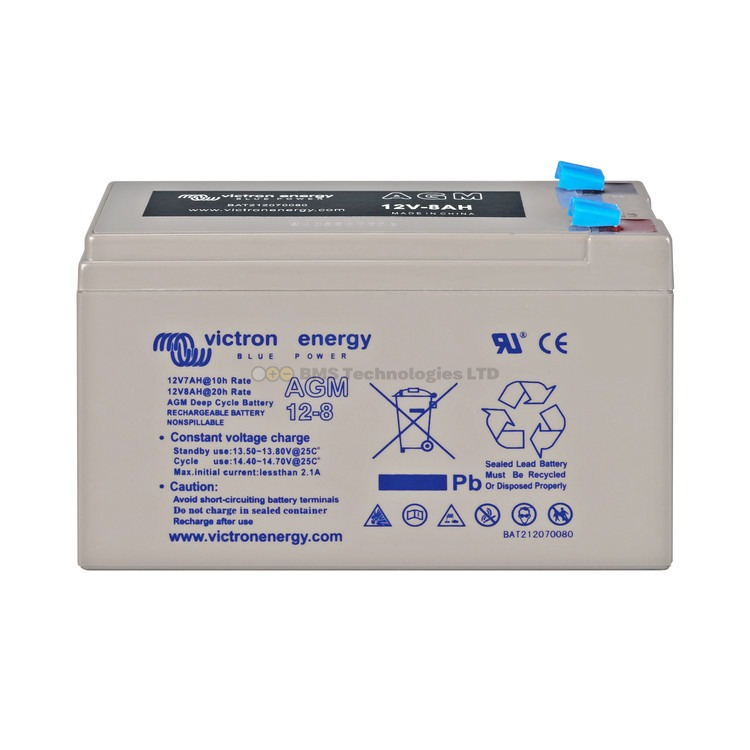
| AGM (Victron AGM) | 50% | 50% of rated Ah |
| Gel (Victron Gel) | 50% | 50% of rated Ah |
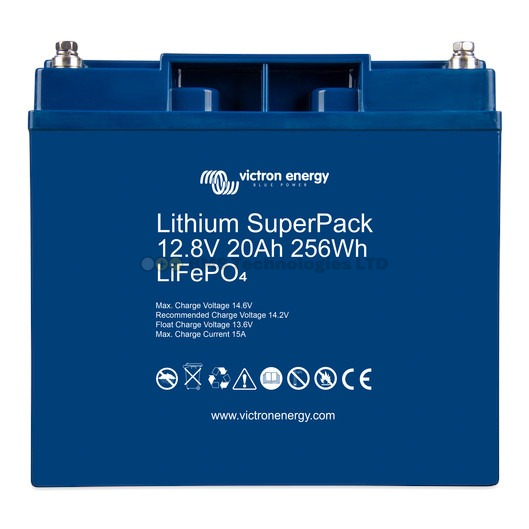
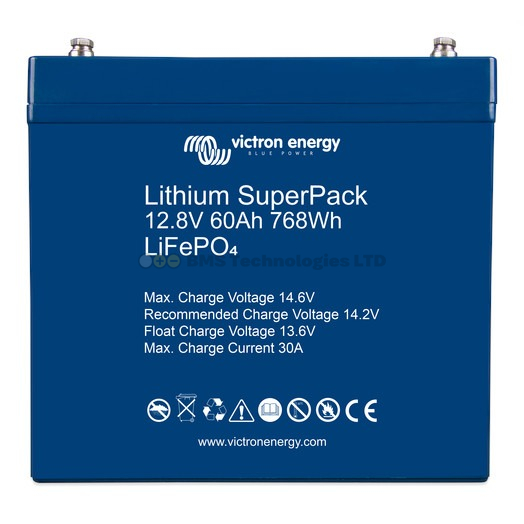
| Victron Lithium Smart | 80% | 80% of rated Ah |
| Victron Smart LiFePO4 | 80-90% | 80-90% of rated Ah |
Battery Sizing Formula
The formula is:
Required battery capacity (Wh) = Daily consumption (Wh) x Days of autonomy / DOD
For our example cabin with 3 days of autonomy using Victron Lithium batteries (80% DOD):
1,620 Wh x 3 / 0.80 = 6,075 Wh
To convert to Ah at your system voltage: 6,075 Wh / 48V = 126.5 Ah, or 6,075 / 24V = 253 Ah, or 6,075 / 12V = 506 Ah.
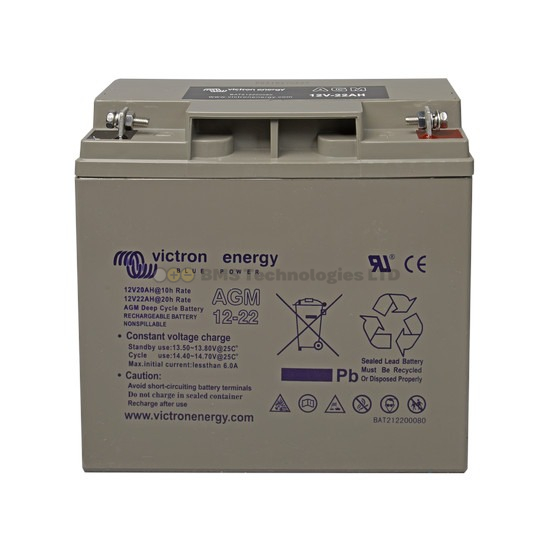
For a 48V system, a single Victron Smart Lithium 25.6V/200Ah battery (5,120 Wh) falls slightly short. Two in series-parallel would give 10,240 Wh — more than enough with generous headroom for degradation and cold weather.
For lead-acid batteries at 50% DOD, the same calculation yields: 1,620 x 3 / 0.50 = 9,720 Wh — significantly more battery required, which is one reason lithium is increasingly popular for off-grid installations.
Step 3: Size the Solar Array
Solar array sizing depends on your location's peak sun hours (PSH) — the number of hours per day where solar irradiance averages 1,000 W/m². The UK's PSH values vary dramatically by season and region.
UK Peak Sun Hours by Region
| Region | Annual Average PSH | December PSH | June PSH |
|---|---|---|---|
| South East England | 2.9 | 0.6 | 5.2 |
| South West England | 3.0 | 0.7 | 5.3 |
| Midlands | 2.6 | 0.5 | 4.8 |
| North England | 2.4 | 0.4 | 4.5 |
| Wales | 2.5 | 0.5 | 4.6 |
| Scotland (central) | 2.3 | 0.3 | 4.5 |
| Scotland (highlands) | 2.1 | 0.2 | 4.3 |
| Northern Ireland | 2.3 | 0.4 | 4.4 |
The critical figure is December PSH. If your system must work year-round without a generator, you size for the worst month. If you have a backup generator for winter, you can size for the annual average and accept that the generator will run occasionally from November to February.
Solar Array Sizing Formula
Required solar array (W) = Daily consumption (Wh) / (PSH x System efficiency)
System efficiency accounts for cable losses, MPPT conversion losses, temperature derating, and dust/dirt. Use 0.75 as a realistic combined efficiency factor for a well-installed UK system.
For our cabin in the Midlands, sizing for December: 1,620 / (0.5 x 0.75) = 4,320W
That is an enormous array just for a small cabin — and illustrates exactly why most year-round UK off-grid systems include a generator for winter. If we size for the annual average instead: 1,620 / (2.6 x 0.75) = 831W
A practical approach is to install around 1,000-1,200W of solar and accept generator use in December and January. This keeps the system affordable while providing solar independence for 9-10 months of the year.
Panel Selection
For off-grid roof-mounted installations, rigid monocrystalline panels offer the best efficiency per square metre. A typical 400W panel measures roughly 1.7m x 1.1m. Three 400W panels (1,200W total) require approximately 5.6m2 of unshaded roof space. Check our solar panel comparison for current options.
Step 4: Size the MPPT Charge Controller
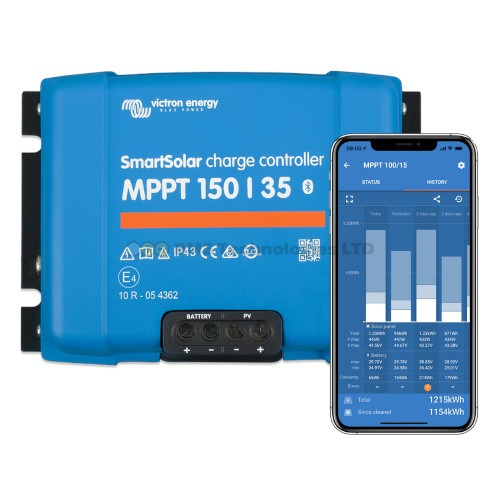
The Victron SmartSolar MPPT charge controller must be rated for both the solar array's open-circuit voltage (Voc) and the maximum charge current.
Voltage Rating
Add up the Voc of all panels wired in series. A typical 400W panel has a Voc of approximately 49V. Two in series = 98V, three in series = 147V. Always allow a cold temperature margin — Voc increases in cold weather. In the UK, panels can reach -10 degrees C in winter. Add 10% to the calculated Voc.
Current Rating
The MPPT output current must handle the total solar power divided by the battery voltage. For 1,200W into a 48V battery: 1,200 / 48 = 25A. A Victron SmartSolar MPPT 150/35 handles this comfortably.
Recommended MPPT Controllers by Array Size
| Solar Array | 48V System | 24V System | 12V System |
|---|---|---|---|
| Up to 500W | MPPT 100/20 | MPPT 100/20 | MPPT 75/15 |
| 500-1,000W | MPPT 150/35 | MPPT 100/30 | MPPT 100/30 |
| 1,000-1,500W | MPPT 150/35 | MPPT 150/35 | MPPT 150/45 |
| 1,500-2,000W | MPPT 250/60 | MPPT 150/60 | MPPT 150/70 |
| 2,000-3,000W | MPPT 250/70 | MPPT 250/70 | N/A — use 24V |
Use the Victron MPPT sizing tool on their website to verify your specific panel and battery combination, as Voc and Isc vary between panel models.
Step 5: Size the Inverter/Charger
The inverter must handle your peak simultaneous load, not your average consumption. Add up the wattage of everything that might run at the same time. For our cabin:
- Fridge (50W) + lights (60W) + laptop (65W) + kettle (2,000W) = 2,175W peak
- Without the kettle: 175W continuous
A Victron MultiPlus-II 48/3000 handles the 2,175W peak easily and provides 3,000W continuous. It also includes a built-in charger for generator or grid top-up. For smaller systems, the MultiPlus 12/1600 or 24/1600 may suffice if you avoid high-wattage heating appliances.
If you never intend to use a kettle, toaster, or other high-draw appliances on inverter power, a smaller unit saves money and runs more efficiently at partial load. See our inverter sizing guide for detailed recommendations.
Worked Example: Small UK Off-Grid Cabin
Scenario
A two-bedroom off-grid cabin in rural Wales, used year-round. No mains gas or electric connection. Wood-burning stove for heating. LPG for cooking. Backup petrol generator available.
Load Audit Result
Daily consumption: 2,400 Wh (winter) / 1,800 Wh (summer), accounting for inverter losses.
Battery Bank
3 days of autonomy, lithium at 80% DOD: 2,400 x 3 / 0.80 = 9,000 Wh. Two Victron Smart Lithium 25.6/200 batteries in series for a 51.2V system gives 10,240 Wh. This provides 4.3 days of autonomy in summer and 3.2 days in winter — a comfortable margin.
Solar Array
Wales annual PSH: 2.5. Sizing for annual average with generator backup: 2,400 / (2.5 x 0.75) = 1,280W. Install 4 x 370W panels = 1,480W. This produces a surplus in summer (stored in batteries) and falls short in December-January (generator tops up).
MPPT Controller
Four 370W panels (Voc ~49V each). Two strings of two in series: Voc per string = 98V. With cold weather margin: 108V. A Victron SmartSolar MPPT 150/35 handles both strings easily (two parallel inputs, 150V max, 35A output into 48V battery).
Inverter/Charger
Peak load including kettle: 2,600W. A Victron MultiPlus-II 48/3000/35 provides 3,000W continuous with a 35A charger for generator top-up. The built-in transfer switch automatically switches between inverter and generator power.
Monitoring
A Victron Cerbo GX connects to the MPPT, MultiPlus, and battery BMS via VE.Direct and VE.Bus cables. Remote monitoring through VRM shows battery state of charge, solar yield, consumption, and generator run hours. A SmartShunt provides accurate state-of-charge readings.
Common Sizing Mistakes
- Using summer PSH figures for year-round systems — the most common error. UK winter solar output is roughly 10-15% of summer output
- Forgetting phantom loads — routers, standby power, smoke alarms, and the GX device itself all draw power 24/7
- Undersizing the battery for lead-acid — regularly discharging lead-acid below 50% dramatically shortens lifespan
- Ignoring cable losses — long cable runs between panels and controller, or between batteries and inverter, cause real voltage drop and power loss. Use appropriately thick cables and keep runs as short as possible
- Not allowing for battery degradation — lithium batteries lose roughly 20% capacity over 10 years. Size with this in mind
- Oversizing everything as a safety margin — spending an extra £2,000 on batteries you never need is poor value. Size correctly with a modest 15-20% margin
System Voltage: 12V, 24V, or 48V?
The choice of system voltage affects cable sizing, component availability, and cost:
- 12V — suitable for very small systems under 1,000W. Simple, and most caravan/marine equipment runs natively on 12V. But cables must be thick for any meaningful power
- 24V — the sweet spot for cabin systems between 1,000W and 3,000W. Halves the current (and cable size) compared to 12V. Good component availability from Victron
- 48V — recommended for systems above 3,000W. Quarter the current of 12V. Required for larger MultiPlus-II and Quattro models. Best efficiency overall
For our example cabin at 2,400 Wh/day with a 3,000W inverter, 48V is the right choice. It keeps cable sizes manageable and opens up the full range of Victron inverter/chargers.
Next Steps
Once you have completed your sizing calculations, use our Victron System Builder to spec out compatible components and compare prices across UK retailers. If you are new to Victron, start with our getting started guide for an overview of the ecosystem before diving into component selection.