Choosing the right amperage for your Victron battery charger affects charge time, battery lifespan, and cost. Too small and your batteries take forever to charge. Too large and you waste money — or worse, stress your batteries. This guide helps you select the ideal charger size.
The Basic Rule
For most battery types, the ideal charge rate is 10–20% of the battery's Ah capacity. This is known as the C-rate:
- C/10 (10% of capacity): Gentle, maximises battery life. A 200Ah battery would need a 20A charger.
- C/5 (20% of capacity): Faster charging, still within safe limits. A 200Ah battery would need a 40A charger.
For Victron LiFePO4 lithium batteries, you can charge faster — up to C/2 (50% of capacity) — though C/5 to C/3 is more typical in practice.
Recommended Charger Sizes by Battery Type
| Battery Type | Capacity | Minimum Charger | Recommended Charger | Maximum Charger |
|---|---|---|---|---|
| AGM | 100Ah | 10A | 15–20A | 30A |
| AGM | 200Ah | 20A | 30A | 50A |
| GEL | 100Ah | 10A | 15A | 25A |
| GEL | 200Ah | 20A | 25–30A | 40A |
| LiFePO4 | 100Ah | 10A | 20–30A | 50A |
| LiFePO4 | 200Ah | 20A | 30–50A | 100A |
| LiFePO4 | 300Ah | 30A | 50A | 150A |
Charger Type Matters
Victron makes several charger ranges for different applications:
Blue Smart IP22 (Shore Power / Mains Charger)
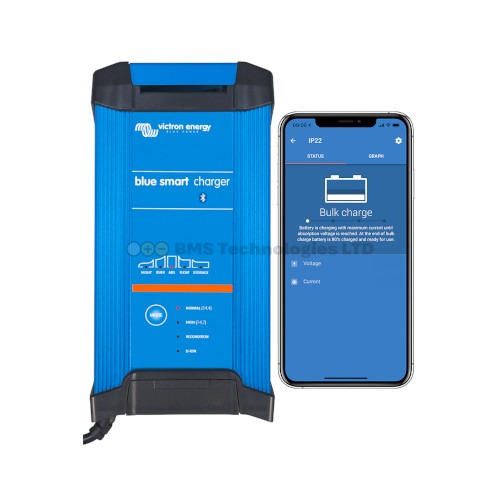
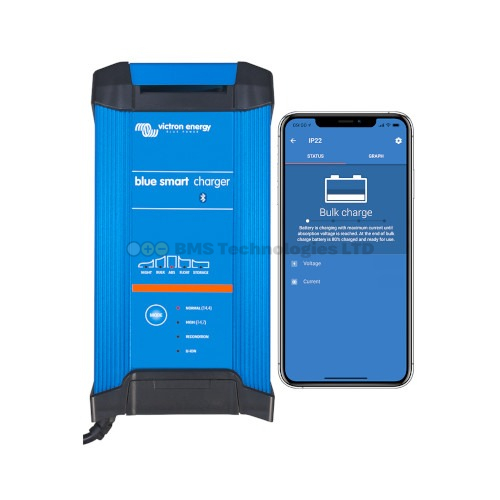
Available at 15A, 20A, and 30A (12V). These are your main mains-powered chargers for plugging into shore power or a home socket. The IP22 vs IP65 vs IP67 guide covers which IP rating to choose.
Blue Smart IP65 / IP67 (Waterproof Mains Charger)
Lower amperage options (5A to 25A) in weatherproof enclosures. Use where the charger may get damp.
Phoenix Smart IP43 (High-Power Mains Charger)
Available at 30A and 50A (12V) or 16A and 25A (24V). These are the heavy-duty mains chargers for larger battery banks or faster charging. The "1+1" designation means they have one main output plus one auxiliary output for a starter battery.
MultiPlus Built-in Charger
If you have a MultiPlus or MultiPlus-II, it includes a built-in battery charger rated from 20A to 200A depending on the model. This is often sufficient as your primary shore power charger, and you may not need a separate Blue Smart charger at all.
Matching Charger to Shore Power Supply
Your charger's input power is limited by your shore power supply. In the UK:
- Standard 13A socket: Maximum ~3,000W input → supports chargers up to about 200A at 12V (though no single Blue Smart is this large)
- Campsite hookup (10A): Maximum ~2,300W → supports chargers up to about 150A at 12V
- Campsite hookup (16A): Maximum ~3,680W → supports any Blue Smart charger
In practice, the Blue Smart range tops out at 30A (12V), drawing about 500W from the mains. This is well within any shore power supply, so power availability is rarely a constraint for standalone chargers.
However, if you have a MultiPlus charging at 50A+ while also running AC loads, you may hit the shore power limit. Use PowerControl to manage this.
Oversizing vs Undersizing
Undersizing (Too Small)
An undersized charger isn't harmful — it just charges slowly. A 10A charger on a 200Ah lithium battery takes about 16 hours from 20% to 100%. If you're on shore power overnight, this might be fine. If you need faster turnaround, size up.
Oversizing (Too Large)
For lead-acid batteries, significantly oversizing the charger (above C/3) can cause excessive heating and gassing, reducing battery life. Stay within the manufacturer's recommended maximum charge current.
For lithium batteries, the BMS limits charge current regardless of the charger size. A 50A charger on a 100Ah lithium battery with a 50A BMS limit will charge at 50A. A 50A charger on a battery with a 30A BMS limit will be capped at 30A by the BMS. So oversizing a lithium charger doesn't harm the battery — you just pay for capacity you don't use.
Victron Blue Smart Charger Selection Guide
| Your Battery | Recommended Charger | Charge Time (20% → 100%) |
|---|---|---|
| 100Ah AGM | Blue Smart IP22 12/15 | ~6 hours |
| 200Ah AGM | Blue Smart IP22 12/20 or 12/30 | ~8 hours (20A) or ~6 hours (30A) |
| 100Ah LiFePO4 | Blue Smart IP22 12/20 | ~4 hours |
| 200Ah LiFePO4 | Blue Smart IP22 12/30 or Phoenix IP43 12/50 | ~5.5 hours (30A) or ~3.5 hours (50A) |
| 300Ah LiFePO4 | Phoenix Smart IP43 12/50 | ~5 hours |
Charge times assume charging from 20% SOC to 100% and include the slower absorption phase where current tapers off.
Do You Need a Separate Charger If You Have a MultiPlus?
Usually not. The MultiPlus has a built-in charger that operates whenever shore power or generator power is connected. The only reasons to add a separate Blue Smart charger:
- Charging a separate starter battery — the IP22 three-output model is ideal for this.
- Portable use — taking a charger between vehicles or to a workshop.
- Backup/redundancy — a second charging source in case the MultiPlus has issues.
- No MultiPlus in the system — if you only have a Phoenix inverter (no built-in charger), you need a separate charger for shore power.
Summary
Size your Victron charger at 10–20% of battery capacity for lead-acid or 20–50% for lithium. For most campervan and boat builds with a 100–200Ah bank, a Blue Smart IP22 12/20 or 12/30 is the sweet spot. If you have a MultiPlus, its built-in charger may be all you need — only add a separate charger for starter batteries, portable use, or systems without a MultiPlus.