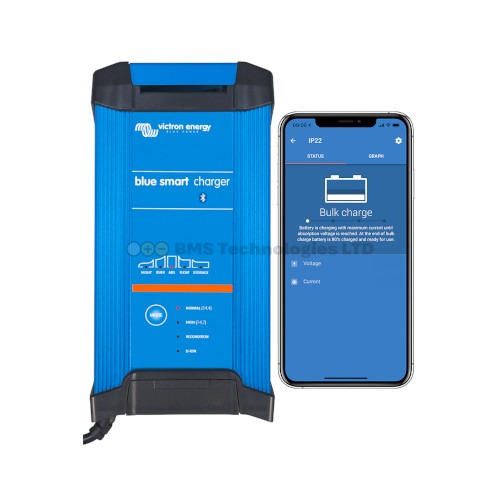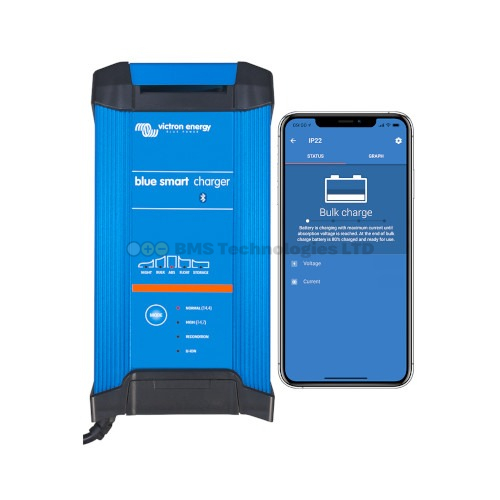
The Victron Blue Smart IP22 charger comes in both single-output and three-output versions. The three-output model is one of the most useful chargers for boats and motorhomes with multiple battery banks. This guide explains how it works and when you need one.
What Is a Three-Output Charger?
The Blue Smart IP22 three-output charger has one main output and two auxiliary outputs. Each output is independently regulated, meaning each connected battery gets the correct charge voltage and current for its state of charge, regardless of what the other batteries are doing.
This is not the same as splitting a single output with a distribution bus bar — the three-output charger genuinely manages three separate charging circuits.
Available Three-Output Models
| Model | Main Output | Aux Output 1 | Aux Output 2 | Battery Voltage |
|---|---|---|---|---|
| IP22 12/15(3) | 15A | 4A | 4A | 12V |
| IP22 12/20(3) | 20A | 4A | 4A | 12V |
| IP22 12/30(3) | 30A | 4A | 4A | 12V |
| IP22 24/12(3) | 12A | 4A | 4A | 24V |
| IP22 24/16(3) | 16A | 4A | 4A | 24V |
The main output provides the full rated current for your primary (leisure) battery bank. The two auxiliary outputs provide up to 4A each — enough to maintain and charge smaller batteries like starter batteries and bow thruster batteries.
How the Outputs Work
Main Output
The main output follows the full Victron adaptive charging algorithm (bulk → absorption → float → storage). This is your primary leisure battery connection. The battery type (lithium, AGM, GEL, etc.) is set via the VictronConnect app, and the charger adjusts voltages and timing automatically.
Auxiliary Outputs
Each auxiliary output is independently regulated and follows its own charge cycle. The auxiliary outputs can charge batteries of a different type to the main output — for example, your main output can charge a lithium leisure battery while an auxiliary charges a lead-acid starter battery.
The auxiliary outputs are current-limited to 4A each. This is intentional — starter batteries and auxiliary batteries are typically smaller and don't need high charge currents. 4A is enough to maintain a healthy starter battery and top it up overnight.
Common Three-Output Configurations
Boat: Leisure + Starter + Bow Thruster
- Main output: 200Ah leisure battery bank (lithium or AGM)
- Aux 1: Engine starter battery (lead-acid)
- Aux 2: Bow thruster battery (lead-acid or AGM)
This is the classic marine setup. One charger, one shore power connection, three batteries properly charged.
Motorhome: Leisure + Starter + Cab Battery
- Main output: Leisure battery bank
- Aux 1: Vehicle starter battery
- Aux 2: Unused (or connected to a small backup battery)
Workshop: Main Battery + Two Maintenance
- Main output: Battery being actively charged
- Aux 1 & 2: Two batteries on maintenance/float charge
Three-Output vs Separate Chargers
You could achieve the same result with three separate chargers — one per battery. But the three-output model offers clear advantages:
- One mains connection: Only uses one shore power socket.
- Less space: One unit instead of three.
- Lower cost: Cheaper than buying three separate chargers.
- Simpler wiring: One AC input, three DC outputs.
The only downside is the 4A limit on auxiliary outputs. If your auxiliary batteries need more than 4A charging (e.g., a 200Ah bow thruster bank), you'd need a separate charger for that battery.
Setting Up via VictronConnect
Connect to the charger via Bluetooth and open VictronConnect. You can configure:
- Main output battery type: Lithium, AGM, GEL, flooded, or custom
- Auxiliary output mode: Each aux can be set independently to charge a specific battery type, or set to "fixed voltage" for non-standard applications
- Current limits: Reduce the main output current if needed (useful for smaller batteries)
Each output's charge state is visible in the app — you can see which batteries are in bulk, absorption, or float at any time.
When You Don't Need Three Outputs
If you only have one battery (or one battery bank), the single-output version is simpler and slightly cheaper. The three-output model doesn't offer any advantage with just one battery connected.
If your auxiliary batteries are already charged by other means (e.g., starter battery charged by the alternator, which runs daily), the extra outputs are redundant.
Summary
The Blue Smart IP22 three-output charger is the ideal solution for boats and motorhomes with multiple battery banks connected to shore power. The main output fully charges your leisure bank, while two 4A auxiliary outputs maintain your starter and auxiliary batteries. It's simpler, cheaper, and more space-efficient than running multiple separate chargers. Choose the three-output version whenever you have two or more batteries that need shore power charging.