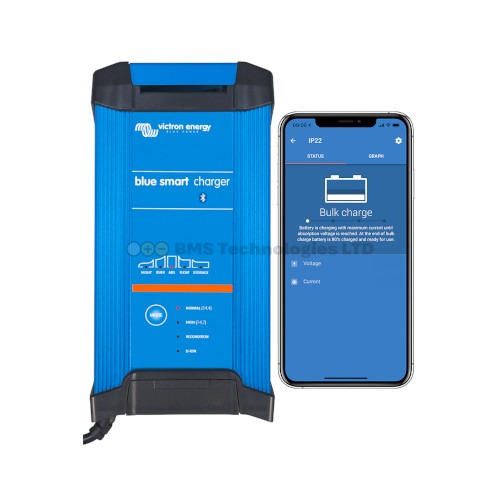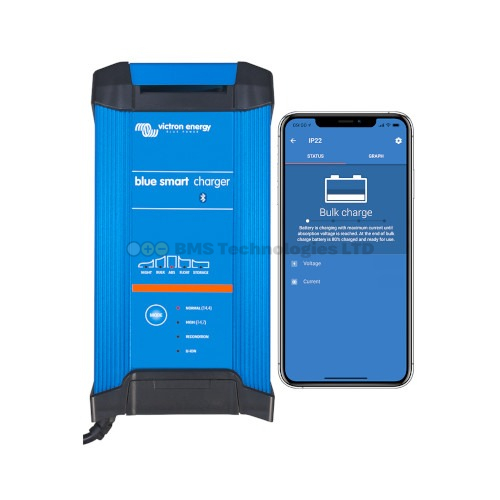
Victron's Blue Smart charger range comes in three IP ratings — IP22, IP65, and IP67 — each designed for different environments. They all use the same excellent adaptive charging algorithm, but they differ in weatherproofing, size, and features. This guide helps you pick the right one.
Quick Overview
| Feature | Blue Smart IP22 | Blue Smart IP65 | Blue Smart IP67 |
|---|---|---|---|
| Protection rating | IP22 (indoor only) | IP65 (dust-tight, water jets) | IP67 (submersible to 1m) |
| Intended location | Indoor / dry spaces | Engine rooms, under seats | Exposed bilges, outdoor |
| Outputs | 1 or 3 outputs | 1 output | 1 output |
| Bluetooth | Yes | Yes | Yes |
| 12V range | 15A, 20A, 30A | 5A, 7A, 10A, 15A, 25A | 7A, 13A, 17A, 25A |
| 24V range | 8A, 12A, 16A | 5A, 8A, 13A | 5A, 8A, 12A |
| Supply mode | Yes | Yes | Yes |
| VE.Direct port | No | No | No |
| Can be permanently mounted | Yes (indoors) | Yes (any location) | Yes (any location) |
| Cooling | Fan-cooled | Sealed (convection) | Sealed (convection) |
Blue Smart IP22: The Indoor Charger
The IP22 is designed for dry, indoor environments — a garage, workshop, or dry electrical cupboard. It's Victron's most powerful Blue Smart charger, with models up to 30A at 12V.
Key Advantages
- Highest amperage options: Up to 30A at 12V, the most charging power in the Blue Smart range.
- Three-output models: The IP22 is the only Blue Smart charger available with three independent outputs. Each output has its own regulation, so you can charge three separate batteries simultaneously (e.g., starter battery, leisure battery, and bow thruster battery).
- Fan-cooled: Active cooling means the IP22 can sustain full output current even in warmer conditions. The sealed IP65 and IP67 models may derate in high ambient temperatures.
- Most affordable per amp: The IP22 typically offers the best value for the charging current.
Limitations
- Not waterproof: IP22 means it's only protected against objects larger than 12mm and dripping water. It cannot be exposed to rain, spray, or condensation.
- Fan noise: The cooling fan produces a gentle hum when the charger is working hard. In a quiet boat cabin, this can be noticeable.
Best For
Motorhomes and campervans with a dry electrical cupboard. Boats with a dry engine room or nav station. Home garages for maintaining vehicle and leisure batteries.
Blue Smart IP65: The Versatile Middle Ground
The IP65 is dust-tight and protected against water jets. It can handle splashes, condensation, and damp environments — but it shouldn't be submerged.
Key Advantages
- Sealed enclosure: No fan, no vents, no way for moisture or dust to enter. Ideal for under-seat installations, damp engine rooms, and outdoor-adjacent locations.
- Wide amperage range: From a tiny 5A for small batteries to a substantial 25A for larger banks.
- DC connector included: The IP65 comes with both ring terminals and a DC connector (cigarette lighter style), making it versatile for connecting to different battery setups.
- Compact and light: The sealed design is surprisingly compact for its output rating.
Limitations
- Single output only: No three-output option like the IP22.
- Lower maximum amperage: Tops out at 25A at 12V, compared to 30A for the IP22.
- Passive cooling: May reduce output in very hot environments (above 40°C ambient).
Best For
Boats (engine rooms, cockpit lockers). Campervans where the charger may be exposed to condensation. Any installation where the charger can't be kept completely dry. Also excellent as a portable charger you can take between vehicles.
Blue Smart IP67: The Bulletproof Option
The IP67 is fully submersible to 1 metre for 30 minutes. This is the charger for genuinely hostile environments.
Key Advantages
- Maximum waterproofing: Can survive temporary submersion, making it suitable for bilge areas, open boats, and locations that may flood.
- Extremely rugged: The most durable charger in the Blue Smart range.
- Can be mounted in any orientation: Including upside-down, as there's no ventilation to consider.
Limitations
- Most expensive per amp: The premium waterproofing costs significantly more than equivalent IP22 or IP65 models.
- Lower amperage options: Maximum 25A at 12V.
- Passive cooling with limited thermal dissipation: The fully sealed case means heat management is the most challenging, so these may derate more aggressively in warm conditions.
Best For
Sailing yacht bilge areas. Open RIBs and fishing boats. Any installation where water immersion is a realistic risk. Jet-wash environments.
Charging Algorithm: All the Same
Regardless of IP rating, all Blue Smart chargers use Victron's adaptive 8-stage charging algorithm:
- Desulphation (if needed)
- Soft start
- Bulk
- Absorption
- Recondition (if enabled)
- Float
- Storage
- Refresh
They all support lithium, AGM, GEL, and flooded lead-acid battery types, configurable via the VictronConnect app over Bluetooth. They all have a Supply mode that turns the charger into a fixed-voltage power supply for bench testing or powering equipment.
Which Should You Buy?
| Scenario | Recommended | Reason |
|---|---|---|
| Dry garage or workshop | IP22 | Best value, highest amps, fan-cooled |
| Motorhome with dry cupboard | IP22 | Best value, 3-output option for multiple batteries |
| Campervan under-seat install | IP65 | Handles condensation, no fan noise |
| Boat engine room | IP65 | Handles damp, spray-resistant |
| Boat bilge area | IP67 | Survives flooding |
| Open boat / RIB | IP67 | Fully waterproof |
| Portable between vehicles | IP65 | Rugged, includes DC connector, versatile |
| Charging 3 batteries at once | IP22 (3-output) | Only option with multiple outputs |
Summary
Choose the IP22 for dry indoor installations where you want the most charging power for the least money — especially the 3-output version for multi-battery setups. Choose the IP65 for any location that might get damp, or as a versatile portable charger. Choose the IP67 only if there's a genuine risk of the charger being submerged in water. All three deliver the same excellent Victron charging quality — the difference is purely about environmental protection.