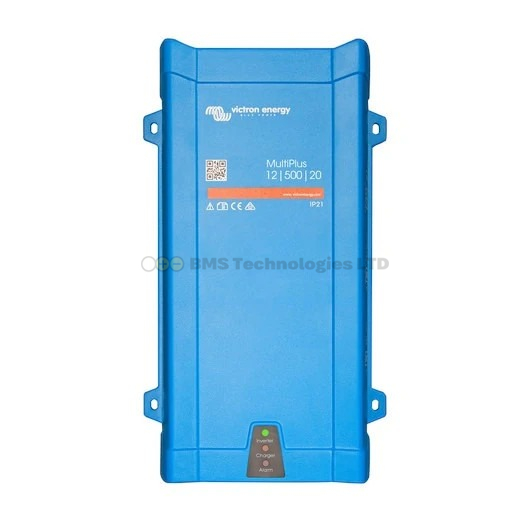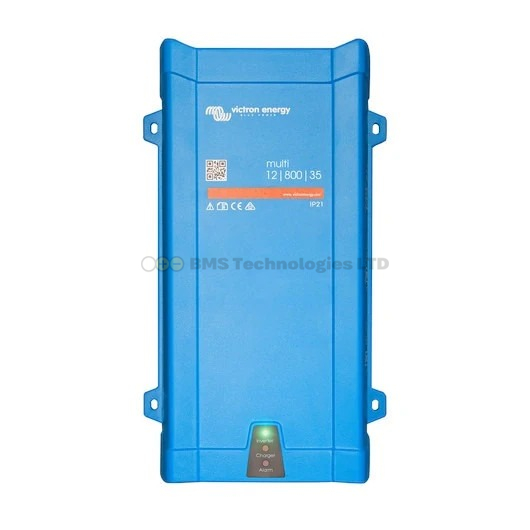
Victron's EasySolar combines a MultiPlus inverter/charger and an MPPT solar charge controller into a single enclosure. It simplifies wiring, saves space, and reduces the number of separate boxes to install. But it also comes with trade-offs. This guide compares the EasySolar to building a system from separate components, so you can decide which approach suits your project.
What the EasySolar Includes
Each EasySolar unit contains:
- A MultiPlus inverter/charger — handles DC-to-AC conversion, AC-to-DC battery charging, and automatic transfer switching
- An MPPT solar charge controller — converts solar panel output into battery charging current with maximum power point tracking
- Internal wiring — the MPPT and MultiPlus are pre-wired together inside the enclosure, sharing the same DC bus
Externally, you connect your solar panels to the MPPT input, your battery to the DC terminals, your AC loads to the AC output, and optionally a grid or generator feed to the AC input. One box does everything that would otherwise require two separate boxes plus interconnecting cables.
Available EasySolar Models
| Model | System Voltage | Inverter Rating | Built-in MPPT | Max PV Input |
|---|---|---|---|---|
| EasySolar 12/1600/70 MPPT 100/50 | 12V | 1,600 VA | SmartSolar 100/50 | 700W (12V) |
| EasySolar 24/1600/40 MPPT 100/50 | 24V | 1,600 VA | SmartSolar 100/50 | 1,400W (24V) |
| EasySolar 48/3000/35 MPPT 150/70 | 48V | 3,000 VA | SmartSolar 150/70 | 4,000W (48V) |
| EasySolar 48/5000/70 MPPT 250/70 | 48V | 5,000 VA | SmartSolar 250/70 | 4,000W (48V) |
| EasySolar-II 48/3000 MPPT 250/70 | 48V | 3,000 VA | SmartSolar 250/70 | 4,000W (48V) |
| EasySolar-II 48/5000 MPPT 250/70 | 48V | 5,000 VA | SmartSolar 250/70 | 4,000W (48V) |
| EasySolar-II GX 48/3000 MPPT 250/70 | 48V | 3,000 VA | SmartSolar 250/70 | 4,000W (48V) |
| EasySolar-II GX 48/5000 MPPT 250/70 | 48V | 5,000 VA | SmartSolar 250/70 | 4,000W (48V) |
The EasySolar-II GX models also include a built-in GX device, adding VRM monitoring and ESS capability without needing a separate Cerbo GX. This makes them genuinely all-in-one solutions for smaller ESS or off-grid systems.
Advantages of the EasySolar
Simpler Wiring
With separate components, you need to run DC cables between the MPPT controller and the battery bus, between the battery bus and the inverter, and power cables for the MPPT. The EasySolar handles these connections internally. Fewer external cables means fewer opportunities for wiring errors, less voltage drop in interconnections, and a tidier installation.
Space Saving
A single EasySolar unit takes up less wall space than a MultiPlus plus a separate MPPT controller. In a campervan, small boat, or compact equipment cupboard, this can be a significant advantage. The EasySolar 12/1600 is particularly popular in campervans where every inch of wall space is precious.
Simpler Purchasing
One product to buy, one delivery, one warranty. You do not need to check compatibility between a separate MPPT and inverter — Victron has already matched them. For buyers who find the Victron product range overwhelming, the EasySolar reduces decision-making to choosing the right size.
Cost
The EasySolar is typically 5-15% cheaper than buying the equivalent MultiPlus and MPPT controller separately. The saving comes from shared enclosure, shared packaging, and reduced wiring components.
Disadvantages of the EasySolar
Less Flexibility
The MPPT controller inside the EasySolar is a fixed model. You cannot swap it for a larger or different MPPT if your solar array changes. With separate components, upgrading from an MPPT 100/30 to an MPPT 150/70 is a simple swap. With an EasySolar, you are locked into the built-in controller.
Limited MPPT Options
Each EasySolar model pairs a specific inverter with a specific MPPT. If the ideal combination for your system does not exist as an EasySolar variant, you have no choice but to use separate components. For example, if you want a MultiPlus 24/3000 with an MPPT 150/45, no EasySolar model offers this combination.
Expandability Constraints
If you later want to add more solar capacity beyond the built-in MPPT's rating, you need to add an external MPPT controller anyway. The EasySolar's built-in MPPT continues to work, but you now have a hybrid setup — partially integrated, partially separate. You also cannot add a second inverter in parallel with an EasySolar (for higher AC output) as easily as you can with standalone MultiPlus units.
Repair and Replacement
If the MPPT inside an EasySolar fails, you may need to return the entire unit for repair, even though the MultiPlus portion still works. With separate components, a failed MPPT is swapped out in minutes while the rest of the system continues operating. For critical off-grid installations where downtime is costly, separate components offer better resilience.
Fewer Model Choices
Victron offers dozens of MultiPlus and MPPT models across 12V, 24V, and 48V systems. The EasySolar range is much narrower. If your system requires a specific combination that does not exist as an EasySolar, separate components are your only option.
When EasySolar Is the Best Choice
- Campervans and motorhomes — the EasySolar 12/1600 is one of the most popular choices for van builds. Limited space, straightforward requirements (solar + battery + inverter), and the desire for a clean installation make the EasySolar ideal. See our campervan electrical guide for more
- Small boats and sailing yachts — similar reasoning to campervans. Space is premium, the system is self-contained, and the solar array is typically modest (200-600W)
- Simple off-grid cabins — a weekend cabin or garden building with a small solar array and modest loads. The EasySolar-II GX models are particularly suited here because they include the GX device for monitoring
- First-time Victron users — if the Victron product range feels overwhelming, the EasySolar simplifies the decision to "how much power do I need?"
- Budget-conscious builds — the small cost saving adds up when every pound counts
When Separate Components Win
- Home ESS systems — these typically evolve over time. You might start with a 3 kWp solar array and later expand to 6 kWp. Separate components let you upgrade the MPPT controller independently
- Large solar arrays — if your array exceeds the built-in MPPT's capacity, you need external controllers anyway. Starting with separate components avoids a mixed setup
- Systems requiring multiple MPPT controllers — if your panels face different directions (east/west split, for example), each orientation benefits from its own MPPT controller. An EasySolar only provides one
- Three-phase systems — these require three MultiPlus-II units. No EasySolar model is available for three-phase configurations
- Parallel inverter systems — if you need more AC output than a single inverter provides, parallel MultiPlus-II units are straightforward. Adding a second EasySolar is wasteful because you would have an unused MPPT controller in the second unit
- Critical off-grid installations — where uptime matters and you want to swap a failed component quickly without taking the whole system offline
- Systems with alternator charging — if you use a Victron Orion-Tr Smart DC-DC charger alongside solar and shore power, separate components give cleaner integration
Cost Comparison Example
For a 24V campervan system with 800W of solar:
| Approach | Components | Approx. Cost |
|---|---|---|
| EasySolar | EasySolar 24/1600/40 MPPT 100/50 | £1,100-1,400 |
| Separate | MultiPlus 24/1600/40 + SmartSolar MPPT 100/50 | £1,200-1,600 |
For a 48V home ESS with 4 kWp solar:
| Approach | Components | Approx. Cost |
|---|---|---|
| EasySolar-II GX | EasySolar-II GX 48/5000 MPPT 250/70 | £2,800-3,500 |
| Separate | MultiPlus-II 48/5000 + SmartSolar 250/70 + Cerbo GX | £3,000-3,800 |
The savings are real but modest — typically £100-300. The decision should be driven by flexibility requirements rather than price.
EasySolar-II GX: The All-in-One Option
The EasySolar-II GX models deserve special mention. By integrating a GX device, they include:
- Full VRM monitoring and remote access
- ESS capability (scheduled charging, self-consumption, grid-tied operation)
- DVCC for lithium battery coordination
- Generator auto-start relay
This makes the EasySolar-II GX a genuine one-box solution for small-to-medium ESS installations. Connect a battery, connect solar panels, connect to the grid, and you have a working home battery system with cloud monitoring. For a small home or a system where simplicity is the priority, it is hard to beat.
The main limitation remains expandability. If you later want more solar, more battery, or more inverter capacity, the integrated approach becomes a constraint. For systems likely to stay at their initial size, this is not a concern.
Making the Decision
Ask yourself these questions:
- Will my solar array stay the same size? If yes, EasySolar works well. If you plan to expand, choose separate components
- Do I need more than one MPPT controller? (Multiple roof orientations, separate arrays.) If yes, separate components are necessary
- Is space a critical constraint? If yes (campervans, boats), EasySolar's compact form factor is valuable
- Is this system likely to grow? More battery, parallel inverters, additional solar? If yes, separate components give more headroom
- Do I want the simplest possible installation? EasySolar reduces wiring and decisions
For most campervans and small boats, the EasySolar is the sensible choice. For most home installations, separate components provide the flexibility you will likely want as your system evolves. For help choosing the right combination of components, use our system builder tool to explore compatible configurations and compare prices across UK retailers.