Victron Energy Meters measure AC current and power at specific points in your electrical system. They're essential for grid-tied ESS installations and useful for detailed monitoring of AC loads or generator output. This guide explains the different models, where they fit in a system, and — importantly — when you don't actually need one.
What Does a Victron Energy Meter Do?
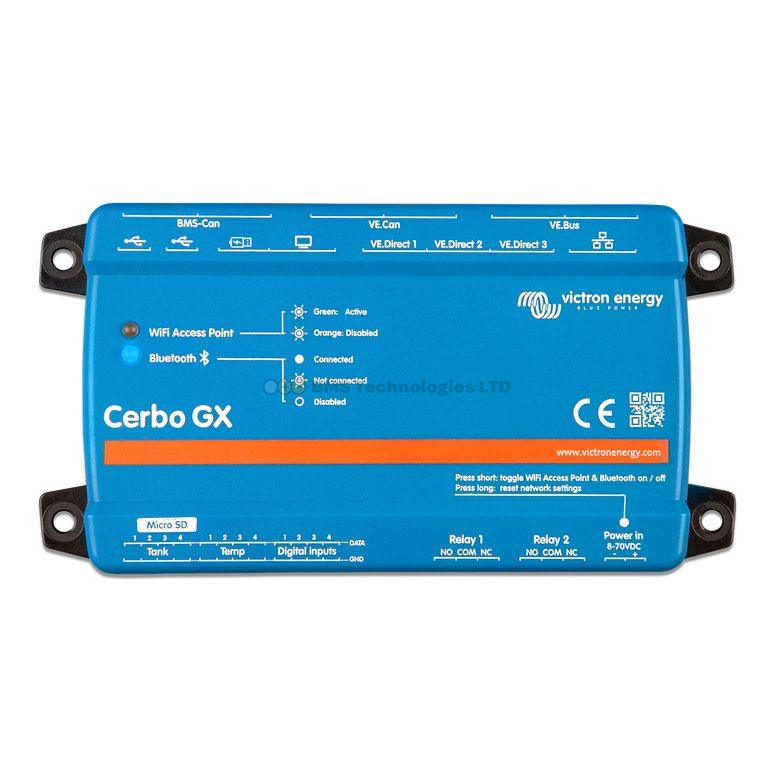
A Victron Energy Meter is a DIN-rail-mounted device that measures AC voltage, current, power, and energy (kWh) on one or more phases. It connects to a Cerbo GX (or other GX device) and reports real-time AC measurements that the GX device uses for system management, display, and logging.
Energy meters don't control anything themselves — they purely measure and report. But the data they provide is critical for certain system configurations, particularly ESS (Energy Storage System) setups where the system needs to know how much power the grid is supplying or how much you're exporting.
The Three Energy Meter Models
Victron offers three energy meter models. Choosing the right one depends on whether you have a single-phase or three-phase electrical supply.
ET112 — Single-Phase Energy Meter
The ET112 is the simplest and most affordable option. It measures a single phase of AC power. This is the correct choice for most UK homes, which have a single-phase supply.
- Phases: 1
- Max current: 100A
- Connection: RS485 to the Cerbo GX (via a USB-to-RS485 cable, sold separately)
- Mounting: DIN rail (fits in a standard consumer unit or distribution board)
- Typical UK price: £90–£130
ET340 — Three-Phase Energy Meter
The ET340 measures all three phases simultaneously. It's designed for commercial premises or larger homes with a three-phase supply.
- Phases: 3
- Max current: 65A per phase
- Connection: RS485 to the Cerbo GX
- Mounting: DIN rail
- Typical UK price: £150–£200
EM24 — Three-Phase Energy Meter (Ethernet)
The EM24 is a higher-end three-phase meter that connects to the Cerbo GX via Ethernet rather than RS485. It's typically used in larger commercial installations.
- Phases: 3
- Max current: 65A per phase
- Connection: Ethernet (TCP/IP) to the Cerbo GX
- Mounting: DIN rail
- Typical UK price: £250–£350
For most UK residential installations, the ET112 is the right choice. Only select the ET340 or EM24 if you have a confirmed three-phase supply.
Where Energy Meters Are Installed
The energy meter's role in your system depends entirely on where it's installed. Victron's GX device allows you to assign each energy meter to a specific role:
Grid Meter (Most Common)
Installed at the point where your property connects to the national grid — typically immediately after the main incoming isolator or electricity meter. In this position, the energy meter measures how much power you're importing from or exporting to the grid.
This is essential for ESS systems. The Cerbo GX uses the grid meter reading to control the MultiPlus: if the meter shows you're importing power, the MultiPlus can discharge the battery to reduce grid import. If the meter shows you're exporting (solar surplus), the MultiPlus can charge the battery instead.
AC Load Meter
Installed on the output side of the MultiPlus/Quattro to measure the total AC loads being powered by the inverter. This is useful for monitoring how much power your loads consume, but it's often not necessary because the MultiPlus can report this data internally via VE.Bus.
PV Inverter Meter
If you have a non-Victron AC-coupled solar inverter (like a SolarEdge, Enphase, or SMA grid-tie inverter), an energy meter on its output tells the Cerbo GX how much solar power is being generated on the AC side. This data feeds into the ESS calculations and the VRM dashboard.
Generator Meter
Installed on the generator output to measure how much energy the generator is producing. Useful for tracking fuel efficiency and generator runtime costs.
When You Need an Energy Meter
Not every Victron system needs an energy meter. Here's a clear breakdown:
| System Type | Energy Meter Needed? | Role |
|---|---|---|
| Grid-tied ESS (single-phase) | Yes — ET112 | Grid meter — essential for ESS to know import/export |
| Grid-tied ESS (three-phase) | Yes — ET340 or EM24 | Grid meter — measures all three phases |
| ESS with AC-coupled solar | Yes (additional) | PV inverter meter — measures non-Victron solar inverter output |
| Off-grid with Victron MPPT solar | No | MPPT data comes via VE.Direct, no grid to measure |
| Campervan / boat | No | No grid connection, all data from VE.Direct devices |
| Off-grid with generator | Optional | Generator meter — nice to have for tracking fuel costs |
In short: if you're building an ESS (grid-tied) system, you almost certainly need an energy meter as the grid meter. If you're building an off-grid system with Victron solar charge controllers, you probably don't.
How Energy Meters Connect to the Cerbo GX
RS485 Connection (ET112 and ET340)
The ET112 and ET340 connect to the Cerbo GX via RS485 serial communication. You'll need a Victron RS485-to-USB interface cable (sold separately) which plugs into one of the Cerbo's USB ports. The cable has bare wires on one end that connect to the meter's RS485 terminals.
Wiring is straightforward — connect the A, B, and Ground wires from the interface cable to the corresponding terminals on the energy meter. The cable can be up to 100 metres long, so the meter doesn't need to be near the Cerbo GX.
Ethernet Connection (EM24)
The EM24 connects via a standard Ethernet cable to the same network as the Cerbo GX. The Cerbo auto-detects it on the local network.
Configuration on the Cerbo GX
Once connected, the energy meter appears automatically in the Cerbo GX device list. Navigate to Settings → Energy Meters and assign the meter's role (Grid, AC Load, PV Inverter, or Generator). For ESS systems, the grid meter role is critical — without it, ESS cannot function.
When a CT Clamp Is Sufficient Instead
The Victron MultiPlus II (not the original MultiPlus) has an internal current transformer (CT) input. By attaching a CT clamp to the grid cable, the MultiPlus II can measure grid import/export directly — without a separate energy meter.
This is a significant cost saving. A CT clamp costs a few pounds compared to £90+ for an ET112 plus the RS485 cable. The CT clamp method is:
- Accurate enough for most residential ESS systems
- Simpler to install — no DIN rail space needed, no RS485 cable to route
- Only available on MultiPlus II — the original MultiPlus and Quattro don't have this feature
If you're installing a new ESS system with a MultiPlus II, the CT clamp approach is often the better choice for single-phase systems. The standalone energy meter remains necessary for three-phase systems, AC-coupled PV metering, or when using the original MultiPlus/Quattro.
Installation Notes for the UK
Energy meters installed in the main consumer unit or near the electricity meter must comply with UK wiring regulations (BS 7671). Key points:
- Installation must be carried out by a qualified electrician (Part P competent person for domestic work)
- The energy meter connects in series with the live conductor — it carries the full circuit current
- Ensure the meter's current rating exceeds your main fuse rating (most UK homes have a 60A or 100A main fuse — the ET112's 100A rating covers both)
- DIN rail mounting in the consumer unit requires sufficient space — check before purchasing
Summary
Victron Energy Meters (ET112, ET340, EM24) are measurement devices that report AC power data to the Cerbo GX. They're essential for ESS grid-tied systems, where the grid meter reading drives the entire energy management strategy. For off-grid systems, campervans, and boats, they're rarely needed because all relevant data comes directly from Victron devices via VE.Direct. If you're building a single-phase ESS with a MultiPlus II, consider whether the built-in CT clamp is sufficient before purchasing a separate energy meter — it often is.