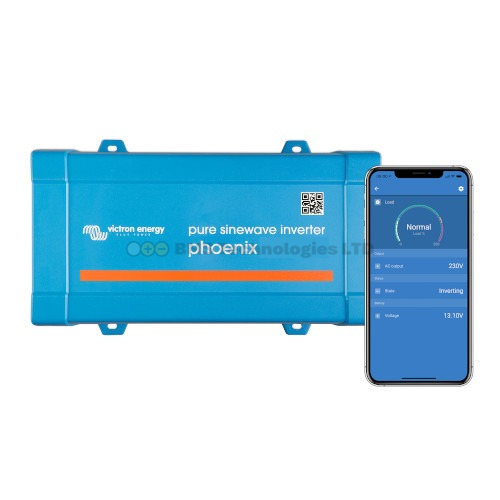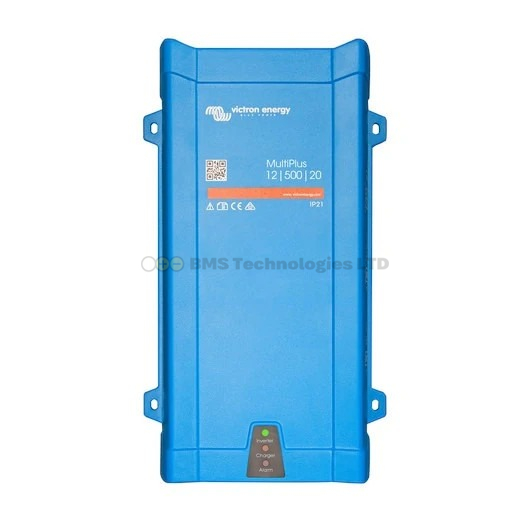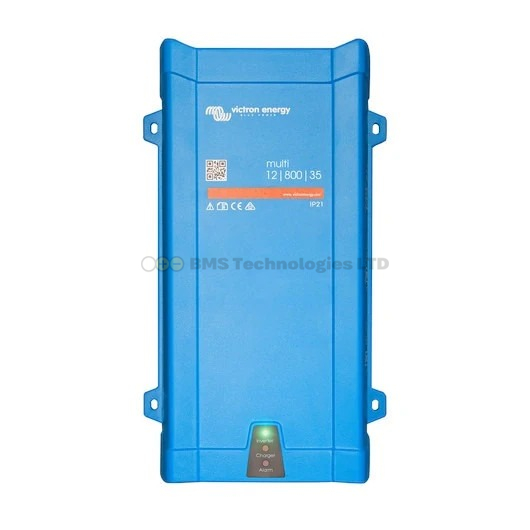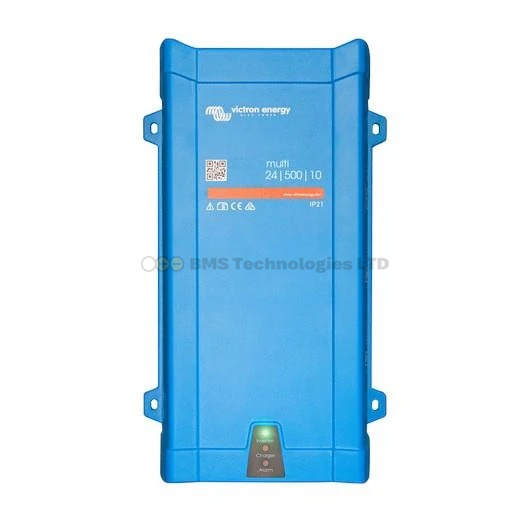
When choosing a Victron inverter/charger for marine use, the specifications can be confusing. What does 3000VA actually mean in watts? Why does a 2000VA inverter struggle with a 1500W compressor? And how do transfer switch ratings affect shore power? This guide explains every important specification and how to apply them to marine electrical loads.
VA vs Watts: Why They're Different
Victron rates their inverter/chargers in VA (volt-amperes), not watts. For simple loads like heaters, kettles, and incandescent lights, VA and watts are effectively the same. But for loads with motors, transformers, or electronic power supplies, the distinction matters.
Power Factor
Power factor is the ratio of real power (watts) to apparent power (VA). A purely resistive load (kettle, toaster) has a power factor of 1.0 — 1000VA = 1000W. A motor-driven load typically has a power factor of 0.6-0.8 — a 1000VA motor might only deliver 600-800W of useful work, but it still draws 1000VA from the inverter.
Victron's MultiPlus series has a rated power factor of 0.8 for continuous output. This means:
| MultiPlus Model | VA Rating | Continuous Watts (at 0.8 PF) | Peak Power |
|---|---|---|---|
| MultiPlus 12/800 | 800VA | 640W | 1500W |
| MultiPlus 12/1200 | 1200VA | 960W | 2400W |
| MultiPlus 12/1600 | 1600VA | 1300W | 3000W |
| MultiPlus 12/2000 | 2000VA | 1600W | 4000W |
| MultiPlus 12/3000 | 3000VA | 2400W | 6000W |
| MultiPlus 24/5000 | 5000VA | 4000W | 10000W |
The peak power rating is available for a few seconds to handle motor startup surges. This is critical for marine applications.
Marine Loads: Why Boats Need More Inverter Capacity
Marine electrical loads are often more demanding than equivalent land-based loads because of the prevalence of electric motors and compressors. Motor-driven loads have two challenging characteristics:
1. Low Power Factor
As explained above, motors draw more VA than their watt rating suggests. A refrigeration compressor rated at 150W might draw 200-250VA while running. The inverter must supply the VA, not just the watts.
2. High Startup Current (Inrush)
Electric motors draw 3-7 times their running current for the first fraction of a second when starting. A fridge compressor that runs at 2A might draw 10-15A for 0.5 seconds at startup. A watermaker's high-pressure pump can draw even more. The inverter must handle these surges without tripping its overload protection.
Common Marine Motor Loads
| Appliance | Running Power (W) | Running VA (approx) | Startup Surge (VA) |
|---|---|---|---|
| Fridge compressor | 80-150W | 120-200VA | 600-1000VA |
| Freezer compressor | 100-200W | 150-300VA | 800-1500VA |
| Watermaker (12V pump) | 60-100W | 80-130VA | 400-700VA |
| Watermaker (AC high-pressure) | 300-600W | 400-800VA | 1500-3000VA |
| Air conditioning compressor | 800-2000W | 1000-2500VA | 3000-8000VA |
| Electric windlass | 500-1500W | 700-2000VA | 2000-5000VA |
| Washing machine (spin cycle) | 300-500W | 400-600VA | 1200-2000VA |
| Microwave oven | 800-1200W | 900-1400VA | 1200-1800VA |
| Vacuum cleaner | 800-1500W | 1000-1800VA | 1500-3000VA |
This is why a boat with a fridge, freezer, and watermaker — totalling perhaps 500W running — may need a 2000VA or even 3000VA inverter. The startup surges from any two of these starting simultaneously can easily exceed a smaller inverter's peak rating.
Calculating Your Total AC Load
To size your inverter correctly, you need to consider both continuous load and worst-case simultaneous startup.
Step 1: List All AC Loads
Write down every AC appliance on the boat with its running power (watts) and its VA draw if known. If VA isn't specified, divide watts by 0.7 for motor loads or by 1.0 for resistive loads.
Step 2: Identify Simultaneous Loads
What runs at the same time? The fridge and freezer compressors can start at any moment. The watermaker runs for extended periods. The microwave might run while the fridge is cycling. Add up the worst-case combination.
Step 3: Add Startup Surges
The inverter must handle the running load of everything currently on plus the startup surge of the next motor to kick in. If your running load is 800VA and the fridge compressor starts (surge 1000VA), the inverter briefly needs 1800VA.
Step 4: Add a Safety Margin
Choose an inverter rated at least 25-50% above your calculated continuous load. Running an inverter at 90%+ of its rated capacity constantly reduces efficiency, generates more heat, and shortens its lifespan. On a boat where reliability matters, the extra headroom is worth the modest additional cost and weight.
Transfer Switch Ratings
The Victron MultiPlus has a built-in transfer switch that switches between shore power and inverter output. The transfer switch has its own current rating, which limits the maximum shore power passthrough.
| MultiPlus Model | Transfer Switch Rating |
|---|---|
| MultiPlus 500VA-1600VA | 16A |
| MultiPlus 2000VA | 16A |
| MultiPlus 3000VA | 16A (50A on some models) |
| MultiPlus 5000VA (24V/48V) | 50A |
For most UK marina shore power connections (16A), the standard 16A transfer switch is perfectly adequate. Larger boats with 32A shore power may need the MultiPlus-II (which has a 32A transfer switch on larger models) or a Quattro (which offers two AC inputs — useful for separate shore power and generator connections).
The Quattro Option for Marine Use
The Victron Quattro is a MultiPlus with two AC inputs. On a boat, this is useful for:
- Input 1: Shore power — connected when in a marina
- Input 2: Generator — connected to an onboard generator for anchored power
The Quattro automatically prioritises between the two inputs. If both are available, it uses the higher-priority input (configurable). If shore power is disconnected, it automatically switches to the generator input. If neither is available, it switches to inverter mode. This three-way automatic switching is seamless and means you never need to manually select your AC source.
Efficiency Matters at Sea
Inverter efficiency determines how much battery power is wasted as heat. Victron MultiPlus models achieve 93-96% efficiency at moderate loads (40-80% of rated capacity). At very low loads (under 10% of capacity), efficiency drops significantly because the inverter's own power consumption becomes a larger proportion of total draw.
This means an oversized inverter running a small load is less efficient than a correctly-sized one. On a sailing yacht at anchor running only LED lights and a phone charger (50W total), a 3000VA MultiPlus wastes more power on its own no-load consumption than a 1200VA unit would.
Victron's ECO mode helps: the inverter periodically switches off and briefly pulses on to check for loads. If no significant load is detected, it stays off. This reduces standby consumption to under 5W but introduces a brief delay when a load is first connected.
Sizing Recommendations for Common Boat Types
| Boat Type | Typical Loads | Recommended Minimum |
|---|---|---|
| Day sailor | Phone charging, occasional laptop | MultiPlus 500VA or Phoenix 800VA |
| Coastal cruiser (35ft) | Fridge, microwave, laptop, TV | MultiPlus 2000VA |
| Offshore yacht (40-50ft) | Fridge, freezer, watermaker, microwave, washing machine | MultiPlus 3000VA |
| Narrowboat (liveaboard) | Full domestic loads, washing machine, power tools | MultiPlus 3000VA |
| Motor cruiser (large) | Air conditioning, full galley, watermaker | MultiPlus 5000VA or paralleled 3000VA |
For help deciding between 12V and 24V systems, see our 12V vs 24V marine guide. For complete system design, our sailboat installation guide and narrowboat system guide cover full component selection. And for understanding shore power setup, read our shore power charging guide.