Victron Energy offers three distinct lithium iron phosphate (LiFePO4) battery ranges: the Smart series, the SuperPack series, and the newer NG (Next Generation) series. Each targets different budgets, system sizes, and feature requirements. Choosing the wrong range can mean overpaying for features you don't need — or missing critical functionality your system requires. This guide breaks down every meaningful difference to help you pick the right Victron lithium battery for your project.
Victron Lithium Smart Batteries
The Smart range is Victron's established premium lithium offering. These batteries have been the go-to choice for serious off-grid, marine, and motorhome installations for several years, and they remain extremely popular in the UK market.
Key Features
- Built-in Bluetooth: Monitor state of charge, voltage, temperature, and cell voltages directly from the VictronConnect app on your phone
- Integrated BMS: Each battery contains a Battery Management System that protects against over-voltage, under-voltage, over-current, over-temperature, and short circuit
- Parallel and series support: Up to 20 batteries in parallel, and series connections supported (e.g., two 12.8V batteries for a 24V system)
- Heated version available: The Smart with Heating variant includes an internal heating element that allows charging at temperatures down to -20°C — critical for UK winter installations in unheated spaces
- M8 bolt terminals: Suitable for high-current connections with proper cable lugs
Available Sizes
| Model | Voltage | Capacity | Energy | Max Continuous Discharge |
|---|---|---|---|---|
| Smart 12.8V 100Ah | 12.8V | 100Ah | 1.28kWh | 200A |
| Smart 12.8V 150Ah | 12.8V | 150Ah | 1.92kWh | 300A |
| Smart 12.8V 200Ah | 12.8V | 200Ah | 2.56kWh | 400A |
| Smart 25.6V 100Ah | 25.6V | 100Ah | 2.56kWh | 200A |
| Smart 25.6V 200Ah | 25.6V | 200Ah | 5.12kWh | 400A |
Victron Lithium SuperPack Batteries
The SuperPack range is Victron's more affordable lithium option. It sacrifices some advanced features to hit a lower price point, making lithium accessible for smaller or budget-conscious builds.
Key Features
- Built-in BMS: Protection against over-charge, deep discharge, over-current, and short circuit — the essentials are covered
- No Bluetooth: You cannot connect to these batteries with VictronConnect. Monitoring requires an external battery monitor like the SmartShunt
- Cannot be paralleled: Each SuperPack must be used individually. This is the most significant limitation — if you need more capacity, you must go to a larger single battery or switch to the Smart range
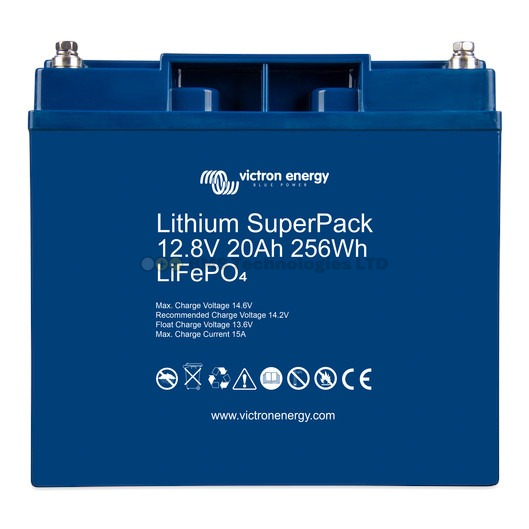
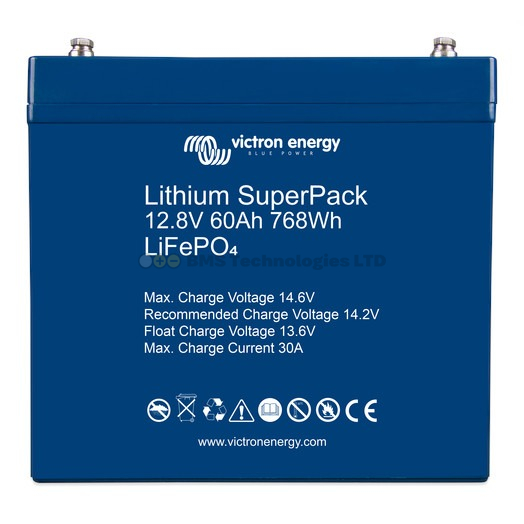
- Smaller capacities available: 20Ah and 60Ah options make the SuperPack ideal for small loads — lighting, electronics, or backup power
- Compact form factor: The smaller models are physically small and light, fitting into tight spaces
Available Sizes
| Model | Voltage | Capacity | Energy | Max Continuous Discharge |
|---|---|---|---|---|
| SuperPack 12.8V 20Ah | 12.8V | 20Ah | 0.26kWh | 30A |
| SuperPack 12.8V 50Ah | 12.8V | 50Ah | 0.64kWh | 50A |
| SuperPack 12.8V 60Ah | 12.8V | 60Ah | 0.77kWh | 60A |
| SuperPack 12.8V 100Ah | 12.8V | 100Ah | 1.28kWh | 100A |
Victron Lithium NG (Next Generation) Batteries
The NG range is Victron's newest lithium battery line, building on the Smart range with refinements. These are positioned as the future direction of Victron's lithium lineup.
Key Features
- Bluetooth built in: Full VictronConnect app monitoring, same as the Smart range
- Improved BMS: Enhanced cell balancing and more granular diagnostic data available via Bluetooth and GX devices
- Parallel and series support: Designed for multi-battery configurations, similar to Smart
- Updated cell chemistry: Uses the latest generation LiFePO4 cells for improved cycle life and consistency
- Heating option: Available with integrated heating for cold-climate installations
- Refined communication: Better integration with the Lynx Smart BMS and Cerbo GX via improved data protocols
Head-to-Head Comparison
| Feature | Smart | SuperPack | NG |
|---|---|---|---|
| Bluetooth monitoring | Yes | No | Yes |
| Built-in BMS | Yes | Yes | Yes (improved) |
| Parallel connection | Yes (up to 20) | No | Yes |
| Series connection | Yes | No | Yes |
| Heated version | Yes | No | Yes |
| Smallest capacity | 100Ah | 20Ah | 100Ah |
| 24V option | Yes | No | Yes |
| Price positioning | Premium | Budget | Premium |
| VictronConnect cell data | Yes | No | Yes (enhanced) |
Which Range Should You Choose?
Choose SuperPack If:
- You need a small, standalone battery (20–100Ah) for a simple application
- You will never need to expand capacity by paralleling
- Budget is the primary concern and you don't need Bluetooth monitoring
- Typical use: small campervan with minimal loads, caravan lighting, backup power for a router or alarm system
Choose Smart If:
- You want a proven, well-established product with years of real-world track record
- You need to parallel multiple batteries for larger capacity banks
- You want Bluetooth monitoring without external accessories
- You need a 24V system (25.6V models available)
- Typical use: motorhome conversions, marine systems, off-grid cabins, larger campervans
Choose NG If:
- You want the latest technology and don't mind paying for it
- You're building a new system and want the best long-term investment
- You plan to use the Lynx Smart BMS and want the best integration
- You value the improved diagnostic data and enhanced BMS features
- Typical use: new-build professional installations, high-spec motorhomes, marine vessels, off-grid homes
BMS Differences Explained
All three ranges include a BMS, but they are not equal. The SuperPack BMS handles the basics — it will disconnect the battery if voltage goes too high, too low, or current exceeds limits. However, it does not communicate with external devices. There is no way for your MultiPlus or MPPT controller to know the BMS is about to disconnect.
The Smart and NG BMS units can communicate via the Lynx Smart BMS or VE.Bus BMS, which connects to a Cerbo GX. This enables DVCC (Distributed Voltage and Current Control), where the GX device coordinates all chargers and inverters based on real-time BMS data. This is far safer and more efficient — chargers ramp down smoothly rather than being abruptly disconnected.
Price Considerations for UK Buyers
At the time of writing, you can expect the following approximate price ranges from UK retailers. Use our price comparison tool to find the current best deals:
- SuperPack 12.8V 100Ah: Around £400–£500 — the cheapest way into Victron lithium
- Smart 12.8V 100Ah: Around £700–£850 — significant premium for the extra features
- Smart 12.8V 200Ah: Around £1,300–£1,600 — better per-kWh value than two 100Ah units
- NG models: Similar to or slightly above the Smart range pricing
Remember that the SuperPack's inability to parallel means if you outgrow a 100Ah SuperPack, you must replace it entirely. Two Smart 100Ah batteries in parallel give you 200Ah with room to add more later. Factor this upgrade path into your budget calculation.
Final Recommendation
For most UK installations — campervans, motorhomes, boats, and small off-grid systems — the Smart range remains the best all-round choice. It offers proven reliability, excellent feature set, and the critical ability to expand. The SuperPack makes sense only for genuinely small, fixed-capacity applications. The NG range is worth considering for new professional installations where the improved BMS integration justifies the cost. Whichever you choose, make sure you configure your charging correctly and size your cables and fuses appropriately.