Choosing between a 12V and 24V Victron MultiPlus for a marine installation is one of the most important decisions in your electrical system design. Get it right and everything works efficiently. Get it wrong and you're either stuck with unnecessarily heavy cables or facing compatibility headaches with marine equipment. This guide breaks down the decision for boat owners.
The Core Difference: Current
Power (watts) = voltage x current. For any given power demand, a 24V system draws half the current of a 12V system. A 2400W load draws 200A from a 12V battery but only 100A from a 24V battery.
Lower current means:
- Thinner cables — saving weight, space, and cost
- Less voltage drop — critical on boats with long cable runs
- Higher efficiency — less energy lost as heat in cables and connections
- Smaller fuses and switches — easier to source and cheaper
Higher voltage means:
- Less equipment compatibility — most standard marine gear is 12V
- Need for DC-DC converters — to supply 12V equipment from a 24V bank
- Higher voltage = higher danger — 24V is still low voltage, but battery short circuits are more energetic
Available Victron MultiPlus Models: Marine-Relevant Options
12V Models
| Model | Inverter Output (VA) | Charger (A) | Peak Power | Weight |
|---|---|---|---|---|
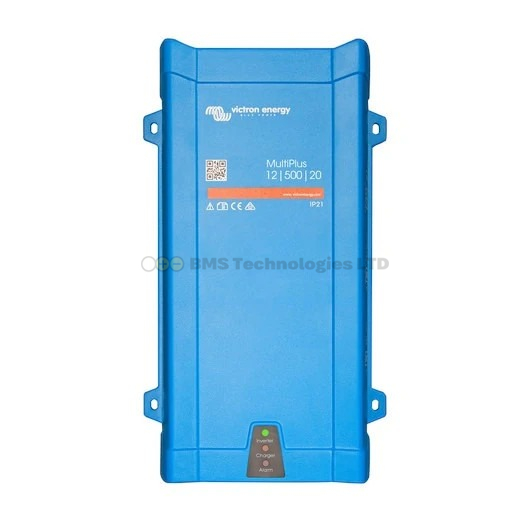
| MultiPlus 12/500/20 | 500VA | 20A | 900W | 7kg |
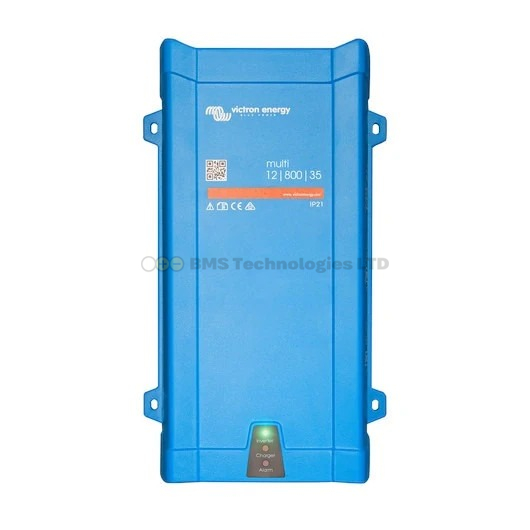
| MultiPlus 12/800/35 | 800VA | 35A | 1500W | 10kg |
| MultiPlus 12/1200/50 | 1200VA | 50A | 2400W | 12kg |
| MultiPlus 12/1600/70 | 1600VA | 70A | 3000W | 17kg |
| MultiPlus 12/2000/80 | 2000VA | 80A | 4000W | 19kg |
| MultiPlus 12/3000/120 | 3000VA | 120A | 6000W | 30kg |
24V Models
| Model | Inverter Output (VA) | Charger (A) | Peak Power | Weight |
|---|---|---|---|---|
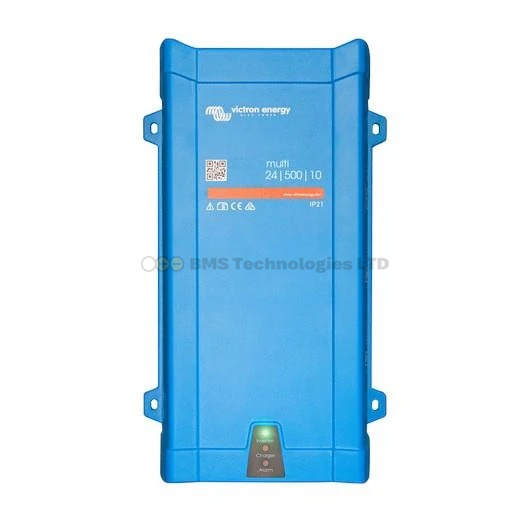
| MultiPlus 24/500/10 | 500VA | 10A | 900W | 7kg |
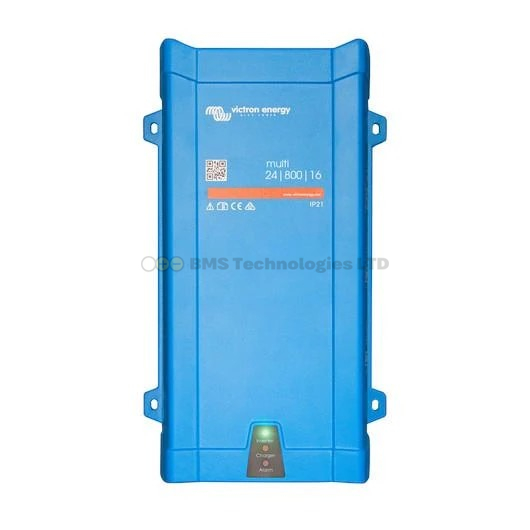
| MultiPlus 24/800/16 | 800VA | 16A | 1500W | 10kg |
| MultiPlus 24/1200/25 | 1200VA | 25A | 2400W | 12kg |
| MultiPlus 24/1600/40 | 1600VA | 40A | 3000W | 17kg |
| MultiPlus 24/2000/50 | 2000VA | 50A | 4000W | 19kg |
| MultiPlus 24/3000/70 | 3000VA | 70A | 6000W | 30kg |
| MultiPlus 24/5000/120 | 5000VA | 120A | 10000W | 45kg |
Note that the 5000VA model is only available in 24V and 48V — not 12V. If you need more than 3000VA at 12V, you must either parallel two 12V units (using the MultiPlus parallel feature) or step up to 24V.
When to Choose 12V for Your Boat
Small to Medium Boats (Under 40ft)
Most boats under 40ft run perfectly well on 12V. Power demands are moderate, cable runs are manageable, and all standard marine equipment works without conversion. The MultiPlus 12/1600/70 or 12/2000/80 handles typical loads: a microwave, battery charger, TV, laptop, and small appliance use.
Existing 12V Boats
If your boat already has a 12V system with 12V pumps, lighting, navigation instruments, and windlass, converting to 24V means replacing or adapting every piece of 12V equipment. This is rarely cost-effective unless you're doing a complete refit.
Equipment Compatibility
The vast majority of marine equipment is 12V:
- VHF radios
- Chart plotters and radar
- Navigation lights
- Bilge pumps
- Anchor windlasses (most)
- USB charging sockets
- LED interior lighting
- Diesel heater control units
- Fresh water pumps
Staying at 12V means direct compatibility with all of this, without needing DC-DC converters.
When to Choose 24V for Your Boat
Large Boats (Over 45-50ft)
On a 60ft narrowboat or a large sailing yacht, cable runs from the battery bank to the bow can exceed 20 metres each way. At 12V with a 200A inverter load, you'd need impractically heavy cables to maintain acceptable voltage drop. At 24V, the current is halved and reasonable cable sizes work over longer distances.
High Power Demands
If you need more than 3000VA of inverter capacity — for an induction hob, electric heater, workshop tools, or simultaneous heavy loads — the 24V MultiPlus 5000VA is the only single-unit option. At 12V, you'd need to parallel two MultiPlus 3000VA units, which is more complex, more expensive, and takes more space.
Weight-Sensitive Sailboats
A 24V lithium battery bank delivering 400Ah weighs roughly the same as a 12V 400Ah bank, but stores twice the energy (9.6kWh vs 4.8kWh). For a cruising yacht where weight in the bilge matters, 24V gives more energy per kilogram.
Dual-Voltage Systems
The practical compromise on many larger boats is a 24V house bank with a Victron Orion-Tr 24/12 DC-DC converter to supply 12V for standard marine equipment. This gives you the efficiency of 24V for the main power system while maintaining 12V compatibility for everything else.
How It Works
The 24V battery bank connects to the MultiPlus 24V, solar MPPT, and battery monitor — all the main power infrastructure. A Victron Orion-Tr 24/12-20A (or -30A) steps down to 12V for a separate 12V bus bar that powers navigation instruments, lighting, pumps, and other 12V loads.
Sizing the DC-DC Converter
Calculate the maximum simultaneous 12V load. A typical boat with LED lighting, instruments, a fridge, and pumps might draw 15-20A peak at 12V. The Orion-Tr 24/12-20A delivers 20A continuous — enough for most boats. For boats with a 12V windlass or bow thruster, a larger converter or a separate dedicated battery may be needed.
Recommendation by Boat Type
| Boat Type | Recommended Voltage | Recommended MultiPlus | Reasoning |
|---|---|---|---|
| Small narrowboat (under 40ft) | 12V | MultiPlus 12/1600/70 | Simple, compatible, sufficient power |
| Medium narrowboat (40-57ft) | 12V | MultiPlus 12/3000/120 | Handles most domestic loads, strong charger |
| Large narrowboat/widebeam (57ft+) | 24V | MultiPlus 24/3000/70 or 24/5000/120 | Reduced cable sizes, higher capacity available |
| Coastal sailing yacht (30-40ft) | 12V | MultiPlus 12/2000/80 | Matches existing 12V equipment |
| Offshore cruising yacht (40-50ft) | 24V | MultiPlus 24/3000/70 | Long cable runs, high efficiency, more energy per kg |
| Motor cruiser (under 40ft) | 12V | MultiPlus 12/3000/120 | Plenty of power, simple installation |
| Motor cruiser (over 40ft) | 24V | MultiPlus 24/5000/120 | High power needs (air con, watermaker, galley) |
Converting from 12V to 24V
If you're considering converting an existing 12V boat to 24V, be aware of the scope:
- Batteries — need reconfiguring (series pairs for 24V) or complete replacement
- Charging — all chargers, MPPT controllers, and DC-DC chargers must be 24V
- 12V loads — need a DC-DC step-down converter or individual 24V replacements
- Wiring — much of the existing DC wiring can be reused (it was oversized for 12V anyway)
- Alternator — needs replacing with a 24V unit, or use a 12V alternator with a Victron buck-boost charger
A voltage conversion is a major project. It makes sense during a complete refit but rarely justifies doing on its own unless you're hitting genuine limitations with 12V (cable size, power capacity).
For complete narrowboat system recommendations, see our narrowboat product guide. For help understanding MultiPlus power ratings, our marine inverter ratings guide explains VA, watts, and power factor. And for sailboat-specific advice, read our sailboat installation guide.