Victron Energy product names look like random numbers at first glance, but they actually follow a consistent naming convention that tells you almost everything about a product's capabilities. Once you learn to decode them, you can quickly compare models and pick the right one without diving into datasheets. This guide breaks down the naming logic for every major Victron product family.
The General Pattern
Most Victron product names follow this structure: Product Family + Battery Voltage / Key Rating / Secondary Rating. The exact meaning of each number depends on the product family, but battery voltage almost always comes first. Knowing this one rule gets you 80% of the way there.
MultiPlus and MultiPlus-II
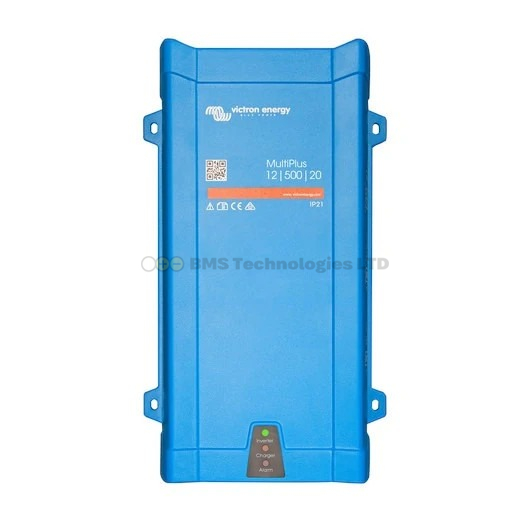
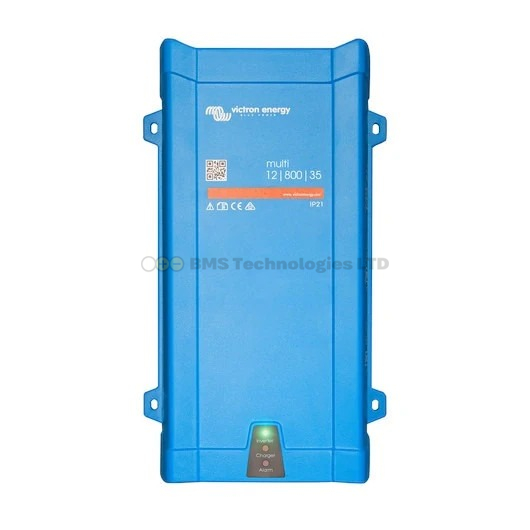
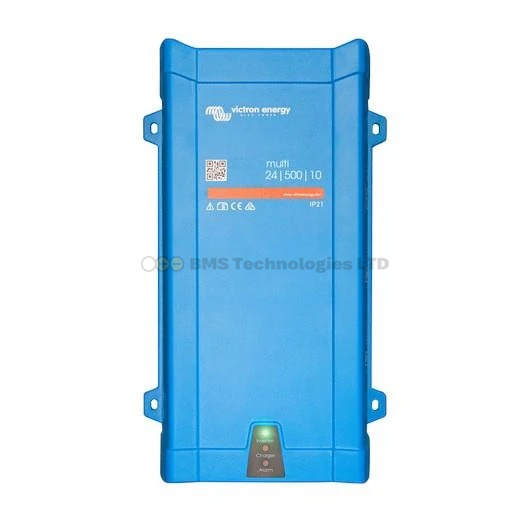
The MultiPlus naming format is: MultiPlus Voltage/VA/Amps. For example:
- MultiPlus 12/3000/120-50 — 12V battery bank, 3000VA inverter output, 120A battery charger, 50A transfer switch
- MultiPlus-II 48/5000/70-50 — 48V battery bank, 5000VA inverter, 70A charger, 50A transfer switch
- MultiPlus 24/1600/40-16 — 24V battery bank, 1600VA inverter, 40A charger, 16A transfer switch
The first number is always the nominal battery voltage (12V, 24V, or 48V). The second number is the inverter power in VA (volt-amps). The third is the maximum battery charging current in amps. The fourth number, after the dash, is the AC transfer switch rating — the maximum amps the unit can pass through from a connected mains or generator supply.
The MultiPlus-II has an identical naming scheme to the original MultiPlus. The "II" designation indicates a newer generation with improvements such as an external current transformer (CT) for PowerAssist and a higher peak power capability.
Quattro and Quattro-II
The Quattro follows the same pattern as the MultiPlus: Quattro Voltage/VA/Amps-Transfer. The key difference is that the Quattro has two AC inputs (for example, mains plus generator), whereas the MultiPlus has one. The naming convention remains the same:
- Quattro 48/10000/140-100/100 — 48V, 10000VA inverter, 140A charger, with two 100A transfer switches (one per AC input)
- Quattro 24/5000/120-100/100 — 24V, 5000VA inverter, 120A charger, dual 100A inputs
SmartSolar MPPT Charge Controllers
SmartSolar MPPT controllers use the format: SmartSolar MPPT MaxPV/MaxOutput. For example:
- SmartSolar MPPT 150/35 — maximum 150V from solar panels, 35A maximum charge current to battery
- SmartSolar MPPT 250/100 — maximum 250V PV input, 100A output to battery
- SmartSolar MPPT 100/20 — maximum 100V PV, 20A output
- SmartSolar MPPT 75/15 — maximum 75V PV, 15A output
The first number is the maximum open-circuit voltage (Voc) from your solar array. This is the absolute maximum your panels can produce — typically in cold weather. Exceeding this voltage will damage the controller. The second number is the maximum charge current delivered to your battery bank.
The "Smart" prefix means the unit has built-in Bluetooth for configuration and monitoring via the VictronConnect app. Older "BlueSolar" models lack Bluetooth but can be retrofitted with a VE.Direct Bluetooth Smart dongle.
Working Out Solar Panel Wattage
The model number does not directly tell you the maximum solar panel wattage. You need to calculate this based on battery voltage. As a rough guide: Max Watts = Max Output Amps x Battery Voltage. So a 150/35 on a 12V system handles approximately 35A x 14.4V = ~500W of solar. On a 24V system, the same controller handles ~1000W. Victron publish exact figures in each product's datasheet.
Phoenix Inverters
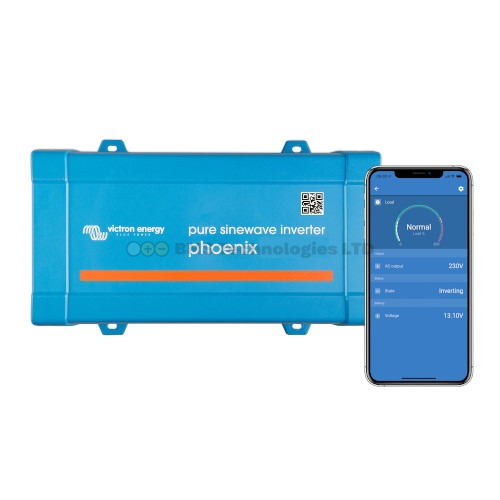
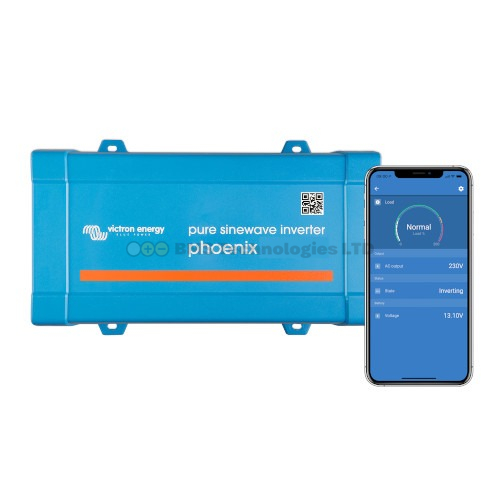
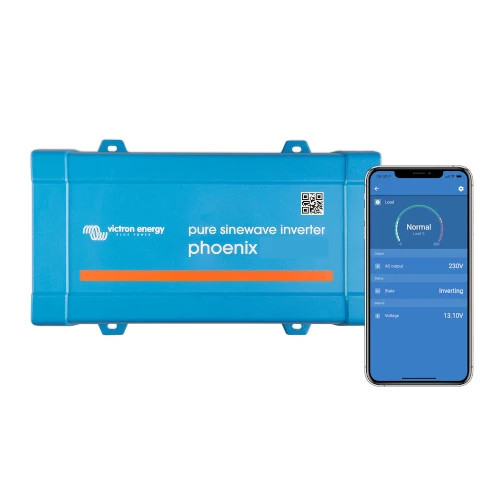
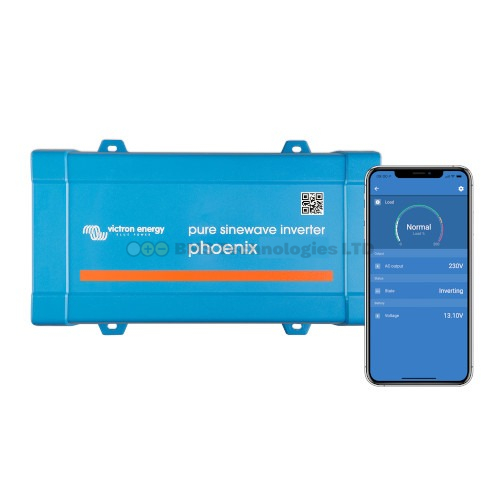
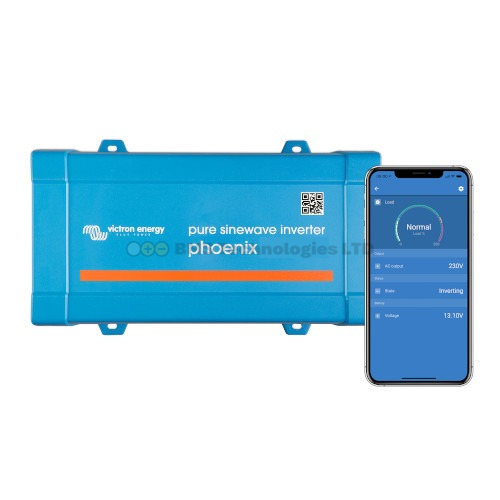
Phoenix inverters use: Phoenix Voltage/VA. These are pure inverters (no charger):
- Phoenix 12/1200 — 12V battery input, 1200VA output
- Phoenix 24/3000 — 24V battery input, 3000VA output
- Phoenix 48/500 — 48V battery input, 500VA output
The Phoenix Smart range adds Bluetooth connectivity. Some older Phoenix models use watts (W) rather than VA in the name — for example, the Phoenix Inverter 12/250 is a 250VA unit.
Phoenix Smart IP43 Chargers
Phoenix Smart IP43 Chargers use: Phoenix Smart IP43 Charger Voltage/Amps:
- Phoenix Smart IP43 Charger 12/50(3) — 12V output, 50A total, 3 outputs
- Phoenix Smart IP43 Charger 24/25(1+1) — 24V, 25A, with 1 main output plus 1 auxiliary
The number in brackets indicates the number of charging outputs. A "(3)" means three outputs for charging multiple battery banks simultaneously.
BlueSmart IP65 and IP22 Chargers
These mains chargers follow: Blue Smart IP65/IP22 Charger Voltage/Amps:
- Blue Smart IP65 Charger 12/25 — 12V, 25A, IP65-rated (waterproof)
- Blue Smart IP22 Charger 24/16(3) — 24V, 16A total across 3 outputs, IP22-rated (indoor)
The IP rating in the name tells you the enclosure protection level — see our IP ratings guide for details.
Orion-Tr DC-DC Converters and Chargers
The Orion-Tr range uses: Orion-Tr InputVoltage/OutputVoltage-Amps:
- Orion-Tr Smart 12/12-30 — 12V input, 12V output, 30A (a DC-DC charger for alternator-to-leisure battery)
- Orion-Tr 24/12-20 — 24V input, 12V output, 20A (a voltage converter stepping down 24V to 12V)
- Orion-Tr Smart 12/24-15 — 12V input, 24V output, 15A (step-up converter)
When both input and output voltages are the same (e.g., 12/12), it functions as a DC-DC charger rather than a voltage converter. This is essential for charging a leisure battery from a modern vehicle with a smart alternator.
Lynx Distributor, Shunt, and Smart BMS
The Lynx range does not use numerical suffixes in the same way. Instead, each product has a descriptive name:
- Lynx Distributor — fused DC busbar distribution system
- Lynx Shunt VE.Can — battery monitor with CAN-bus communication
- Lynx Smart BMS — battery management system for Victron Lithium batteries
- Lynx Power In — battery connection point with integrated fuse holder
SmartShunt and BMV Battery Monitors
Battery monitors use an amp-hour rating:
- SmartShunt 500A — handles up to 500A continuous measurement
- BMV-712 Smart — the "712" is a model number (successor to BMV-700 and BMV-702), not a voltage rating
The SmartShunt replaced the BMV range. The amperage rating (500A, 1000A, or 2000A) refers to the shunt's continuous current measurement capability, not the battery capacity.
GX Devices
GX products are named by form factor and connectivity rather than electrical ratings:
- Cerbo GX — the flagship system controller, with multiple ports and optional touchscreen
- Cerbo-S GX — compact variant of the Cerbo
- Venus GX — older generation system controller (discontinued, replaced by Cerbo)
- Color Control GX (CCGX) — older model with built-in screen (discontinued)
- Ekrano GX — GX device with large built-in touchscreen display
Victron Lithium Batteries
Victron batteries use: Voltage Ah - Type:
- Lithium SuperPack 12.8V/100Ah — 12.8V nominal, 100Ah capacity, built-in BMS
- Smart Lithium 25.6V/200Ah — 25.6V (24V nominal), 200Ah, requires external BMS
The "12.8V" and "25.6V" figures are the nominal voltages of LiFePO4 cells — 12.8V replaces a 12V lead-acid battery, 25.6V replaces a 24V bank.
Quick Reference Table
| Product Family | Format | Example | Meaning |
|---|---|---|---|
| MultiPlus / Quattro | V / VA / A - Transfer | 12/3000/120-50 | 12V, 3000VA, 120A charger, 50A transfer |
| SmartSolar MPPT | MaxPV / MaxOutput | 150/35 | 150V max PV, 35A max charge |
| Phoenix Inverter | V / VA | 12/1200 | 12V input, 1200VA output |
| Phoenix Charger | V / A (outputs) | 12/50(3) | 12V, 50A, 3 outputs |
| Orion-Tr | Vin / Vout - A | 12/12-30 | 12V in, 12V out, 30A |
| SmartShunt | Amps | 500A | 500A measurement range |
| Lithium Battery | V / Ah | 12.8V/200Ah | 12.8V nominal, 200Ah |
Tips for Comparing Models
- Always check battery voltage first — buying a 24V product for a 12V system is a costly mistake that happens more often than you would think
- VA is not the same as watts — most Victron inverters have a power factor of around 0.8, so a 3000VA inverter delivers roughly 2400W of real power
- MPPT controller sizing depends on your battery voltage — the same 150/35 controller handles ~500W at 12V but ~1000W at 24V
- "Smart" prefix means Bluetooth — this adds VictronConnect app access for monitoring and configuration
- Use our price comparison tool to find the best UK prices once you have identified your model
Conclusion
Victron's naming system is genuinely logical once you learn the patterns. The key numbers — voltage, power rating, and current — are always presented in the same order within each product family. Bookmark this guide as a quick reference when shopping for Victron products, and use our system builder tool if you need help picking the right combination of products for your installation.