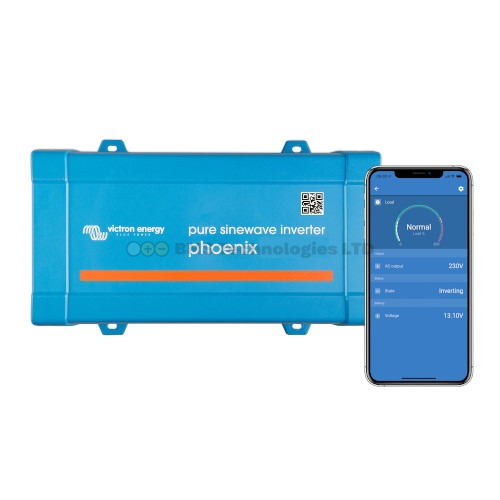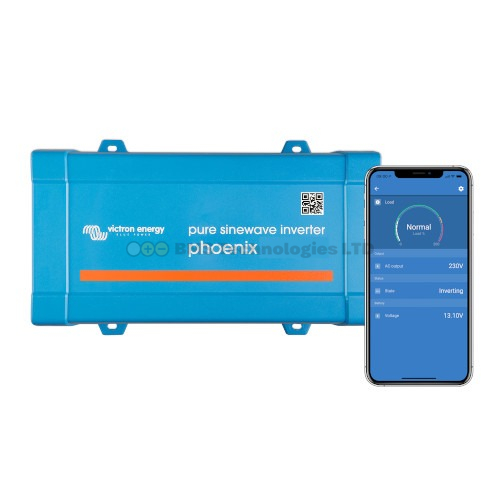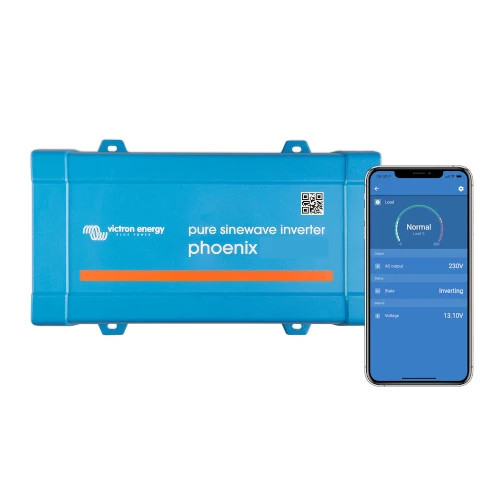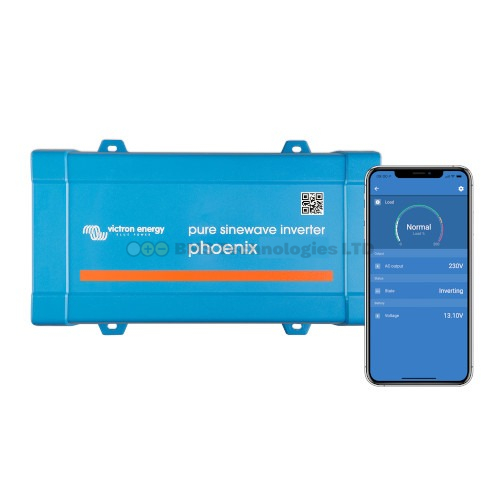
Getting the right size Victron inverter is crucial. Too small and it'll trip on overload every time you boil a kettle. Too large and you'll waste money on a unit that idles most of the time, drawing unnecessary standby power. This guide helps you calculate exactly what you need.
Understanding Inverter Ratings
Victron inverter ratings are expressed in VA (Volt-Amps), which is closely related to watts but not identical. For most household loads:
- Resistive loads (kettles, toasters, heaters): VA ≈ Watts. A 2000W kettle needs approximately 2000VA.
- Inductive loads (motors, compressors, power tools): VA > Watts due to power factor. A 1000W motor might need 1200–1500VA.
- Electronic loads (laptops, phone chargers, TVs): VA ≈ Watts for modern switch-mode power supplies.
For sizing purposes, use the watt rating of your appliances and add a 20% margin for safety.
Step 1: List Your AC Loads
Write down every AC appliance you'll run from the inverter, its power consumption in watts, and whether it has a significant startup surge.
Common Appliance Power Ratings
| Appliance | Running Watts | Startup Surge | Notes |
|---|---|---|---|
| Phone charger | 10–25W | Negligible | |
| Laptop charger | 45–100W | Negligible | |
| LED TV (32") | 30–50W | Negligible | |
| Hair dryer (low) | 1000W | Low | |
| Hair dryer (high) | 2000W | Low | |
| Kettle | 1800–3000W | Low | Check rating plate |
| Microwave (700W cooking) | 1000–1200W | Moderate | Input wattage is higher than cooking wattage |
| Toaster | 800–1500W | Low | |
| Washing machine | 500–2000W | High (motor start) | Surge can be 3× running |
| Air conditioning unit | 800–1500W | Very high (compressor) | Surge can be 5× running |
| Power drill | 500–1200W | High | |
| Coffee machine (espresso) | 1000–1500W | Moderate | |
| Induction hob (single ring) | 1000–2000W | Low |
Step 2: Calculate Your Peak Load
Add up the wattage of all appliances you might run simultaneously. This is your peak continuous load.
Example — campervan:
- Laptop charger: 65W
- Phone charger: 20W
- Coffee machine: 1200W
- LED lighting (via AC): 20W
- Peak total: 1,305W
Example — narrowboat:
- Microwave: 1200W
- TV: 40W
- Laptop: 65W
- Washing machine: 500W (running, not startup)
- Peak total: 1,805W
Step 3: Account for Surge Requirements
Many appliances draw a startup surge that's significantly higher than their running wattage. Electric motors (washing machines, power tools, air conditioners) are the worst offenders — startup surge can be 3–6× the running power.
Victron inverters handle surges well. Their peak power rating (short-duration) is typically double the continuous rating:
| Victron Model | Continuous Power | Peak Power (short duration) |
|---|---|---|
| Phoenix 800VA | 800VA / 650W | 1600W |
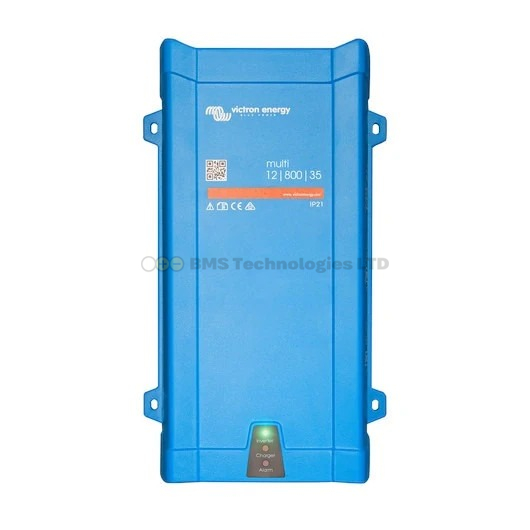
| Phoenix/MultiPlus 1200VA | 1200VA / 1000W | 2400W |
| Phoenix/MultiPlus 1600VA | 1600VA / 1300W | 3000W |
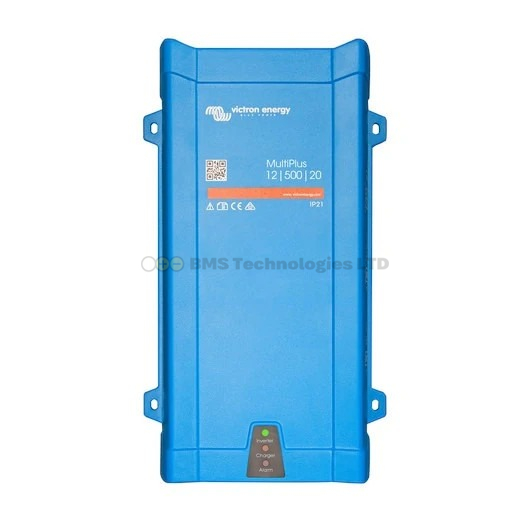
| MultiPlus 3000VA | 3000VA / 2400W | 6000W |
| MultiPlus 5000VA | 5000VA / 4000W | 10000W |
If your highest surge load (e.g., washing machine startup at 4500W) is within the peak power rating, the inverter will handle it.
Step 4: Choose Your Battery Voltage
Your battery voltage determines which inverter models are available and how much current the inverter draws from the battery:
Battery current = Inverter watts ÷ Battery voltage ÷ Inverter efficiency
| Inverter Size | Current at 12V | Current at 24V | Current at 48V |
|---|---|---|---|
| 1000W | ~95A | ~48A | ~24A |
| 2000W | ~190A | ~95A | ~48A |
| 3000W | ~285A | ~143A | ~71A |
| 5000W | Not available | ~238A | ~119A |
Key insight: 12V systems are limited to about 3000W maximum because the battery currents become impractically high above this. For systems above 2000W, 24V is strongly recommended. For systems above 5000W, go 48V.
Step 5: Select the Right Model
Choose an inverter with a continuous rating at least 20% above your calculated peak simultaneous load. This headroom accounts for:
- Power factor losses on inductive loads
- Temperature derating in hot environments
- Future load additions
Sizing Recommendations by Application
| Application | Typical Peak Load | Recommended Inverter | Battery Voltage |
|---|---|---|---|
| Campervan (basic) | 300–500W | Phoenix 500–800VA | 12V |
| Campervan (with coffee machine) | 1000–1500W | Phoenix/MultiPlus 1600VA | 12V |
| Motorhome (full kitchen) | 1500–2500W | MultiPlus 3000VA | 12V or 24V |
| Narrowboat | 2000–3000W | MultiPlus 3000VA | 24V |
| Sailing yacht | 1500–3000W | MultiPlus 1600–3000VA | 12V or 24V |
| Off-grid cabin | 3000–5000W | MultiPlus 5000VA | 24V or 48V |
| Off-grid home | 5000–10000W | MultiPlus-II 5000–8000VA (parallel) | 48V |
The Most Common Mistake: Oversizing for a Kettle
Many people buy a 3000VA inverter just to run a kettle. A standard UK kettle draws 2800–3000W. While the inverter can handle it, the battery impact is enormous — a 3000W kettle on a 12V system draws nearly 285A. A lithium battery can handle this briefly, but it's a huge load.
Consider alternatives:
- Low-wattage travel kettle (1000W) — works with a smaller, cheaper inverter
- 12V kettle — no inverter needed at all
- Gas hob + kettle — zero electrical load
Don't let a single appliance dictate your entire inverter budget.
Standby Power Consumption
Every inverter draws power even when no load is connected. For Victron inverters:
- Phoenix VE.Direct 250–1600VA: 8–15W standby
- Phoenix Smart 1600–5000VA: 15–25W standby
- MultiPlus 500–5000VA: 8–25W standby
Over 24 hours, 15W standby = 360Wh — that's a significant drain on a small battery system. If you only need the inverter occasionally, use its ECO mode (available on most Victron models) which reduces standby to near-zero by periodically pulsing the output to detect loads.
Summary
Size your Victron inverter by adding up your peak simultaneous loads, adding a 20% margin, and checking that startup surges fall within the inverter's peak power rating. Choose 12V for systems under 2000W, 24V for 2000–5000W, and 48V for larger installations. Don't oversize for a single high-power appliance like a kettle — consider lower-power alternatives instead.