UK narrowboats have unique electrical demands that set them apart from campervans, motorhomes, and even sea-going vessels. They're lived on for months or years at a time, cruise canals at low speed, moor in remote locations without shore power, and need reliable heating through British winters. This guide covers the best Victron products for narrowboats at three size categories, building a complete system for each.
Why Victron Works So Well on Narrowboats
Narrowboat electrical systems need to handle three charging sources (solar, engine alternator, shore power), provide reliable 230V for household appliances, and be monitored remotely when you're away from the boat. Victron's ecosystem handles all of this with components that integrate seamlessly via the VE.Bus, VE.Direct, and VE.Can communication networks. Everything appears on one screen through a Cerbo GX or similar GX device.
Narrowboat Electrical Basics
12V or 24V?
Most narrowboats under 57ft run 12V systems. The majority of marine equipment (nav lights, bilge pumps, horn, domestic 12V lighting) is designed for 12V. However, boats over 57ft with larger power demands benefit from 24V — lower currents mean thinner cables and less voltage drop over long cable runs from stern to bow. If you're fitting a system above 3000W inverter capacity, seriously consider 24V.
Key Narrowboat Considerations
- Engine room heat — components in the engine bay must tolerate high temperatures
- Damp environment — even inside, narrowboats have condensation issues in winter
- Long cable runs — a 60ft boat may need 20m+ total cable length from stern to bow
- Continuous cruiser vs moored — continuous cruisers rely more on solar and engine; moored boats have regular shore power
- Bow thruster bank — many narrowboats have a separate battery bank for the bow thruster, needing its own charging consideration
Small Narrowboat System (Under 40ft)
A smaller narrowboat typically has modest power demands: LED lighting, phone and laptop charging, a 12V fridge, water pump, and perhaps a small inverter for occasional 230V use. Total daily consumption is typically 60-100Ah at 12V.
| Component | Recommended Product | Why |
|---|---|---|
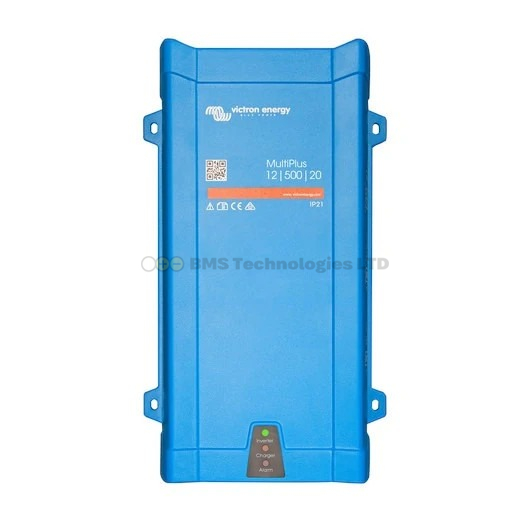
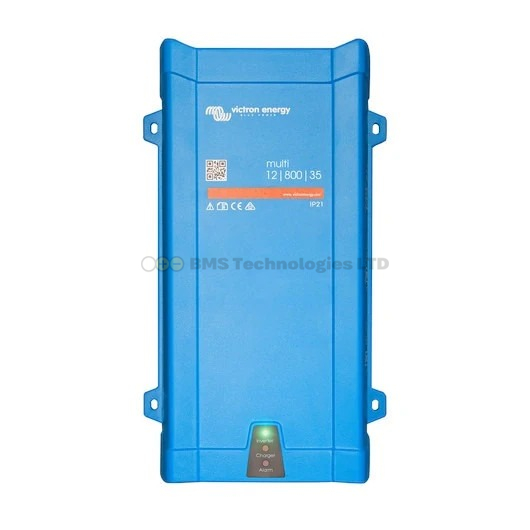
| Inverter/Charger | MultiPlus 12/1600/70 | Handles shore power charging, runs most appliances, compact enough for a small engine bay |
| Battery Bank | 2x Victron Lithium SuperPack 100Ah or 200Ah AGM bank | 200Ah lithium or 400Ah AGM gives 2+ days autonomy |
| Solar | 2x 175W panels + SmartSolar MPPT 100/30 | 350W covers summer needs; MPPT 100/30 handles two panels in series |
| Battery Monitor | SmartShunt 500A | Compact, Bluetooth accessible, accurate state-of-charge |
| DC-DC Charger | Orion-Tr Smart 12/12-30 | Charges house bank from engine alternator safely, essential for lithium |
| GX Device | Cerbo GX + GX Touch 50 | Central monitoring, VRM remote access, mount at the helm or saloon |
Medium Narrowboat System (40-57ft)
A typical 50ft liveaboard narrowboat runs a washing machine, microwave, TV, multiple lighting circuits, diesel heating with electrical fans, a large fridge-freezer, and charges power tools. Daily consumption is typically 150-250Ah at 12V.
| Component | Recommended Product | Why |
|---|---|---|
| Inverter/Charger | MultiPlus 12/3000/120 | Runs a washing machine, microwave, and most domestic loads. 120A charger makes the most of limited shore power time |
| Battery Bank | Victron Lithium Smart 200Ah x2 (or 400Ah+ AGM bank) | 400Ah lithium = usable 360Ah. Enough for a full day without charging |
| Solar | 4x 175W panels + SmartSolar MPPT 150/35 | 700W is the practical max for most narrowboat roofs at this size. Two strings of two panels in series |
| Battery Monitor | SmartShunt 500A | Handles the higher currents from a 3000VA inverter |
| DC-DC Charger | Orion-Tr Smart 12/12-30 (x2 if needed) | Two units can be paralleled for 60A charge rate from the engine |
| GX Device | Cerbo GX + GX Touch 70 | Larger screen suits a navigation station. Remote monitoring via VRM when away from the boat |
Large Narrowboat System (57ft+)
Large widebeam or 70ft narrowboats often function as permanent homes. They may have a full domestic kitchen, induction hob, tumble dryer, and workshop equipment. At this level, a 24V system starts making real sense — particularly with inverter loads above 3000W. Daily consumption can reach 200-400Ah at 24V.
| Component | Recommended Product | Why |
|---|---|---|
| Inverter/Charger | MultiPlus-II 24/5000/120 or Quattro 24/5000/120 | 5kVA handles induction hob, tumble dryer, full domestic loads. Quattro adds dual AC input (shore + generator) |
| Battery Bank | Victron Lithium Smart 200Ah 24V x2 (or x3) | 400-600Ah at 24V = serious capacity for full-time living |
| Solar | 6x 175W panels + SmartSolar MPPT 250/60 | 1050W is realistic for a 60ft+ roof. High-voltage MPPT handles long string in series efficiently |
| Battery Monitor | SmartShunt 500A | Still appropriate — 24V system draws lower currents |
| DC-DC Charger | Orion-Tr Smart 24/24-17 (or buck-boost) | Matches 24V system. Alternatively use a Cyrix-Li-ct for non-lithium |
| GX Device | Cerbo GX + GX Touch 70 | Full system monitoring, tank levels, temperature sensors |
| Generator Input | Quattro dual AC input | Accepts both shore power and generator simultaneously with automatic priority switching |
Additional Components for All Narrowboat Systems
Engine Starter Battery Charging
Keep the engine starter battery charged with a Cyrix-Li-Charge (for lithium house banks) or Cyrix-ct (for lead-acid). This connects the starter battery to the house charging system without risk of over-discharge.
Bow Thruster Battery
If your boat has a bow thruster with its own battery bank, a second Cyrix relay or a dedicated Orion-Tr DC-DC charger keeps it topped up from the house bank. The thruster bank only needs charging — it's not monitored as closely as the house bank.
Tank Level Monitoring
The Cerbo GX supports tank level sensors for fresh water, waste water, and diesel. On a narrowboat, knowing your water level is essential for planning when to fill up at a water point. Victron's resistive tank senders work with the Cerbo's tank inputs.
Installation Tips for Narrowboats
- Mount the MultiPlus in the engine bay — close to the battery bank keeps high-current cables short. Ensure adequate ventilation; engine bays get hot
- Run AC cables through conduit — protect 230V wiring from bilge water and mechanical damage
- Use tinned copper cable throughout — standard copper corrodes in the damp canal environment
- Mount the Cerbo GX in the saloon — where you can see it and where it stays dry. Use an Ethernet cable to the engine bay for VE.Bus connection if needed
- Fuse everything — see our campervan wiring mistakes guide for fuse placement guidance that applies equally to boats
For more on shore power integration, read our shore power charging guide for narrowboats. For solar installation specifics, see our narrowboat solar mounting guide. And for help choosing between the MultiPlus models, our 12V vs 24V MultiPlus marine guide covers the decision in detail.