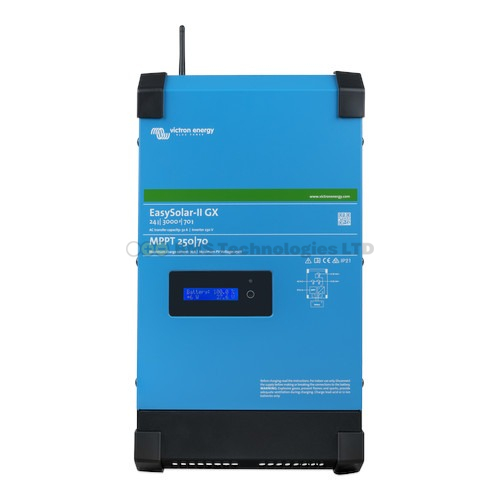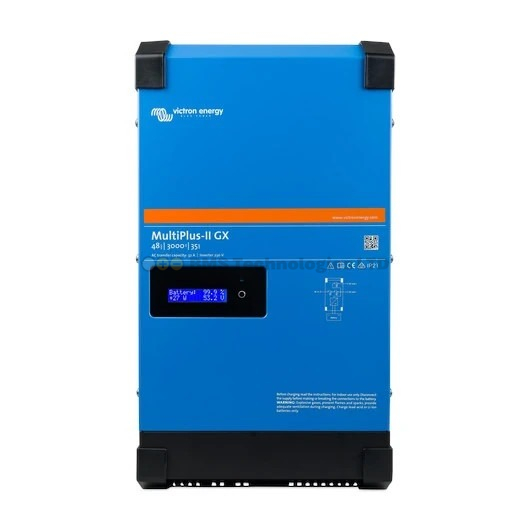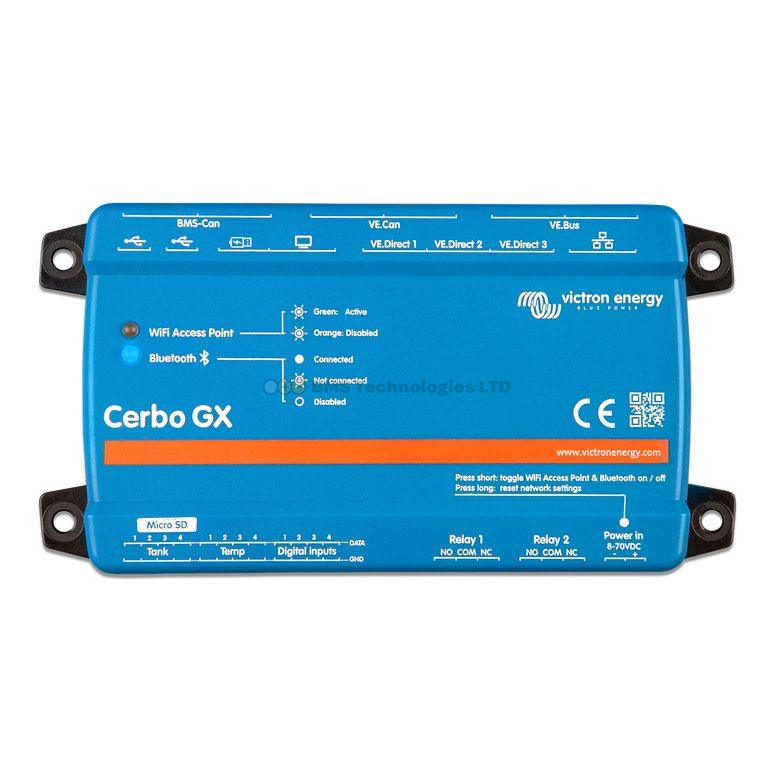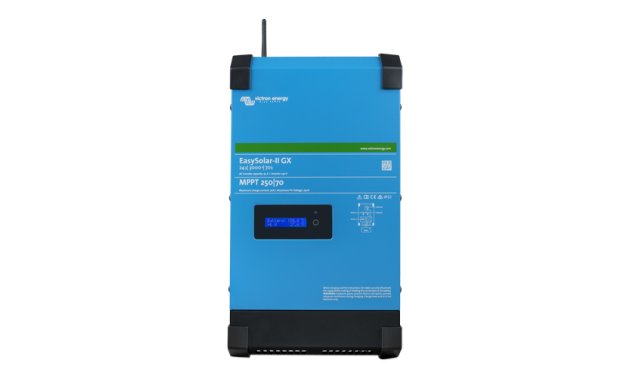
The Victron MultiPlus-II GX is essentially a standard MultiPlus-II with a Cerbo GX communication centre built into the same enclosure. The inverter/charger hardware is identical — same power ratings, same transfer switch, same firmware. The only difference is the integrated GX device. This guide helps you decide whether that integration is worth the premium or whether a separate GX makes more sense for your system.
Quick Answer
If you are building a simple, single-inverter system and want the tidiest install with the fewest cables, the MultiPlus-II GX is a great choice. If you plan to run parallel or three-phase inverters, need a touchscreen, or already own a GX device, buy the standard MultiPlus-II and a separate Cerbo GX.
What Is a GX Device?
Victron's GX family — Cerbo GX, Cerbo-S GX, Venus GX, Color Control GX — acts as the central communications hub for an energy system. It connects to inverters, solar chargers, battery monitors, and batteries via VE.Bus, VE.Direct, and VE.Can, then presents everything on the VRM online portal and an optional local touchscreen. Without a GX device you can still use the VictronConnect app over Bluetooth, but you lose remote monitoring, advanced scheduling, ESS control, and DVCC (Distributed Voltage & Current Control).
Available Models Side-by-Side
| Model | Standard MultiPlus-II | MultiPlus-II GX |
|---|---|---|
| 24V / 3000VA / 70A | MultiPlus-II 24/3000/70-32 | MultiPlus-II GX 24/3000/70-32 |
| 48V / 3000VA / 35A | MultiPlus-II 48/3000/35-32 | MultiPlus-II GX 48/3000/35-32 |
| 48V / 5000VA / 70A | MultiPlus-II 48/5000/70-50 | MultiPlus-II GX 48/5000/70-50 |
The GX variant is only available in three sizes. The standard MultiPlus-II line extends much further — from the 12V/3000VA up to the flagship 48V/15000VA — with nine models in total. Six have no GX equivalent: the 12/3000, 12/5000, 24/5000, 48/8000, 48/10000, and 48/15000.
Identical Inverter Hardware
Where a GX model exists, the inverter/charger inside is the same as the standard unit:
- Same continuous power and peak ratings
- Same charger current and charge algorithms
- Same 32A or 50A transfer switch
- Same PowerAssist capability
- Same grid code and ESS compliance
- Same efficiency (approximately 95-96%)
The firmware for the inverter section is updated independently of the GX section, exactly as it would be on a standalone unit.
What the Built-in GX Adds
The integrated GX module provides everything a standalone Cerbo GX does:
- VRM portal access — remote monitoring, historical data, and advanced configuration via the cloud
- DVCC — Distributed Voltage & Current Control for coordinated battery charging across multiple sources
- ESS assistant — Energy Storage System mode for grid-tied self-consumption, scheduled charging, and feed-in
- VE.Direct ports — two ports for solar chargers or battery monitors
- VE.Can port — for Lynx Smart BMS, MPPT RS, or other CAN-bus devices
- Ethernet & Wi-Fi — internet connectivity for VRM and remote firmware updates
- USB port — for GPS, temperature sensors, or additional VE.Direct adapters
- Relay outputs — for generator auto-start, alarms, or custom triggers
What the Built-in GX Lacks
There are a few things a standalone Cerbo GX can do that the integrated GX module cannot:
- Touchscreen support — the MultiPlus-II GX has no HDMI output for a GX Touch 50 or GX Touch 70 display. You rely on VRM or VictronConnect for monitoring.
- Bluetooth — the Cerbo GX has built-in Bluetooth for temperature sensors and Ruuvi tags. The GX module in the MultiPlus-II GX does not.
- Physical placement — a separate Cerbo GX can be mounted at eye level near a display, while the MultiPlus-II is typically mounted low on a wall or inside a cabinet.
Parallel & Three-Phase Limitation
This is the most important technical difference. In a parallel or three-phase system only one GX device should be present on the VE.Bus network. If you buy three MultiPlus-II GX units for a three-phase setup, you must disable the GX module in two of them — meaning you paid for three GX devices but only use one. The standard approach is:
- Parallel / three-phase: buy standard MultiPlus-II units + one separate Cerbo GX
- Single inverter: MultiPlus-II GX is ideal
Price Comparison
The GX premium varies by model. Here are current UK prices compared with buying the standard MultiPlus-II plus a separate Cerbo GX:
| Configuration | Price Range | Notes |
|---|---|---|
| MultiPlus-II GX 24/3000/70 | £663 – £1,169 | All-in-one |
| MultiPlus-II 24/3000/70 + Cerbo GX | £887 – £1,152 | Two separate units |
| MultiPlus-II GX 48/3000/35 | £350 – £572 | All-in-one |
| MultiPlus-II 48/3000/35 + Cerbo GX | £569 – £851 | Two separate units |
| MultiPlus-II GX 48/5000/70 | £516 – £900 | All-in-one |
| MultiPlus-II 48/5000/70 + Cerbo GX | £731 – £1,101 | Two separate units |
In most cases the GX variant is cheaper or comparable to buying the two units separately — and you save DIN rail space, cabling, and a power supply. The separate route only wins when you need features the integrated GX cannot provide.
Installation Differences
MultiPlus-II GX Install
- Mount one box on the wall
- Connect AC in, AC out, battery, and an Ethernet cable
- Plug solar chargers or BMS into the VE.Direct/VE.Can ports on the front
- No additional power supply needed for the GX — it draws from the inverter
Standard MultiPlus-II + Cerbo GX Install
- Mount the inverter on the wall and the Cerbo GX on a DIN rail (or flat surface)
- Run a VE.Bus RJ45 cable between the Cerbo and the MultiPlus-II
- Power the Cerbo from an 8-70V DC supply (typically tapped from the battery bus)
- Connect Ethernet, VE.Direct, VE.Can as needed
- Optional: connect a GX Touch 50 or GX Touch 70 via HDMI
Upgrade & Expansion Flexibility
A separate Cerbo GX gives you more headroom:
- If you later add a second inverter for parallel operation, one Cerbo GX manages both — no wasted GX modules
- If the GX hardware needs replacing (rare), you swap a small box instead of sending back your inverter
- Future GX products (e.g. Cerbo-S GX, Ekrano GX) can slot in without changing your inverter
- A touchscreen display can be added at any time
The MultiPlus-II GX suits set-and-forget installations where the system scope is unlikely to change.
Choose the MultiPlus-II GX If...
- You are building a single-inverter system
- You want the simplest, tidiest install with fewest cables
- You do not need a touchscreen (VRM on a phone or tablet is sufficient)
- Your chosen model exists in the GX range (24/3000, 48/3000, or 48/5000)
- You want to save money — the all-in-one is usually cheaper than buying separately
Choose the Standard MultiPlus-II + Cerbo GX If...
- You plan to run parallel or three-phase inverters
- You want a GX Touch 50 or GX Touch 70 display
- You need a model not available in the GX range (12/3000, 12/5000, 24/5000, 48/8000, 48/10000, or 48/15000)
- You want the GX device mounted separately from the inverter (e.g. at eye level)
- You anticipate expanding the system in future
- You want Bluetooth for Ruuvi temperature sensors
Bottom Line
The MultiPlus-II GX is a smart, cost-effective choice for simple single-inverter installations. The built-in GX module gives you full VRM monitoring, ESS control, and DVCC without extra boxes or cables. But if your system will grow, needs a touchscreen, or uses multiple inverters, the separate Cerbo GX route is more flexible and ultimately more practical. Either way, the inverter hardware is identical — you are never compromising on power.