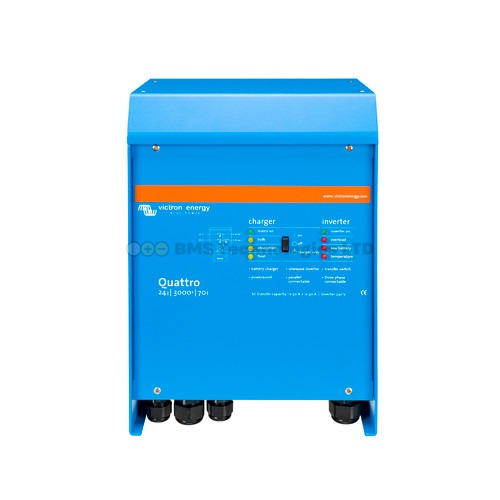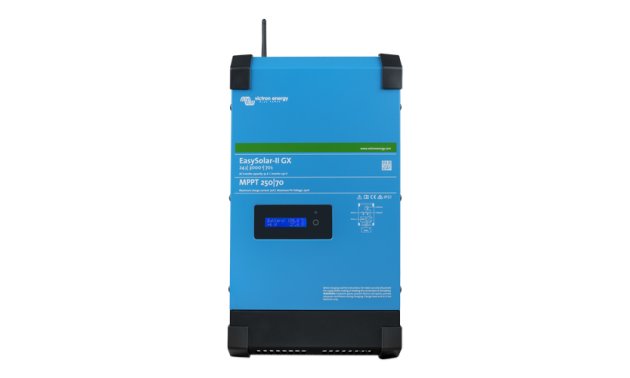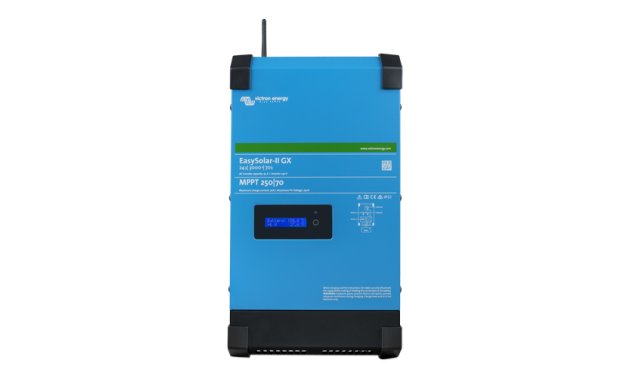
The Victron Quattro and MultiPlus-II are both inverter/chargers that convert DC battery power into AC mains electricity and charge your batteries from an external AC source. They share the same VE.Bus communication, the same GX device compatibility, and the same VRM remote monitoring. The critical difference is that the Quattro has two AC inputs while the MultiPlus-II has one. This guide explains when that second input justifies the higher cost and larger footprint.
Quick Answer
Choose the MultiPlus-II if you have a single AC source (grid or generator, not both wired permanently). Choose the Quattro if you need grid and generator connected simultaneously, or if you want automatic failover between two independent AC supplies without an external transfer switch.
Key Differences at a Glance
| Feature | MultiPlus-II | Quattro |
|---|---|---|
| AC inputs | 1 | 2 (with priority switching) |
| AC outputs | 2 | 2 |
| System voltages | 12V, 24V, 48V | 24V, 48V |
| VA range (230V) | 3000 – 15000VA | 3000 – 15000VA |
| Grid code compliance (ESS) | Yes (G98/G99) | No (off-grid only) |
| Anti-islanding | Built-in | No |
| Transfer switch | 32A, 50A, or 100A | 2 x 50A or 2 x 100A |
| Standby consumption | Lower (~9W) | Higher (~15–20W) |
| 12V models available | Yes (3000VA, 5000VA) | No |
| Typical use case | Grid-tied ESS, single-source off-grid | Dual-source off-grid, marine, commercial |
| Price range | From ~£430 | From ~£1,220 |
The Dual AC Input Explained
The Quattro's defining feature is its two independent AC inputs, each with its own transfer switch. You can permanently connect both your grid supply and a generator (or two grid phases, or shore power and a generator) and assign a priority to each. The Quattro will automatically switch between them based on availability and your configured priority — no external automatic transfer switch (ATS) required.
The MultiPlus-II has a single AC input. If you need both grid and generator, you must install an external ATS to switch between them before the power reaches the MultiPlus-II. This adds cost, complexity, and another potential point of failure.
Grid Code Compliance & ESS
This is where the MultiPlus-II has a clear advantage. The MultiPlus-II supports grid codes (G98/G99 in the UK, VDE-AR-N 4105, AS4777, and more) and has built-in anti-islanding protection. This means it can legally feed energy back into the grid and run Victron's ESS (Energy Storage System) mode for self-consumption optimisation, scheduled charging, and Dynamic ESS with time-of-use tariffs.
The original Quattro does not support grid codes or ESS. It is designed for off-grid and backup use only. If you want to feed solar energy back to the grid or use time-of-use tariff optimisation, you need the MultiPlus-II (or the newer Quattro-II, which does support ESS).
What About the Quattro-II?
Victron has released the Quattro-II as a modern replacement for the original Quattro. It combines the dual AC input of the Quattro with the grid code compliance and ESS capability of the MultiPlus-II. Currently available in 48V at 5000VA and 10000VA, the Quattro-II is the best of both worlds — but the model range is still limited compared to the original Quattro.
| Feature | Quattro (original) | Quattro-II |
|---|---|---|
| Grid code / ESS | No | Yes |
| Anti-islanding | No | Yes |
| Standby power | Higher | Lower |
| 48V models | 3000 – 15000VA | 5000VA, 10000VA |
| 24V models | 3000VA, 5000VA | Not yet available |
Model Range Comparison
MultiPlus-II (230V)
| Model | Charger | Transfer Switch | Price Range |
|---|---|---|---|
| 12/3000/120-32 | 120A | 32A | £825 – £1,174 |
| 12/5000/220-50 | 220A | 50A | Check price |
| 24/3000/70-32 | 70A | 32A | £746 – £893 |
| 24/5000/120-50 | 120A | 50A | £1,175 – £1,574 |
| 48/3000/35-32 | 35A | 32A | £428 – £592 |
| 48/5000/70-50 | 70A | 50A | £590 – £842 |
| 48/8000/110-100 | 110A | 100A | £1,235 – £1,300 |
| 48/10000/140-100 | 140A | 100A | £1,233 – £1,738 |
| 48/15000/200-100 | 200A | 100A | Check price |
Quattro (230V)
| Model | Charger | Transfer Switch | Price Range |
|---|---|---|---|
| 24/3000/70-2x50 | 70A | 2 x 50A | £1,342 – £2,188 |
| 24/5000/120-2x100 | 120A | 2 x 100A | £1,503 – £2,113 |
| 48/3000/35-2x50 | 35A | 2 x 50A | Check price |
| 48/5000/70-2x100 | 70A | 2 x 100A | £1,223 – £1,978 |
| 48/8000/110-2x100 | 110A | 2 x 100A | £1,333 – £1,690 |
| 48/10000/140-2x100 | 140A | 2 x 100A | £1,624 – £2,020 |
| 48/15000/200-2x100 | 200A | 2 x 100A | £2,150 – £2,580 |
Pricing: The Quattro Premium
At equivalent power ratings, the Quattro costs significantly more than the MultiPlus-II. For example, at 48V/5000VA the MultiPlus-II starts from around £590 while the Quattro starts from around £1,220 — roughly double the price. This premium buys you the second AC input and its associated transfer switch hardware.
If you do not need the dual AC input, the MultiPlus-II delivers identical inverter performance at substantially lower cost.
Physical Size & Weight
The Quattro is physically larger and heavier than an equivalent MultiPlus-II due to the additional transfer switch and AC input circuitry. At 48V/5000VA, the Quattro weighs approximately 35kg compared to 30kg for the MultiPlus-II. The Quattro is also deeper, which matters in tight installations like boat engine rooms or campervan electrical compartments.
Parallel & Three-Phase
Both the MultiPlus-II and Quattro support parallel operation (up to six units) and three-phase configurations. The rules are the same: all units in a parallel or three-phase group must be the same model and firmware version. You cannot mix MultiPlus-II and Quattro units in the same group.
One consideration: for the MultiPlus-II 8000VA, 10000VA, and 15000VA models, parallel operation requires an external AC transfer switch. The smaller MultiPlus-II models and all Quattro models can be paralleled without this requirement.
Efficiency & Standby Power
The MultiPlus-II is more efficient at idle. It draws approximately 9W in standby compared to approximately 15–20W for the Quattro (varying by model). Under load, peak efficiency is similar at 95–96% for both. The difference matters most in systems that spend long periods in standby, such as backup power installations.
Choose the MultiPlus-II If...
- You have a single AC source (grid only, or generator only, switching manually)
- You want ESS and grid-tied operation with self-consumption, feed-in, or Dynamic ESS
- You need grid code compliance (G98/G99 in the UK)
- You want the lowest cost for a given power rating
- You need a 12V system (Quattro has no 12V models)
- Space and weight are limited (campervans, small boats)
- You want lower standby power consumption
Choose the Quattro If...
- You need grid and generator permanently wired with automatic switching
- You have two independent AC supplies (e.g. two shore power connections on a marina berth)
- Your system is off-grid only and you do not need ESS or grid code compliance
- You want the dual AC input built-in without adding an external ATS
- You are building a large commercial or marine installation
Consider the Quattro-II If...
- You need dual AC inputs AND grid code compliance
- You want ESS with automatic generator failover
- A 48V/5000VA or 48V/10000VA model fits your power needs
- You want the latest Victron technology with lower standby consumption
Bottom Line
For the majority of UK home installations, the MultiPlus-II is the right choice. It costs less, supports ESS and grid codes, and covers power ratings from 3000VA to 15000VA. The Quattro earns its place in off-grid systems where grid and generator must both be permanently connected, or in marine and commercial setups with multiple AC supplies. If you need dual AC inputs and grid compliance, look at the Quattro-II — though its model range is still growing.