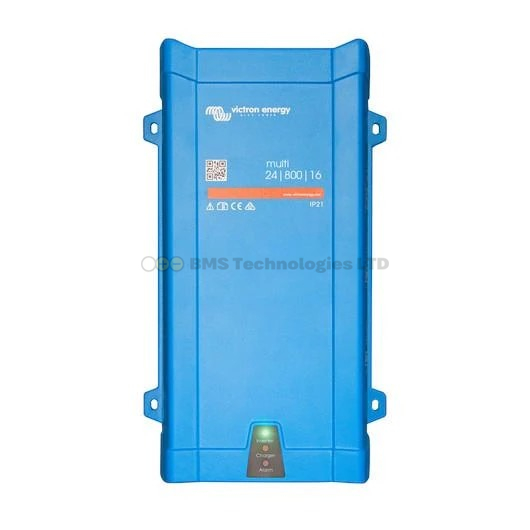
Installing a Victron inverter or inverter/charger in the UK means complying with BS 7671 (the IET Wiring Regulations). One of the most common questions — and sources of confusion — is what type of RCD and MCB protection you need on the inverter output. This guide covers the regulatory requirements, explains the DC leakage problem that causes RCD nuisance tripping, and gives practical guidance on MCB and consumer unit selection.
Why Inverter Outputs Need Protection
The AC output of a Victron MultiPlus, Phoenix inverter, or any other inverter is a live 230V supply. It presents the same electric shock and fire risks as a mains supply. BS 7671 requires that all AC circuits are properly protected with overcurrent devices (MCBs or fuses) and, in most cases, residual current devices (RCDs) for shock protection.
The fact that the 230V is generated from a battery rather than from the grid does not exempt you from these requirements. If anything, inverter installations require more careful consideration because of their unique electrical characteristics.
MCB Sizing for Inverter Output Circuits
Basic Principles
MCBs (miniature circuit breakers) protect against overcurrent — both overloads and short circuits. The MCB rating on each circuit must be sized based on the cable current-carrying capacity and the expected load, just as with any mains installation.
Recommended MCB Sizes for Common Circuits
| Circuit | Typical MCB Rating | Cable Size (minimum) | Notes |
|---|---|---|---|
| LED lighting | 6A Type B | 1.0mm² | Ample for LED circuits |
| General sockets | 16A Type B | 2.5mm² | Standard ring or radial |
| Water heater | 16A Type B | 2.5mm² | Dedicated circuit recommended |
| Microwave / kitchen | 16A Type B | 2.5mm² | High-draw appliances |
| Air conditioning | 16A or 20A Type C | 2.5mm² or 4.0mm² | Motor start current needs Type C |
| Inverter main feed | 32A Type B | 6.0mm² | From MultiPlus to consumer unit |
Type B vs Type C MCBs
Type B MCBs trip at 3–5 times their rated current and are correct for most resistive and general loads (lighting, sockets, heating elements). Type C MCBs trip at 5–10 times rated current and should be used for circuits with high inrush currents, such as motor-driven appliances (compressor fridges, air conditioning units, pumps).
In a vehicle or boat installation, Type B is the standard choice. Use Type C only where you have confirmed motor loads that cause nuisance tripping on Type B breakers.
The Inverter's Own Current Limit
Remember that the inverter itself has a maximum output current. A MultiPlus 12/2000/80 has a maximum continuous AC output of approximately 8.7A at 230V. There is no point installing a 32A ring main behind a 2000VA inverter — the inverter will overload before the MCB ever trips. Size your MCBs to protect the cable, but be aware that the inverter's output capacity is the practical upper limit for total load.
RCD Protection: The Critical Decision
When You Need an RCD
BS 7671 requires RCD protection (rated at 30mA) for:
- All socket outlet circuits rated up to 32A (Regulation 411.3.3)
- Circuits in bathrooms and shower rooms (Section 701)
- Circuits supplying mobile equipment outdoors (Regulation 411.3.3)
- All circuits in caravans and motorhomes (Section 721)
- All circuits in boats (BS EN ISO 13297)
In practice, this means almost every circuit on a Victron inverter output needs RCD protection in a motorhome, caravan, or boat installation. For fixed domestic or commercial installations, socket outlets similarly require RCD protection.
The DC Leakage Problem with Inverters
This is where inverter installations get complicated. A standard Type AC RCD is designed to detect AC earth leakage current only. A Type A RCD detects both AC and pulsating DC fault currents. A Type B RCD detects AC, pulsating DC, and smooth DC fault currents.
Inverters produce a modified or pure sine wave output, but certain connected loads — particularly those with switch-mode power supplies, variable-speed drives, or electronic motor controls — can produce DC fault current components on the AC circuit. If a DC leakage current develops downstream of a Type A or Type AC RCD, the RCD may fail to trip because it cannot detect the DC component. This is a genuine safety hazard.
Type A vs Type B RCDs: What Does Victron Recommend?
Victron's official position is that a Type A RCD is sufficient for the output of their pure sine wave inverters in most installations. The reasoning is that a true pure sine wave inverter does not itself generate DC components — it is the connected loads that may do so.
However, BS 7671 Regulation 531.3.3 states that where an RCD is used, it must be suitable for the type of fault current that may occur. If you connect equipment with variable-speed drives, certain EV chargers, or other DC-producing loads to the inverter output, a Type B RCD may be required for those circuits.
| RCD Type | Detects | Typical Cost | When to Use |
|---|---|---|---|
| Type AC | AC residual current only | £15–25 | Not recommended for inverter installations |
| Type A | AC + pulsating DC | £25–50 | Standard choice for most inverter output circuits |
| Type B | AC + pulsating DC + smooth DC | £150–350 | Required for circuits with VFDs, EV chargers, certain motor loads |
| Type F | AC + pulsating DC + mixed frequency | £80–150 | For circuits with frequency inverters (heat pumps, etc.) |
Why Some RCDs Trip with Inverters (Nuisance Tripping)
Nuisance tripping is a frequent complaint in inverter installations. Common causes include:
- Capacitive leakage in appliances: many modern appliances have EMC filter capacitors that create a small standing leakage current. On mains power, each appliance contributes perhaps 1–3mA. Add enough appliances and the cumulative leakage approaches the 30mA trip threshold.
- Inrush current on power-up: when the inverter starts and energises all connected loads simultaneously, the combined inrush can briefly exceed the RCD's trip threshold. A time-delayed (Type S) RCD can help here.
- Poor neutral-earth bonding: if the neutral-earth bond is not correctly configured on the inverter output, the RCD may not operate correctly or may trip spuriously.
- Long cable runs: in boats and large motorhomes, long cable runs increase capacitive leakage to earth, particularly in damp environments.
Solutions for Nuisance Tripping
- Split the load across multiple RCDs: rather than one 30mA RCD protecting all circuits, use separate RCDs for different circuit groups. This reduces the cumulative leakage per RCD.
- Use an RCBO per circuit: an RCBO combines an MCB and RCD in one device. Each circuit gets its own 30mA protection, so one faulty appliance does not take out the entire system.
- Time-delayed (Type S) RCD: a Type S RCD has a built-in delay of around 40ms, which prevents tripping on brief transient currents during startup.
- Check earth bonding: ensure the MultiPlus ground relay is correctly configured (or that a manual neutral-earth bond is present on the inverter output when appropriate).
Consumer Unit Requirements
Motorhomes and Caravans
BS EN 1648 requires that motorhome and caravan AC installations have a consumer unit with:
- Double-pole isolation (main switch that breaks both line and neutral)
- 30mA RCD protection on all circuits
- Individual MCB protection per circuit
- IP rating appropriate for the installation location (minimum IP40 for internal mounting)
A compact consumer unit with a 40A or 63A double-pole main switch, Type A RCD(s), and individual MCBs is the standard approach. See our motorhome consumer unit wiring guide for a detailed walkthrough.
Boats
BS EN ISO 13297 applies to boat electrical installations. Requirements include 30mA RCD protection and proper isolation from shore earth (galvanic isolation). The consumer unit must be suitable for the marine environment — moisture-resistant enclosures and tinned copper connections are essential.
Domestic and Commercial
For fixed installations in homes and commercial premises, the consumer unit must comply with BS 7671 Part 4 (protection for safety) and Part 5 (selection and erection of equipment). Amendment 2 of BS 7671 requires consumer units in domestic premises to be constructed of non-combustible material (metal consumer units). The same applies to consumer units on inverter output circuits.
Split-Load Consumer Unit Design
A split-load consumer unit has two busbar sections, each protected by its own RCD. This is the recommended approach for inverter installations because:
- If one RCD trips, circuits on the other RCD remain live
- Essential circuits (lighting, fridge) can be on a separate RCD from non-essential circuits (sockets, entertainment)
- It reduces the cumulative leakage current per RCD, minimising nuisance tripping
A typical split-load design for a motorhome might use a 40A Type A RCD for essential circuits (lighting, water pump, fridge) and a second 40A Type A RCD for socket circuits.
Inverter Main Feed Protection
The cable from the MultiPlus AC output to the consumer unit needs overcurrent protection. Options include:
- MCB at the consumer unit: a main switch MCB rated to protect the feed cable (typically 32A for 6.0mm² cable)
- The MultiPlus's own output protection: the MultiPlus has an internal current limit and will shut down on overload, but this does not protect the cable against all fault conditions — an MCB is still required
The MCB rating must not exceed the current-carrying capacity of the cable from the inverter to the consumer unit. Refer to BS 7671 Appendix 4 for cable current ratings based on installation method.
Professional Installation Requirements
In England and Wales, fixed electrical work is notifiable under Part P of the Building Regulations. This includes installing a new consumer unit or adding circuits in a dwelling. A competent person (registered with a Part P scheme such as NICEIC, NAPIT, or ELECSA) should carry out or certify the work.
For motorhomes and boats, while Part P does not directly apply, the NCC (National Caravan Council) requires compliance with BS EN 1648 for habitation areas. Insurance claims may be rejected if electrical work was not carried out to the relevant standard by a competent person.
Even if you are confident in your abilities, having a qualified electrician inspect and sign off the inverter output wiring is strongly recommended. An Electrical Installation Certificate (EIC) or Minor Works Certificate provides documentation that the work meets BS 7671.
Summary Checklist
- Use Type A RCDs as minimum for inverter output circuits (avoid Type AC)
- Consider Type B RCDs if you have VFD loads, EV chargers, or DC-producing equipment
- Size MCBs to protect cables, not to match inverter output — the inverter is the practical current limit
- Use Type B MCBs for general loads, Type C for motor loads with high inrush
- Split the load across multiple RCDs or use RCBOs to prevent nuisance tripping
- Ensure correct neutral-earth bonding on the inverter output
- Use a metal, non-combustible consumer unit for domestic installations
- Have work inspected by a qualified electrician and obtain appropriate certification
For help choosing the right Victron inverter or MultiPlus for your installation, use our price comparison tool or try the system builder.