The Victron MultiPlus and MultiPlus-II are the two most popular inverter/chargers in the Victron Energy range. Both convert DC battery power into AC mains electricity and charge your batteries from shore power or a generator — but they differ in key areas like power output, grid compliance, and smart features.
If you're building an off-grid system for a campervan, narrowboat, sailing yacht, or home battery setup, choosing between these two is one of the most important decisions you'll make. This guide breaks down every difference so you can pick the right one.
Quick Summary
The MultiPlus is the original, proven inverter/charger that has been the backbone of off-grid Victron systems for years. It's available in smaller sizes (from 500VA), costs less, and is ideal for simple campervan and boat installations that don't need grid connection.
The MultiPlus-II is the newer, more capable unit. It starts at 3000VA, supports grid-tied and off-grid use, complies with modern grid codes (G98/G99 in the UK), and draws less standby power. It's the right choice for home energy storage, larger off-grid systems, and any installation that connects to the mains grid.
Key Differences at a Glance
| Feature | MultiPlus | MultiPlus-II |
|---|---|---|
| Size range | 500VA to 5000VA | 3000VA to 15000VA |
| System voltages | 12V, 24V, 48V | 12V, 24V, 48V |
| Grid code compliance | No | Yes (G98/G99, AS4777, etc.) |
| ESS compatible | No | Yes |
| External current limit | Via digital multi control only | Built-in, adjustable via GX |
| Transfer switch rating | 16A or 50A | 32A, 50A, or 100A |
| Anti-islanding protection | No | Yes |
| Standby power consumption | Higher (~11W typical) | Lower (~9W typical) |
| Parallel and three-phase | Up to 6 units | Up to 6 units |
| PowerAssist | Yes | Yes (improved) |
| Price range | From around £200 | From around £430 |
Power Output and Size Range
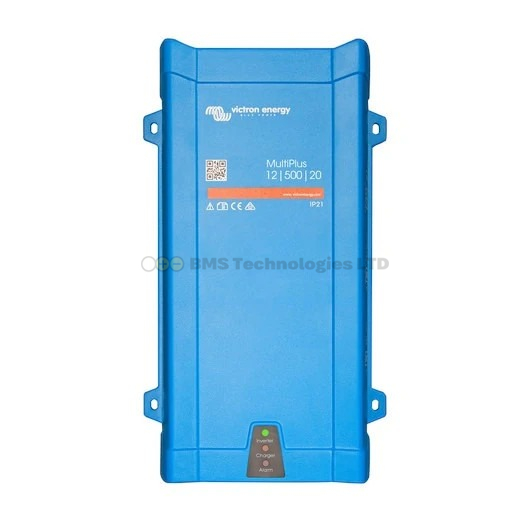
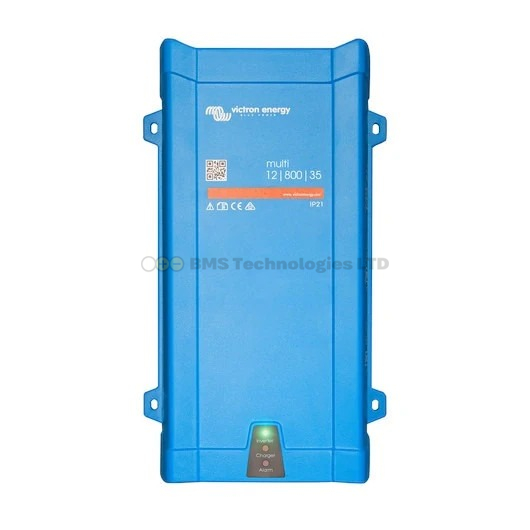
The MultiPlus covers small to medium power needs. The range starts at just 500VA in 12V and 24V configurations, making it practical for compact campervan builds where space and budget are tight. The largest MultiPlus model is the 48/5000/70-50 at 5000VA.
The MultiPlus-II starts higher at 3000VA but extends all the way to 15000VA. If you need less than 3000VA, the MultiPlus is your only option within this product family. If you need 8000VA, 10000VA, or 15000VA, only the MultiPlus-II can deliver that.
MultiPlus model range
| Voltage | Models available | Power range |
|---|---|---|
| 12V | 500VA, 800VA, 1200VA, 1600VA | 500 – 1600VA |
| 24V | 500VA, 800VA, 1200VA, 1600VA, 3000VA | 500 – 3000VA |
| 48V | 800VA, 1200VA, 3000VA, 5000VA | 800 – 5000VA |
MultiPlus-II model range
| Voltage | Models available | Power range |
|---|---|---|
| 12V | 3000VA, 5000VA | 3000 – 5000VA |
| 24V | 3000VA, 5000VA | 3000 – 5000VA |
| 48V | 3000VA, 5000VA, 8000VA, 10000VA, 15000VA | 3000 – 15000VA |
Grid Code Compliance and ESS
This is the single biggest technical difference between the two units and the main reason Victron developed the MultiPlus-II.
The MultiPlus-II supports grid code compliance — meaning it meets the regulatory standards required to feed energy back into the grid or operate alongside a grid connection. In the UK, this means G98 (for systems under 3.68kW) and G99 (for larger installations). Other supported standards include AS4777 (Australia), VDE-AR-N 4105 (Germany), and many more.
The original MultiPlus does not support grid codes. It's designed purely for off-grid or backup use. You can connect it to shore power for passthrough and charging, but it cannot legally feed energy into the national grid.
This also means only the MultiPlus-II supports ESS (Energy Storage System) mode — the Victron software that manages battery charging from solar, grid usage optimisation, and feed-in to the grid. If you're building a home battery system to store solar energy and reduce electricity bills, you need the MultiPlus-II.
Transfer Switch
Both units include a built-in transfer switch that automatically switches your loads between inverter power and external AC (shore power or generator). The key difference is the rating of that switch.
The MultiPlus comes with either a 16A or 50A transfer switch depending on the model. The smaller 500VA to 1600VA models have a 16A switch, while the 3000VA and 5000VA models have a 50A switch.
The MultiPlus-II offers 32A, 50A, or 100A transfer switches. The 3000VA models typically have a 32A switch, the 5000VA models have 50A, and the 8000VA, 10000VA, and 15000VA models have 100A. The higher 32A base rating on the MultiPlus-II is useful for homes and larger boats where the shore power connection exceeds 16A.
PowerAssist
Both the MultiPlus and MultiPlus-II feature Victron's PowerAssist technology, which supplements a limited AC input with battery power. For example, if your shore power bollard is limited to 10A but you're drawing 15A, PowerAssist will pull the extra 5A from the batteries via the inverter.
The MultiPlus-II has an improved implementation with more responsive current sensing and a more configurable external current limit. On the MultiPlus-II, you can adjust the input current limit dynamically via a GX device, VRM, or VictronConnect. On the original MultiPlus, you typically need a separate Digital Multi Control panel to adjust this.
Efficiency and Standby Power
The MultiPlus-II is the more efficient unit. It draws approximately 9W in standby (with AES eco mode disabled), compared to around 11W for the MultiPlus. Over a year of continuous use, that 2W difference translates to roughly 17.5kWh — not dramatic, but meaningful in a solar-dependent off-grid system.
Both units support AES (Automatic Economy Switch) mode and search mode to further reduce standby consumption when no loads are detected.
Communication and Monitoring
Both the MultiPlus and MultiPlus-II use VE.Bus for communication. They connect to GX devices (Cerbo GX, Venus GX, etc.) via the same VE.Bus port, and both support VRM (Victron Remote Management) monitoring when paired with a GX device.
Configuration for both units is done through VEConfigure software (Windows), using a MK3-USB interface cable. The MultiPlus-II also supports some configuration directly through VictronConnect on mobile devices when connected via a GX device, which the original MultiPlus does not.
Parallel and Three-Phase Operation
Both the MultiPlus and MultiPlus-II can be configured in parallel (up to six units for more power) or in three-phase groups. The setup process and capabilities are essentially the same for both units.
One important note: you cannot mix MultiPlus and MultiPlus-II units in the same parallel or three-phase configuration. All units must be the same model and firmware version.
Physical Size and Mounting
For equivalent power ratings (e.g., both at 3000VA/48V), the MultiPlus and MultiPlus-II are similar in physical dimensions. The MultiPlus-II tends to be slightly taller due to the larger transfer switch relay and additional internal components, but the difference is marginal — typically under 20mm.
Both units are designed for wall mounting with the same vertical orientation and ventilation requirements.
Pricing
The MultiPlus is generally more affordable, especially at lower power ratings where the MultiPlus-II has no equivalent model.
At the 500VA to 1600VA level, the MultiPlus is your only option and prices start from around £200 for the 12/500/20-16.
Where the ranges overlap at 3000VA, the MultiPlus-II typically costs 10–25% less than the equivalent MultiPlus at 48V. For example, the MultiPlus 48/3000/35-50 starts from around £525 while the MultiPlus-II 48/3000/35-32 starts from around £428. This is because the MultiPlus-II has largely superseded the MultiPlus at this power level, and production volumes keep prices competitive.
At the higher end (>5000VA), the MultiPlus-II is the only option with the 8000VA, 10000VA, and 15000VA models. The 48/8000 starts from around £1,235 and the flagship 48/15000 delivers 12kW continuous output.
Which Should You Choose?
Choose the MultiPlus if:
- You need a small inverter/charger under 3000VA for a compact campervan, small boat, or basic off-grid setup
- You don't need grid connection — your system is purely off-grid or uses shore power for charging only
- You want the lowest possible cost and the simplest installation
- You're building a basic 12V or 24V system where 500VA to 1600VA is sufficient
Choose the MultiPlus-II if:
- You're building a home energy storage system (ESS) with solar and grid interaction
- You need grid code compliance (G98/G99 in the UK) for feed-in or grid-tied operation
- You need 3000VA or more and want the latest technology with better efficiency
- You want remote configuration via VictronConnect and a GX device
- You're planning a larger system that may need 8000VA, 10000VA, or 15000VA in the future
- You need a higher transfer switch rating (32A+) for home or large boat installations
Can You Upgrade from MultiPlus to MultiPlus-II?
Yes, but it's a full swap — the MultiPlus-II is not a drop-in replacement. While the VE.Bus communication is the same, the units have different dimensions, different wiring configurations, and different firmware. You would need to reconfigure the system in VEConfigure after swapping.
If you're installing a new system and think you might want ESS or grid-tie capability in the future, it's worth choosing the MultiPlus-II from the start to avoid a costly swap later.
The Bottom Line
For most new installations in 2026, the MultiPlus-II is the better choice. It's more efficient, more capable, supports ESS and grid codes, and — at 3000VA and above — is competitively priced against the original MultiPlus.
The original MultiPlus remains the go-to for smaller systems under 3000VA. If you're building a simple campervan or boat electrical system with a 12V or 24V battery bank and you need 500VA to 1600VA, the MultiPlus is the practical and affordable option.