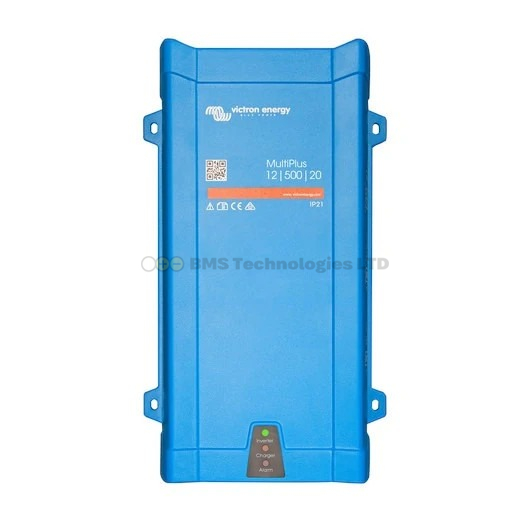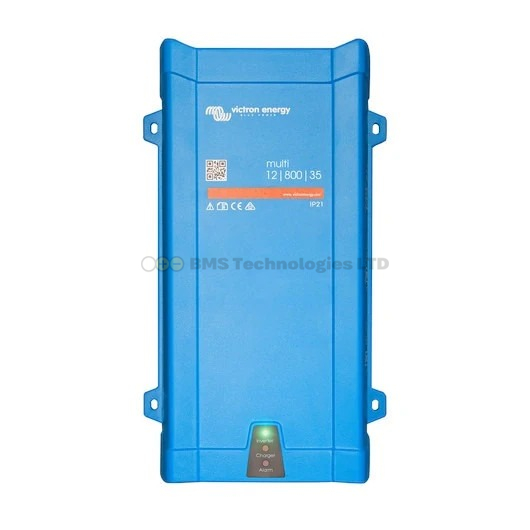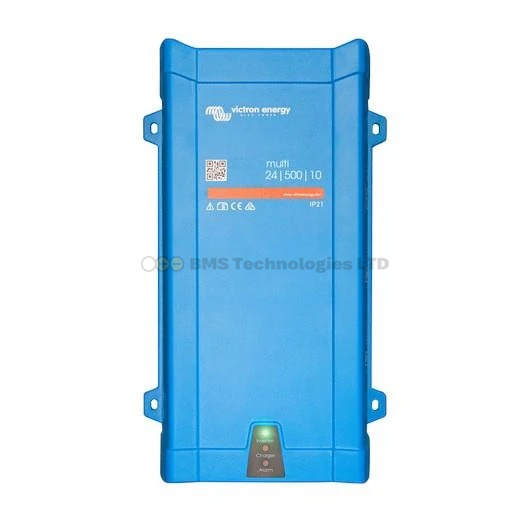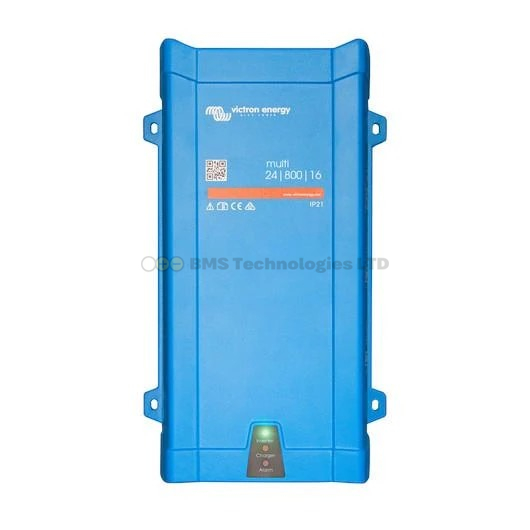
Three-phase electricity is uncommon in UK homes but far from rare. Larger properties, farms, workshops, and some older rural houses have three-phase supplies. If you want to install a Victron battery system on a three-phase property, this guide explains what is involved, when it is necessary, and how to set it up correctly.
What Is Three-Phase Power?
A standard UK home has a single-phase supply: one live conductor (plus neutral and earth) delivering 230V at up to 100A — roughly 23 kW maximum. A three-phase supply has three live conductors, each carrying 230V but offset by 120 degrees from each other. This provides three separate 230V supplies (each phase to neutral) and also 400V between any two phases.
Three-phase supplies offer much higher total power capacity. A 100A three-phase supply delivers approximately 69 kW — three times the capacity of a single-phase 100A supply.
Who Has Three-Phase in the UK?
- Farms and agricultural properties — very common, as farm equipment often requires three-phase motors
- Large detached houses — some properties over 4-5 bedrooms, especially those with electric heating or multiple outbuildings
- Commercial workshops — lathes, milling machines, and large compressors often need three-phase
- Properties with three-phase heat pumps — larger heat pumps (above 5 kW) often run on three-phase for better efficiency
- New builds with high electrical demand — EV chargers, heat pumps, and large solar arrays sometimes warrant a three-phase connection from the outset
If you are unsure whether your property has three-phase, check your consumer unit. A single-phase board has one main switch. A three-phase board typically has a three-pole main switch or three separate single-pole switches, one per phase. You can also check your electricity meter — three-phase meters are physically larger and show readings for each phase.
Why Three-Phase Matters for Victron Systems
If your property has a three-phase supply and you want to install a grid-tied Victron ESS system, you must install inverters on all three phases. This is not just a Victron requirement — it is a UK grid code requirement. The G98 and G99 regulations require that grid-connected inverter systems on three-phase properties are balanced across all phases.
Running a single-phase inverter on a three-phase property creates an imbalance that the DNO (Distribution Network Operator) will not approve, and your system will fail the grid compliance check.
How to Configure Three-Phase Victron
Required Equipment
A three-phase Victron system requires:
- Three identical MultiPlus-II units — one per phase. They must be the same model and firmware version. You cannot mix a 48/3000 with a 48/5000, for example
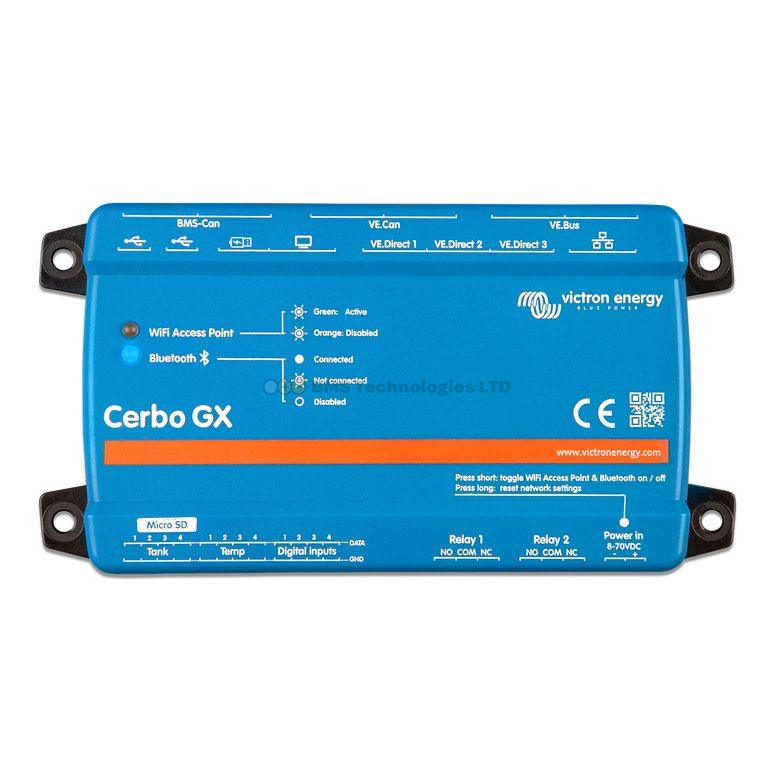
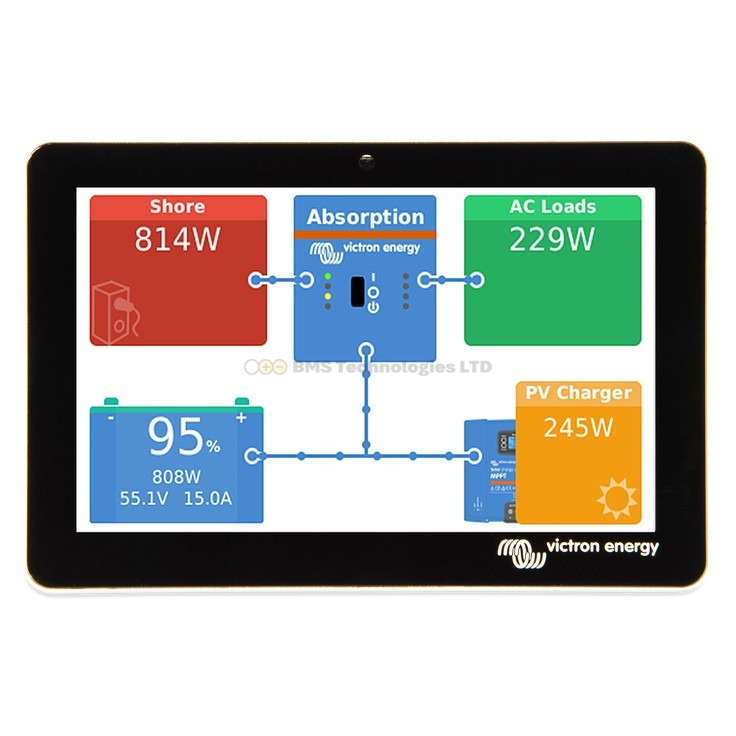
- A GX device — a Cerbo GX is the standard choice. It coordinates the three inverters and manages the ESS logic
- Three-phase energy meter — a Victron ET340 (or Carlo Gavazzi EM24) at the grid connection point, measuring all three phases
- Battery bank — shared across all three inverters. The batteries connect to all three MultiPlus-II units via a common DC bus
- VE.Bus cables — the three MultiPlus-II units connect to each other and to the GX device via VE.Bus (RJ45 cables)
Phase Configuration
The three MultiPlus-II units are configured as a three-phase group using VE.Bus Quick Configure or VE.Bus System Configurator software (Windows). During configuration, you assign each unit to a phase:
- Unit 1: Phase L1 (Master)
- Unit 2: Phase L2
- Unit 3: Phase L3
The master unit on L1 synchronises the other two. All three units share the same battery bank and coordinate their operation through the VE.Bus connection.
Wiring
Each MultiPlus-II connects to its designated phase on the AC side (input and output) and to the shared battery bank on the DC side. The DC wiring must be identical in length and gauge for all three units to ensure balanced charging and discharging.
A typical wiring arrangement:
- Three-phase grid supply enters a three-pole main switch
- Each phase feeds the AC input of its respective MultiPlus-II
- The AC output of each MultiPlus-II feeds its phase on the consumer unit (or a critical loads panel)
- All three MultiPlus-II units connect to the same battery bank via a common DC bus bar
- The VE.Bus daisy-chain connects all three units and terminates at the Cerbo GX
UK Grid Code Compliance: G98 and G99
Three-phase Victron systems in the UK must comply with the Engineering Recommendation G98 or G99, depending on system size:
| Standard | Applies To | Process |
|---|---|---|
| G98 | Systems up to 3.68 kW per phase (11.04 kW total three-phase) | Notification to DNO only — no approval needed |
| G99 | Systems above 3.68 kW per phase | Application to DNO, approval required before commissioning |
Three MultiPlus-II 48/3000 units provide 3 kW per phase (9 kW total) — this falls within G98 and requires notification only. Three MultiPlus-II 48/5000 units provide 5 kW per phase (15 kW total) — this requires G99 application and approval, which can take 4-12 weeks.
Anti-Islanding
Both G98 and G99 require anti-islanding protection: if the grid fails, the system must disconnect from the grid within the required timeframe (typically under 5 seconds) to prevent feeding power back into a dead grid, which is dangerous for utility workers. The MultiPlus-II handles this automatically through the ESS Assistant configuration.
Phase Imbalance Limits
UK DNOs require that the power output on each phase does not differ by more than a specified amount (typically 16A or 3.68 kW). The Victron three-phase system automatically balances export across phases, but import can be naturally unbalanced depending on which loads are on which phase. The system handles this by adjusting each inverter's contribution independently.
ESS on Three-Phase
ESS mode works identically on a three-phase system as on single-phase, but with awareness of all three phases. The Cerbo GX reads the three-phase energy meter and manages each MultiPlus-II independently to achieve the configured grid setpoint across all phases.
For scheduled charging, all three units charge simultaneously from the grid. The total charge rate is three times the single-unit rate. For example, three MultiPlus-II 48/5000/70 units can charge at up to 10.2 kW combined (3.4 kW per unit) — enough to fill a 10 kWh battery in under an hour.
When Single-Phase Is Sufficient
Not every three-phase property needs a three-phase Victron system. In some scenarios, single-phase is sufficient:
- Off-grid systems not connected to the grid — grid code compliance is irrelevant. You can install a single-phase inverter and distribute its output as needed
- Backup-only systems on a dedicated circuit — if the Victron system only powers specific critical loads (not connected to the main grid-tied consumer unit), single-phase may be acceptable. Consult your installer and DNO
- Properties converting from three-phase to single-phase — some homeowners request a single-phase downgrade from their DNO if three-phase is unnecessary. This simplifies the Victron installation
However, if you want a grid-tied ESS system (self-consumption, tariff shifting, backup) on a property with a three-phase supply, you must install on all three phases.
Cost Considerations
A three-phase Victron system costs roughly three times the inverter cost of a single-phase system, because you need three MultiPlus-II units instead of one. The battery, GX device, and solar panels remain the same.
| Component | Single-Phase | Three-Phase |
|---|---|---|
| Inverter/charger | 1 x MultiPlus-II 48/5000 (~£1,500) | 3 x MultiPlus-II 48/5000 (~£4,500) |
| Energy meter | ET112 (~£100) | ET340 (~£180) |
| Battery (10 kWh) | ~£4,000-6,000 | ~£4,000-6,000 (same battery) |
| GX device | Cerbo GX (~£350) | Cerbo GX (~£350) |
| Installation | £1,000-2,000 | £1,500-3,000 |
| Total | ~£7,000-10,000 | ~£10,500-14,000 |
The extra cost is significant but provides a higher total power output (up to 15 kW with 48/5000 units) and full grid compliance. The higher power capacity is particularly beneficial for properties with large loads on different phases — the system can supplement each phase independently.
Parallel and Three-Phase Combined
For very large systems, you can run parallel units on each phase. For example, two MultiPlus-II 48/5000 units per phase (six units total) provides 10 kW per phase, 30 kW total. This is used in large homes, farms, and light commercial applications.
The configuration rules are strict:
- All units must be identical (same model, same firmware)
- Maximum 6 units per phase (Victron's documented limit)
- All units share the same battery bank
- DC wiring to each unit must be symmetrical (identical cable lengths and sizes)
- A GX device is mandatory for systems with more than three units
Common Three-Phase Issues
- Firmware mismatch — all three units must run the same firmware version. If one updates and the others do not, the system may refuse to start. Always update all units together
- Phase rotation — the three phases must be connected in the correct rotation order (L1, L2, L3). Incorrect rotation causes the system to report a phase error. Swap any two phase connections to correct it
- Unbalanced DC wiring — if one MultiPlus-II has shorter battery cables than the others, it carries a disproportionate share of the current. This can trigger overcurrent alarms on that unit. Keep all DC cable runs identical
- VE.Bus cable issues — the RJ45 VE.Bus cables connecting the three units must be standard straight-through Ethernet cables (not crossover). A faulty or incorrect cable causes communication errors and prevents the system from starting
- Grid code configuration — each unit must be configured with the correct grid code (UK G98 or G99) through VEConfigure. The ESS Assistant must be loaded on all three units with matching settings
Applications in the UK
Farmhouse with Three-Phase Supply
A large farmhouse with 20 kWp of solar, three-phase supply, and variable loads (workshop equipment, domestic use, outbuildings). Three MultiPlus-II 48/5000 units, a 15 kWh battery bank, and a Cerbo GX provide ESS for self-consumption and tariff shifting. The three-phase configuration ensures grid compliance and can supplement each phase independently when farm equipment creates uneven loads.
Large Home with Heat Pump
A 5-bedroom home with a three-phase 16 kW heat pump, EV charger, and 10 kWp solar. Three MultiPlus-II 48/5000 units with a 20 kWh battery provide PowerAssist to prevent overloading any single phase when the heat pump, EV charger, and domestic loads run simultaneously. ESS scheduled charging on Octopus Agile maximises savings.
Workshop with Three-Phase Machinery
A woodworking workshop with three-phase machinery (planer, lathe). While the Victron system cannot directly power three-phase motors (it produces three single-phase outputs with a software-defined phase relationship), it can power single-phase loads and provide battery backup for lighting, computers, and single-phase tools when the grid fails.
For help specifying a three-phase system, use our system builder tool or consult an experienced Victron installer. For details on ESS configuration, see our ESS scheduled charging guide.