Victron Energy's battery charger range is extensive, and the model names contain a wealth of information — if you know how to read them. This guide decodes every part of the naming convention so you can identify exactly what a charger does just from its name.
The IP Rating: Where Can You Install It?
The first part of most Victron charger names is an IP (Ingress Protection) rating. This two-digit code tells you how well the charger is protected against dust and water:
| IP Rating | Dust Protection | Water Protection | Suitable Locations |
|---|---|---|---|
| IP22 | Objects > 12mm | Dripping water only | Indoor, dry cupboards, garages |
| IP43 | Objects > 1mm | Water spray up to 60° | Semi-protected engine rooms |
| IP65 | Completely dust-tight | Water jets from any direction | Engine rooms, under seats, damp areas |
| IP67 | Completely dust-tight | Submersion to 1 metre for 30 mins | Bilges, exposed outdoor locations |
The first digit rates dust protection (0–6, where 6 is totally dust-tight). The second digit rates water protection (0–9, where 7 means temporary submersion). A higher IP rating means better environmental protection, but also typically means a sealed unit that relies on convection cooling rather than a fan — which can affect sustained output in high temperatures.
The Number Format: Voltage and Current
After the IP rating, you'll see numbers in the format voltage/current. This is the most important specification encoded in the name:
| Model Name Contains | Meaning | Example |
|---|---|---|
| 12/15 | 12V battery system, 15A charge current | Blue Smart IP22 12/15 |
| 12/30 | 12V battery system, 30A charge current | Blue Smart IP22 12/30 |
| 24/12 | 24V battery system, 12A charge current | Blue Smart IP65 24/12 |
| 24/16 | 24V battery system, 16A charge current | Blue Smart IP22 24/16 |
| 48/25 | 48V battery system, 25A charge current | Skylla IP65 48/25 |
The voltage always comes first. Common voltages are 12V (cars, campervans, most boats), 24V (larger boats, trucks, commercial vehicles), and 48V (large off-grid systems). The current rating tells you how fast the charger can replenish your batteries — higher amps mean faster charging, but also higher power draw from the mains supply.
Working Out Charge Time
A rough guide: divide your battery capacity by the charge current to estimate hours to charge from empty. A 200Ah lithium battery with a 30A charger takes approximately 6–7 hours (200 / 30 = 6.7). In practice, the final absorption phase slows things down, so add 10–20% to this estimate.
The Output Suffix: (1) vs (3)
Some Victron chargers — particularly the Blue Smart IP22 range — have a number in brackets after the voltage/current specification:
- (1) — One charging output. The charger has a single pair of output terminals for one battery or battery bank.
- (3) — Three independent charging outputs. Each output has its own voltage regulation, allowing you to charge up to three separate batteries simultaneously.
For example, the Blue Smart IP22 12/30 (3) is a 12V, 30A charger with three outputs. The total charging current of 30A is distributed across the outputs, with the primary output receiving the bulk of the current and the secondary/tertiary outputs providing a trickle charge (typically 4A each).
Three-output models are popular in motorhomes and boats where you have a leisure battery, a starter battery, and possibly a bow thruster or windlass battery that all need maintaining. Without a three-output charger, you would need separate chargers or a battery-to-battery charger for each bank.
Smart vs Non-Smart
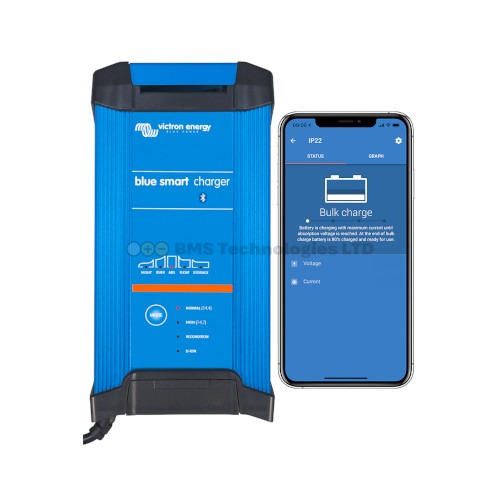
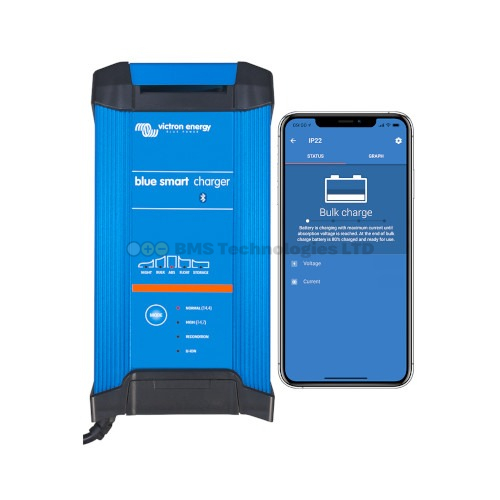
The word Smart in a Victron charger name indicates it has built-in Bluetooth connectivity and can be monitored and configured via the VictronConnect app on your phone, tablet, or computer.
Smart chargers allow you to:
- Monitor charging status, voltage, and current in real-time
- Change charging parameters (absorption voltage, float voltage, equalisation settings)
- Select battery presets (lithium, AGM, gel, flooded)
- View charging history and statistics
- Update firmware over Bluetooth
- Set up VE.Smart networking to synchronise with other Victron devices
Non-Smart chargers still work perfectly well — they just lack Bluetooth. You configure them using a physical rotary switch or DIP switches on the unit. If you don't need app-based monitoring, the non-Smart versions offer the same charging performance at a slightly lower price point.
Blue Smart vs Phoenix Smart IP43
This is where naming can get confusing. Victron has two main charger product lines that use the "Smart" designation:
Blue Smart Chargers (IP22, IP65, IP67)
The Blue Smart range is Victron's consumer/prosumer line. These are compact, relatively affordable chargers designed for leisure vehicles, boats, and home use. Key characteristics:
- Bluetooth built-in as standard
- Single or three outputs (IP22 only offers three-output models)
- Maximum 30A at 12V (IP22 range)
- No VE.Direct or VE.Bus communication ports
- Cannot be integrated into a GX monitoring system natively
- Adaptive 6-stage charging algorithm
Phoenix Smart IP43 Chargers
The Phoenix Smart IP43 range sits above the Blue Smart line. These are professional-grade chargers with higher power output and more connectivity options:
- Available up to 50A at 12V (Phoenix Smart IP43 12/50)
- One or three outputs available
- VE.Direct port — can connect to a Cerbo GX or other GX device for remote monitoring via VRM
- Bluetooth built-in
- IP43 rating — protected against spray but not jets or submersion
- Fan-cooled for sustained high output
- Larger physical size than Blue Smart equivalents
If you need your charger to appear in a GX monitoring system (shown on your Cerbo GX display and VRM portal), the Phoenix Smart IP43 is the way to go. If you just need a reliable charger with Bluetooth control, the Blue Smart range is typically sufficient.
Other Charger Families
Beyond the Blue Smart and Phoenix Smart IP43, Victron produces several other charger ranges:
| Range | Target Use | Key Feature |
|---|---|---|
| Skylla-i / Skylla IP65 | Marine, commercial | High current (up to 100A+), three-stage + recondition |
| Centaur | Marine, commercial | Rugged, analogue, three outputs, no Bluetooth |
| MultiPlus / Quattro (built-in charger) | Integrated systems | Charger + inverter + transfer switch combined |
Putting It All Together: Reading a Full Model Name
Let's decode some real Victron charger model names:
- Blue Smart IP22 Charger 12/30 (3) — Blue Smart range, IP22 rated (indoor only), 12V system, 30A max charge current, 3 independent outputs, Bluetooth enabled.
- Blue Smart IP65 Charger 12/25 — Blue Smart range, IP65 rated (water jet resistant), 12V system, 25A max charge current, single output, Bluetooth enabled.
- Blue Smart IP67 Charger 24/8 — Blue Smart range, IP67 rated (submersible), 24V system, 8A max charge current, single output, Bluetooth enabled.
- Phoenix Smart IP43 Charger 12/50 (1+1) — Phoenix Smart range, IP43 rated (spray resistant), 12V system, 50A max charge current, 1 main output + 1 auxiliary, Bluetooth + VE.Direct.
Which Charger Do You Need?
For most campervan and motorhome owners, the Blue Smart IP22 in the appropriate amperage is the best choice — it's affordable, powerful, and the three-output models are ideal for vehicles with both starter and leisure batteries. For boats or exposed installations, step up to the IP65 or IP67. For advanced systems with GX monitoring, consider the Phoenix Smart IP43.
To compare current prices across all Victron chargers, use our price comparison tool to find the best deals from UK retailers.